





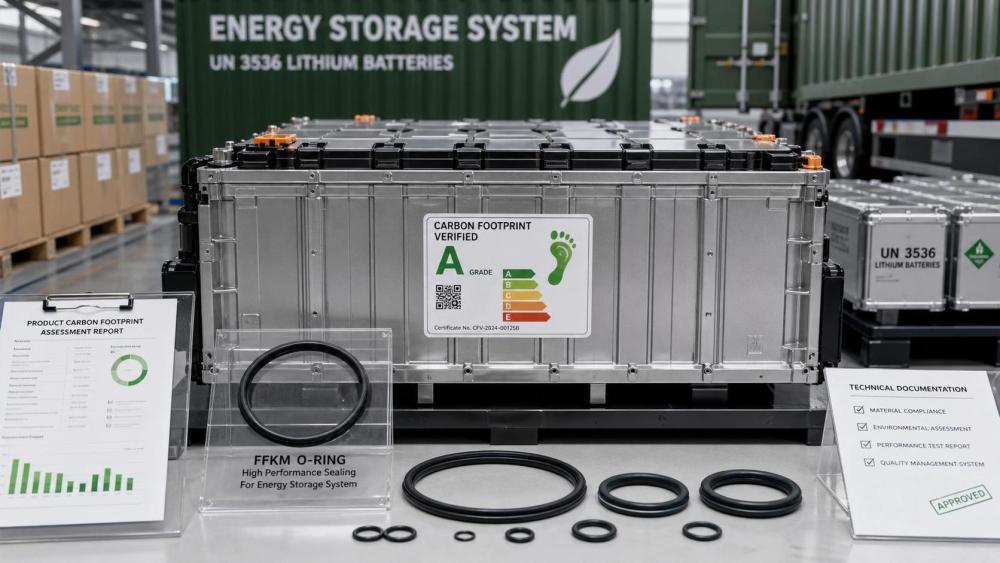
On August 18, 2026, a new compliance threshold takes effect for rechargeable industrial batteries with capacity above 2kWh entering the EU market: carbon footprint performance grading labels become mandatory. The requirement also reaches upstream component suppliers where FFKM O-rings are used in compliant battery packs, because manufacturers of these critical chemical- and heat-resistant sealing parts must provide supporting carbon footprint declarations and related data. For exporters tied to wind power, energy storage, and electric construction machinery, this is not just a labeling issue but a document, supply-chain, and customs filing issue that can directly affect delivery readiness.
What the new requirement confirms
The confirmed change is that, from August 18, 2026, rechargeable industrial batteries with capacity greater than 2kWh must carry a carbon footprint performance grade label for EU market compliance. The event summary also makes clear that related sealing components such as FFKM O-rings, when used as key high-temperature and chemical-resistant parts in compliant battery systems, must be supported by carbon footprint declarations and underlying data from their manufacturers. Products that do not meet the requirement will be unable to complete EU import declaration procedures, and this directly affects the export compliance of complete equipment used in sectors including wind power, energy storage, and electric construction machinery.
Why the impact extends beyond battery makers
Battery pack and system exporters face a documentation dependency
For exporters of battery packs or battery-equipped systems, the impact is not limited to the battery label itself. If key components inside the system require supporting carbon footprint declarations, then the completeness and consistency of supplier documentation become part of export readiness. What deserves closer attention is that customs filing and overall shipment compliance may depend on whether upstream technical documents can be assembled in time.
Seal manufacturers move closer to the compliance chain
FFKM O-ring suppliers may not be the direct importer of the battery product, but they can still become part of the compliance chain when their parts are used in battery systems subject to the rule. From an industry perspective, this means component manufacturers may need to prepare declarations and data support in a form that downstream battery or equipment manufacturers can use for compliance review, tender documents, or import files.
Procurement and supply-chain teams face new screening points
For procurement teams, the rule change may shift supplier evaluation from a focus on performance and delivery alone to a wider review that includes declaration readiness and traceable supporting materials. Observably, this can affect sourcing decisions, document collection timing, and supplier onboarding for projects linked to EU-bound equipment.
Complete equipment exporters carry the downstream risk
Manufacturers exporting wind power equipment, energy storage systems, or electric construction machinery may be affected even if they do not manufacture batteries or sealing parts themselves. If a battery subsystem cannot complete import declaration because the labeling or supporting component declaration is missing, the compliance risk can move downstream to the full equipment shipment and final delivery schedule.
Where companies should focus now
Check whether current product files are submission-ready
Companies involved in EU-bound battery systems should review whether existing technical files already include the carbon footprint declarations and supporting data expected from relevant component suppliers such as FFKM O-ring manufacturers. If the documentation chain is incomplete, the issue may appear late in shipment preparation rather than at the design stage.
Align supplier documents with export workflows
Analysis shows that suppliers and exporters need more than standalone statements; they need documents that can be matched to the battery pack, the shipment file, and the compliance review process. Businesses should therefore pay attention to how declarations, technical materials, and supporting records are requested, stored, and passed along the supply chain.
Watch for changes in tenders and customer requirements
Because the rule affects import declaration and end-product export compliance, customer procurement documents and technical bid requirements may begin to reflect the need for carbon footprint support materials from critical components. It is more appropriate to understand this as a practical contract and delivery issue as much as a regulatory one.
Allow for possible pressure on lead time and handover
The provided information does not specify detailed enforcement procedures, so it should not be assumed that every execution detail is settled. Still, companies should monitor whether added documentation review, supplier confirmation, or file correction begins to influence project schedules, shipment release timing, or final handover arrangements.
What this development most likely signals
Observably, this development is better understood as an implementation-stage compliance signal rather than a distant policy discussion. The mandatory date is clear, and the effect on import declaration is directly stated. At the same time, the market still needs to watch how documentation expectations are interpreted in practice, especially for upstream components that are not the battery itself but are treated as necessary supporting elements in compliant battery systems.
How the market may need to read it
From an industry perspective, this update should be read as a rule change with immediate operational relevance for any company linked to EU-bound industrial battery applications above 2kWh. The key point is not only whether the battery label exists, but whether the supporting compliance chain can hold together from component declaration to final import filing. For now, it is more appropriate to treat the event as a confirmed compliance threshold with further execution details still worth tracking.
Basis of this article
This article is generated from the user-provided news title, event date, and event summary. For developments of this kind, commonly relevant source types may include official notices, regulator publications, customs or trade authority information, industry association updates, standards body documents, and reporting by established industry media. No specific official source link was provided in the input, so the exact official reference still requires further verification. Items that remain worth monitoring include detailed implementation guidance, certification and compliance interpretations, tender document changes, market feedback, and how companies execute the requirement in practice.
Want to dive deeper into these market dynamics, or need data-driven support for your next business move? Drop a line below and let the analysts at PCTS provide customized insights.
We respect your privacy. Your information is strictly confidential.
Related News
- 00
0000-00
How to check vibration analysis software for sensor compatibility - 00
0000-00
IndexBox Forecasts 3.8% Annual Growth for Global Radial Seals Market Through 2035 - 00
0000-00
How to assess the chemical compatibility of FFKM sealing sheets - 00
0000-00
IndexBox Forecasts 3.6% Annual Growth for Construction Bearings Market - 00
0000-00
When do hydraulic components require an export license?
Weekly Insights
Stay ahead with our curated technology reports delivered every Monday.