





On July 8, 2026, the European Chemicals Agency (ECHA) confirmed an enforceable change under REACH Annex XVII that applies mandatory PFAS restrictions to FFKM elastomer sealing products. From October 1, 2026, FFKM O-rings and hydraulic sealing assemblies imported into the EU must be accompanied by conformity technical documentation and a PFAS content test report. For seal manufacturers, exporters, distributors, procurement teams, and customs-facing supply chain functions, this is not just a product compliance update; it directly affects document readiness, clearance workflows, and supplier qualification.
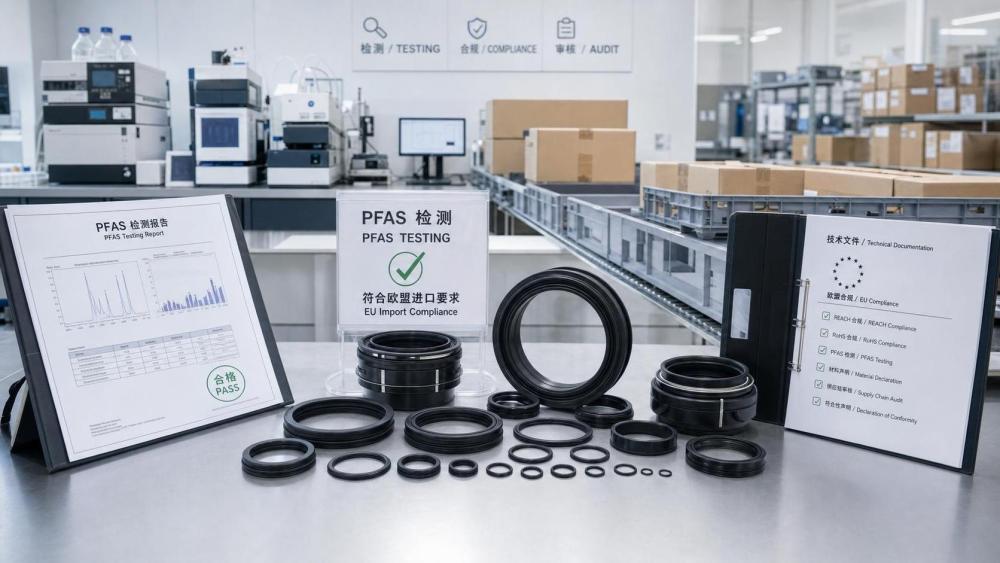
What the ECHA notice confirms
According to the provided event summary, ECHA issued an implementation notice on July 8, 2026 confirming that a new entry under REACH Annex XVII imposes mandatory restrictions on FFKM elastomer seals containing per- and polyfluoroalkyl substances (PFAS). The requirement takes effect on October 1, 2026.
The confirmed scope in the provided information covers FFKM O-rings and hydraulic sealing components imported into the EU. Starting from the effective date, these goods must be shipped with conformity technical documentation and a PFAS content test report.
The provided summary also states that this requirement directly affects the certification path and customs clearance process of Chinese sealing product exporters, while overseas distributors need to update their supplier audit checklists in advance.
Where the operational pressure is likely to appear
Export shipments face a document-driven checkpoint
From an industry perspective, exporters of FFKM sealing products are likely to feel the impact first because the rule is tied to import documentation. The practical pressure point is no longer limited to product specification or commercial paperwork; shipment files now need to align with conformity technical documentation and PFAS testing evidence. What deserves closer attention is whether internal export preparation, document review, and handover to logistics partners can support this added compliance layer without delaying dispatch.
Distributors will need tighter supplier screening
The provided event summary explicitly notes that overseas distributors should update supplier audit checklists in advance. Analysis shows this changes the distributor role from simple channel management to a more active compliance gatekeeper. Supplier onboarding, approved vendor reviews, and repeat-order qualification may increasingly depend on whether the manufacturer can provide consistent technical files and test reports alongside the goods.
Customs and delivery coordination become more sensitive
Observably, the rule also reaches supply chain service functions involved in import filing, document coordination, and delivery timing. Because the requirement is linked to import into the EU, customs-facing processes may become more sensitive to missing or incomplete supporting files. Even without further official detail in the provided information, companies involved in shipping coordination, bonded handling, and order fulfillment should treat documentation completeness as part of delivery readiness rather than a post-shipment correction item.
Procurement teams may need to review sourcing assumptions
For buyers and sourcing teams handling FFKM O-rings or hydraulic sealing assemblies for the EU market, the change may alter vendor selection criteria. Analysis shows that price, lead time, and specification match may no longer be sufficient on their own if suppliers cannot support the required compliance package. This is especially relevant where procurement decisions are tied to fixed delivery windows or customer-specific import documentation requirements.
What companies should check before the rule takes effect
Review whether product files are shipment-ready
It is more appropriate to understand the current stage as a preparation window before enforcement begins on October 1, 2026. Companies handling affected products should examine whether conformity technical documentation and PFAS content test reports can be produced in a form suitable for shipment support, internal review, and customer handover. The event summary confirms the need for these materials, but it does not provide further execution detail, so firms should avoid assuming that existing product files automatically satisfy the new import expectation.
Recheck supplier qualification and audit records
For distributors and procurement organizations, a near-term priority is to revisit supplier audit items for affected FFKM products. Observably, this is not only about whether a supplier says it can comply, but whether its documentation process, testing support, and file consistency can stand up to repeated transactions. The provided information directly points to advance updates of supplier audit checklists, making this a practical step rather than a theoretical one.
Track changes in customs-facing paperwork and handoff responsibilities
Exporters, logistics coordinators, and trade compliance personnel should also clarify who is responsible for assembling, checking, and submitting the required materials in the order workflow. Analysis shows that handoff gaps between sales, quality, documentation, and shipping teams are a likely source of friction when a new import requirement is introduced. Since the input does not provide a detailed enforcement format or filing mechanism, this remains an area that requires close monitoring rather than assumption.
Watch for downstream changes in tenders and customer requirements
What deserves closer attention is how the rule may begin to appear in customer purchase conditions, qualification documents, or distributor review standards. The confirmed facts already indicate pressure on certification pathways and clearance processes. Even so, the specific wording that customers, distributors, or procurement intermediaries may adopt is not provided in the input, so companies should treat this as a developing implementation issue and keep document templates under review.
Why this reads as an execution signal
Analysis shows that this development is better understood as an executed compliance signal rather than a distant policy discussion. The reason is straightforward: the notice confirms a defined restriction framework, identifies affected product categories, and sets a specific effective date tied to import documentation requirements. At the same time, it is not yet a fully closed compliance picture based on the provided input alone, because the summary does not include detailed operational guidance, interpretation notes, or customs practice examples. That combination makes the event both actionable now and still worth watching closely.
How the market is likely to read this change
From an industry perspective, the significance of this update lies in its shift from broad PFAS attention to a more concrete import control point for specified FFKM sealing products. The immediate issue is not abstract regulatory awareness, but whether exporters, distributors, and buyers can align product documentation, testing support, and supplier review processes before the effective date. It is more appropriate to understand this event as a landed rule change with direct operational consequences, while recognizing that market feedback and implementation detail still need continued observation.
Basis of this article and what still needs verification
This article is based on the user-provided news title, event date, and event summary. For developments of this kind, commonly relevant source types may include official notices from regulatory bodies, customs or trade authority updates, industry association communications, standards organization documents, and reporting by authoritative trade media.
No specific official source link was provided in the input, so the exact source document link remains to be verified on an ongoing basis. Observably, the areas that still require follow-up include detailed implementation language, certification and compliance interpretation, customs execution practice, changes in tender or purchasing documents, industry feedback, and how affected companies carry out the requirement in actual export and delivery workflows.
Related News
- 00
0000-00
Where are axial piston pumps used in mining equipment? - 00
0000-00
Embodied AI Robotics and Drive Control Forum Held in Shanghai - 00
0000-00
How does seal service life affect the total cost of ownership? - 00
0000-00
Schaeffler to Cut 3,460 Jobs and Close Five European Plants - 00
0000-00
How does system size affect the price of a belt drive system?
Weekly Insights
Stay ahead with our curated technology reports delivered every Monday.