





On July 14, 2026, the European Chemicals Agency (ECHA) released a draft amendment under REACH that would place PFAS-containing FFKM O-rings on a restriction list and introduce a new documentation requirement for exports to the EU from October 1, 2026. For suppliers, importers, equipment OEMs, and teams handling procurement, export documentation, and delivery planning, the development is worth close attention because it turns PFAS content disclosure and technical conformity files into a near-term compliance checkpoint rather than a background regulatory topic.
What the Draft Changes on Paper
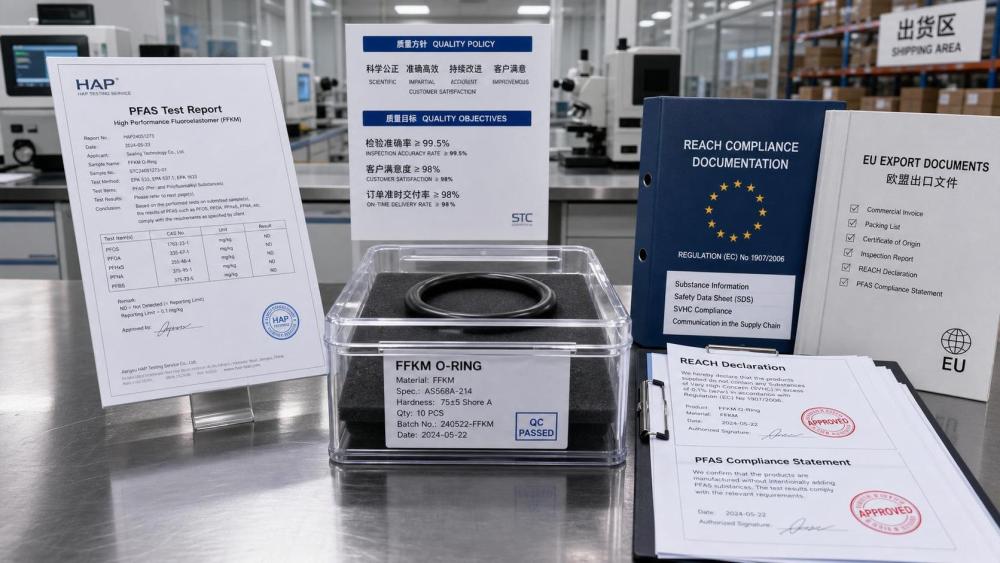
According to the information provided, ECHA issued the draft on July 14, 2026 as a proposed revision to REACH. The draft would add FFKM O-rings containing per- and polyfluoroalkyl substances (PFAS) to the restriction scope. It also states that, starting on October 1, 2026, all FFKM sealing products exported to the EU must be accompanied by a PFAS content declaration issued by an accredited laboratory, together with technical conformity documentation.
The draft has entered a 30-day public comment period. Final adoption is expected in mid-August. The stated effect is a mandatory compliance node for global FFKM seal suppliers, importers, and equipment OEMs.
Where the Immediate Pressure Falls
Export shipments face a documentation threshold
From an industry perspective, exporters are likely to feel the impact first because the change is framed around products shipped into the EU. The practical issue is not only product composition, but whether the shipment file includes the required PFAS declaration and supporting technical documents. What deserves closer attention is the risk that document readiness becomes part of shipment release, customer acceptance, or pre-delivery review.
Importers and buyers will need cleaner supplier evidence
For importers and procurement teams, the draft points to a tighter need for supplier-side proof. Analysis shows that purchasing decisions may increasingly depend on whether a supplier can provide accredited laboratory declarations and maintain conformity records in a form that can be reviewed before ordering or receiving goods. This is relevant not only for new sourcing but also for ongoing framework supply where documentation may need to be refreshed or checked against shipment timing.
OEMs may need to revisit component compliance in equipment deliveries
Equipment OEMs are also exposed because FFKM O-rings are often delivered as embedded components rather than stand-alone items. Observably, the issue may extend from component sourcing into the final delivery package, especially where technical files, spare parts documentation, or customer compliance requests are linked to the equipment shipment. The rule change therefore matters at both component and assembled-equipment levels.
Testing and certification-related services may see earlier engagement
The requirement for declarations from accredited laboratories means testing and compliance service providers may become part of the delivery timetable earlier than before. It is more appropriate to understand this as a procedural shift: laboratory evidence and technical file preparation may move closer to order execution and export scheduling, rather than being handled only when a customer raises a question.
What Companies Should Track Before October
Check whether existing files can support the new declaration requirement
Analysis shows that companies dealing in FFKM seals should first review whether current material records, product files, and shipment documents are sufficient to support a PFAS content declaration from an accredited laboratory. If the existing file set is incomplete, the gap may affect quoting, order confirmation, or shipment preparation.
Watch the wording that emerges after the comment period
Because the draft is still within a 30-day public review period and final adoption is expected in mid-August, the final wording still deserves attention. What deserves closer attention is whether the adopted text clarifies document scope, applicable product descriptions, or how technical conformity files are expected to be presented in practice. At this stage, those execution details should be monitored rather than assumed.
Review supplier qualification and procurement timing
For buyers and supply chain managers, one immediate task is to identify which suppliers can provide the required declaration path within the delivery schedule. Observably, procurement planning may need to account for additional lead time tied to laboratory documentation and file preparation, especially for orders intended for the EU market after October 1, 2026.
Align after-sales and traceability records with export compliance
Where FFKM O-rings are supplied as spare parts or replacement items, companies should also pay attention to traceability and after-sales documentation. Analysis shows that compliance expectations may not stop at the initial shipment; replacement supply and service-related dispatches may also depend on whether the same supporting records can be produced consistently.
Why This Looks Like an Execution Signal, Not Just a Policy Headline
Observably, this development is not yet a fully settled enforcement outcome because the draft remains under public comment and final adoption is still pending. Even so, it is more appropriate to understand this as a concrete execution signal rather than a distant policy discussion. The reason is that the draft already points to a specific product category, a defined compliance document set, and a near-term date tied to exports into the EU.
From an industry perspective, the most important point is not broad debate about PFAS policy in general, but the narrowing of attention onto a named sealing product and the documentation burden around it. That combination is usually where regulatory changes start to affect bid files, supplier screening, shipment release, and customer acceptance procedures.
How the Market Is Likely to Read It for Now
At this stage, the development is best read as a pending but highly actionable compliance change. It does not yet confirm every practical enforcement detail, but it does establish a short window for exporters, importers, and OEMs to verify document readiness, supplier capability, and technical file completeness. A neutral reading is that the market should treat this as an approaching compliance checkpoint, while continuing to watch for the final adopted text and any clearer implementation language.
Basis of This Article
This article is based on the user-provided news title, event date, and event summary concerning ECHA's July 14, 2026 draft under REACH affecting PFAS-containing FFKM O-rings. No specific official source link was provided in the input, so the exact official publication link still needs to be verified on an ongoing basis.
For developments of this kind, commonly relevant source types include official notices from regulatory authorities, trade or customs authorities, industry association communications, standard-setting documents, and reporting by established industry media. Further observation is still needed on final policy wording, certification and declaration practice, tender and technical file requirements, market feedback, and how companies implement the requirement in export and delivery workflows.
Want to dive deeper into these market dynamics, or need data-driven support for your next business move? Drop a line below and let the analysts at PCTS provide customized insights.
We respect your privacy. Your information is strictly confidential.
Related News
- 00
0000-00
How sealing technology reduces contamination in semiconductor manufacturing - 00
0000-00
Where to install vibration sensors on rotating machinery - 00
0000-00
NTSB Probe Finds Boeing Warned of MD-11 Engine Bearing Risk Years Earlier - 00
0000-00
How to size pneumatic grippers for packaging system integration - 00
0000-00
How to size alloy steel power transmission chains for heavy loads
Weekly Insights
Stay ahead with our curated technology reports delivered every Monday.