





On July 7, 2026, U.S. Customs and Border Protection (CBP) issued an updated classification notice for products currently declared under HS 8481.20.00, making clear that electro-hydraulic pumps will need to be declared separately starting August 15, 2026. For exporters to the U.S., customs brokers, compliance teams, and buyers managing hydraulic product flows, this matters because the change is tied to closer origin verification and energy-efficiency label review, with direct implications for declaration accuracy and clearance timing, especially for Chinese suppliers shipping to the U.S. market.
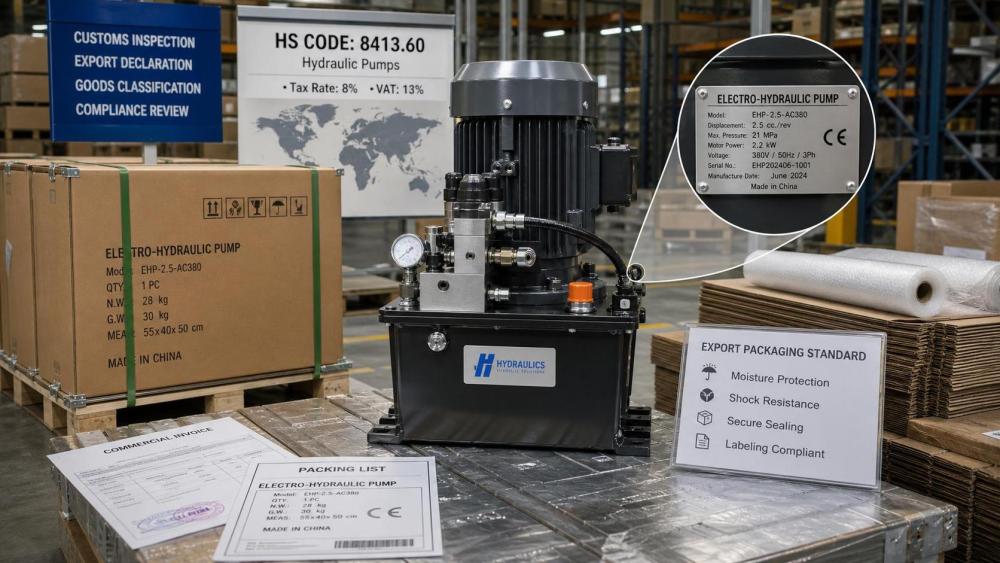
What the CBP Notice Changes
According to CBP notice CSMS#26-000217, released on July 7, 2026, electro-hydraulic pumps may no longer be declared under the traditional axial piston pump subheading 8481.20.00 from August 15, 2026 onward. Instead, these products must use the newly designated control code 8481.20.00.45. The notice also indicates that this adjustment will trigger stricter reviews related to country-of-origin verification and energy-efficiency labeling.
Where the Immediate Pressure May Appear
Export declarations and customs filing accuracy
From an industry perspective, direct trading companies and export teams are the first group likely to feel the change. Their exposure is straightforward: product classification that was previously handled under an existing subheading will now require a more specific declaration route for electro-hydraulic pumps. What deserves closer attention is the risk of filing errors during the transition period, particularly where product descriptions, ERP data, and customs documentation are still aligned with the older practice.
Manufacturers supplying the U.S. market
For processing and manufacturing enterprises, the main issue is not only the tariff code field itself but also whether internal product categorization clearly distinguishes electro-hydraulic pumps from other hydraulic pump types. Analysis shows that if product specifications, technical descriptions, or shipment paperwork are not consistently aligned, manufacturers may face added friction in outbound documentation and shipment preparation for U.S.-bound orders.
Customs brokers and supply chain service providers
Supply chain service providers, including customs brokers and logistics coordinators, may be affected at the execution level. Their work depends on accurate product classification, supporting documents, and smooth communication across exporter, importer, and carrier parties. Observably, the new code requirement increases the need to verify whether shipment data, declaration instructions, and compliance documents match before cargo is submitted for clearance.
Buyers and downstream users managing delivery schedules
U.S.-facing buyers and downstream application businesses may also need to pay attention, even if they are not responsible for filing entries themselves. The reason is operational rather than regulatory ownership: if stricter origin checks and energy-efficiency label reviews slow down clearance, delivery schedules, inbound planning, and purchase coordination may all be affected.
Practical Issues Companies Should Watch Now
Check product scope before the August 15 effective date
Analysis shows that companies dealing in hydraulic products should first identify whether any exported items fall within the electro-hydraulic pump category referenced by the CBP notice. The key practical issue is whether internal systems, product masters, and declaration templates still map those goods to the older subheading treatment.
Align documents used across sales, shipping, and customs
What deserves closer attention is document consistency. Product descriptions used in quotations, invoices, packing lists, and customs declarations should not create ambiguity around whether a shipment is an electro-hydraulic pump or another hydraulic pump type. Where classification changes are implemented in one department but not another, filing mistakes become more likely.
Prepare for closer origin and labeling review
The notice specifically points to stricter country-of-origin verification and energy-efficiency label review. Observably, this means compliance preparation should extend beyond the tariff code itself. Companies may need to review whether origin-related materials and labeling-related records are complete, current, and usable in customs-facing communication.
Set expectations with customers and service partners
From an operational perspective, exporters and suppliers may need earlier coordination with importers, brokers, and customers on timing and documentation. This is not because a delay is a confirmed outcome in every case, but because the notice signals a higher review threshold that can affect clearance efficiency if preparation is incomplete.
Why This Looks Like More Than a Filing Update
Analysis shows that this development is better understood as a compliance signal rather than a narrow coding adjustment alone. The formal separation of electro-hydraulic pumps from prior declaration practice suggests that customs treatment is becoming more product-specific in this category. At the current stage, it would be premature to treat the notice as proof of broad market restructuring or long-term trade impact. However, it is reasonable to view it as a near-term rule change with wider compliance implications that still warrant continued observation.
How the Industry May Best Read This Move
At this point, the clearest takeaway is that the change creates an immediate operational requirement for companies shipping electro-hydraulic pumps to the United States, while also pointing to tighter scrutiny in origin and labeling review. It is more appropriate to understand this as a short-term compliance change with potential follow-on effects in customs efficiency, rather than as a fully formed long-term market conclusion. The practical value for industry participants lies in early classification checks, document alignment, and close monitoring of implementation after the August 15, 2026 effective date.
Basis of This Article and What Still Needs Verification
This article is based on the user-provided news title, event date, and event summary concerning CBP notice CSMS#26-000217 and the separate declaration requirement for electro-hydraulic pumps under control code 8481.20.00.45. For developments of this type, commonly relevant source categories include official government notices, company compliance updates, industry association information, authoritative media reports, and standards-related documents. A specific official source link was not provided in the input, so the exact source text should continue to be verified in follow-up review. The main areas for continued observation are whether further official clarification is issued on product scope, declaration practice, origin review, and energy-efficiency label enforcement in actual customs operations.
Want to dive deeper into these market dynamics, or need data-driven support for your next business move? Drop a line below and let the analysts at PCTS provide customized insights.
We respect your privacy. Your information is strictly confidential.
Related News
- 00
0000-00
How to check vibration analysis software for sensor compatibility - 00
0000-00
IndexBox Forecasts 3.8% Annual Growth for Global Radial Seals Market Through 2035 - 00
0000-00
How to assess the chemical compatibility of FFKM sealing sheets - 00
0000-00
IndexBox Forecasts 3.6% Annual Growth for Construction Bearings Market - 00
0000-00
When do hydraulic components require an export license?
Weekly Insights
Stay ahead with our curated technology reports delivered every Monday.