





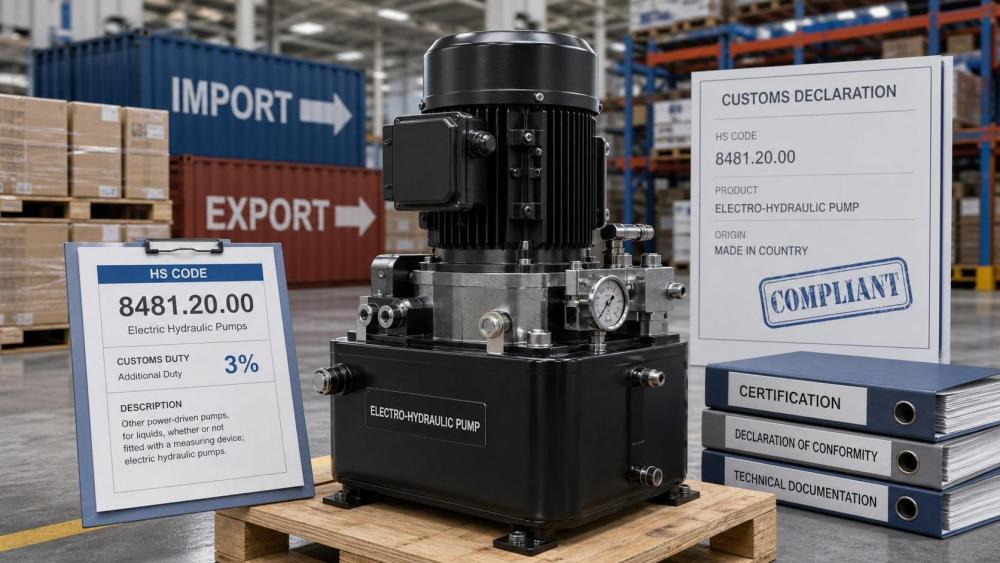
On July 10, 2026, U.S. Customs and Border Protection (CBP) began applying a 3% compliance surcharge to electro-hydraulic pumps under HS code 8481.20.00, while also requiring importers to file an ISO 13849-1:2023 functional safety certification statement together with a manufacturer declaration of conformity at customs clearance. For companies involved in exporting, importing, customs filing, and supply chain coordination around this product category, the development merits close attention because it changes both the cost and documentation threshold tied to entry into the U.S. market.
What the CBP measure now requires
The confirmed facts are limited but clear. CBP launched the compliance surcharge on July 10, 2026, and the measure applies to electro-hydraulic pumps classified under HS 8481.20.00. The surcharge rate is 3%.
At the same time, importers are required to submit two compliance documents during customs clearance: an ISO 13849-1:2023 functional safety certification statement and a manufacturer declaration of conformity.
The measure covers the PCTS core category identified as Electro-hydraulic Pumps and applies to products from all countries of origin. Based on the input provided, Chinese exporters face a higher risk of declaration failure because certification adoption is relatively low.
Where the pressure is likely to appear first
Import clearance and customs filing will feel the impact immediately
From an industry perspective, importers and customs-facing operators are likely to be the first group affected because the new requirement is tied directly to clearance. The practical pressure point is not only the 3% surcharge itself, but also whether the required certification statement and manufacturer conformity documentation can be presented in a complete and consistent way when goods are declared.
Export manufacturers may face higher document-readiness demands
Analysis shows that manufacturers supplying electro-hydraulic pumps into the U.S. market may be affected through documentation preparation, internal compliance review, and coordination with overseas customers. Where a buyer or importer depends on the manufacturer to provide conformity materials, any gap in certification readiness could move from a technical issue to a shipment execution issue.
China-linked shipments may carry added declaration risk
What deserves closer attention is the specific note that Chinese exporters may see a higher declaration failure rate due to lower certification penetration. This does not change the formal scope of the rule, which applies to all origins, but it suggests that exporters from China may encounter more friction in the filing stage if supporting documents are incomplete or not prepared in line with the new requirement.
Supply chain service providers will need tighter coordination
Observably, customs brokers, logistics coordinators, and related service providers may also be affected because they often sit between importer requirements and exporter documentation. Their main area of exposure is timing: whether compliance materials are available early enough to prevent delays, refiling, or disputes over responsibility in the shipment process.
What companies should be checking now
Confirm product classification and scope
Companies dealing in electro-hydraulic pumps should first verify whether the goods involved fall under HS 8481.20.00 and whether they are being handled within the product scope referenced in the CBP measure. In practice, this is the starting point for deciding whether the surcharge and supporting document requirements apply to a shipment.
Review whether the required documents are actually clearance-ready
The key operational issue is not simply whether a company has internal compliance materials, but whether the importer can submit an ISO 13849-1:2023 functional safety certification statement and a manufacturer declaration of conformity in the form needed for customs clearance. This distinction matters because a document that exists internally may still fall short in actual filing use.
Align exporter, importer, and service partners before shipment
Analysis shows that communication across the transaction chain now matters more. Exporters, importers, and customs-related service providers should confirm in advance who prepares each document, when it is delivered, and how exceptions will be handled if a shipment is ready but compliance paperwork is not.
Watch for further official clarification
Because the current input establishes the launch date, surcharge rate, covered HS code, and required documents, but does not include fuller implementation guidance, companies should continue monitoring whether CBP or related parties issue clarifications on filing practice, document format, or enforcement detail. That follow-up matters for day-to-day execution.
How this development is best understood at this stage
Observation suggests this is more than a simple tariff-style cost adjustment, because the measure combines a 3% surcharge with documentary compliance conditions at the point of customs entry. That combination makes the development relevant not only to pricing, but also to shipment eligibility and filing success.
At the same time, it is more appropriate to understand this as a concrete compliance change with broader signaling value, rather than as a fully settled indicator of long-term market restructuring. The immediate result is clear: the U.S. entry process for this product category now carries a higher documentation threshold. The longer-term effect on sourcing behavior, supplier selection, or market share still requires observation.
Why the industry should treat this as an active compliance signal
The significance of this update lies in its direct effect on a named product category, a defined HS code, and the customs clearance process itself. For the industry, the issue is not limited to an added 3% charge. It also raises the importance of certification readiness, conformity documentation, and cross-border coordination for electro-hydraulic pump shipments entering the United States.
From a neutral industry reading, the development is best understood as an actionable near-term compliance change and a policy signal worth continued monitoring. It already affects current transaction handling, while its wider commercial consequences remain something the market will need to watch over time.
Basis of this article and what still needs verification
This article is based on the user-provided news title, event date, and event summary. No additional data, policy numbers, company cases, market figures, or external source links have been added beyond that input.
For this type of development, relevant source categories would typically include official government notices, importer or manufacturer compliance communications, industry association updates, authoritative media reporting, and standard-related materials. However, a specific official source link was not provided in the input, so the exact original publication path still needs ongoing verification.
Further observation should focus on whether additional official wording, filing guidance, or implementation clarification emerges around the CBP requirement for electro-hydraulic pumps under HS 8481.20.00.
Want to dive deeper into these market dynamics, or need data-driven support for your next business move? Drop a line below and let the analysts at PCTS provide customized insights.
We respect your privacy. Your information is strictly confidential.
Related News
- 00
0000-00
How sealing technology reduces contamination in semiconductor manufacturing - 00
0000-00
Where to install vibration sensors on rotating machinery - 00
0000-00
NTSB Probe Finds Boeing Warned of MD-11 Engine Bearing Risk Years Earlier - 00
0000-00
How to size pneumatic grippers for packaging system integration - 00
0000-00
How to size alloy steel power transmission chains for heavy loads
Weekly Insights
Stay ahead with our curated technology reports delivered every Monday.