





How to Size Construction Equipment Hydraulic Cylinders for Load and Cycle Life
Selecting the right size for construction equipment hydraulics cylinders directly affects lifting force, stability, sealing reliability, and service life.
A poor sizing decision can create side loads, pressure spikes, rod buckling, seal damage, or wasted power.
An oversized unit may look safer on paper.
In practice, it can increase cost, slow response, and raise oil heating.
That is why construction equipment hydraulics cylinders should be sized around real load cases and real duty cycles.
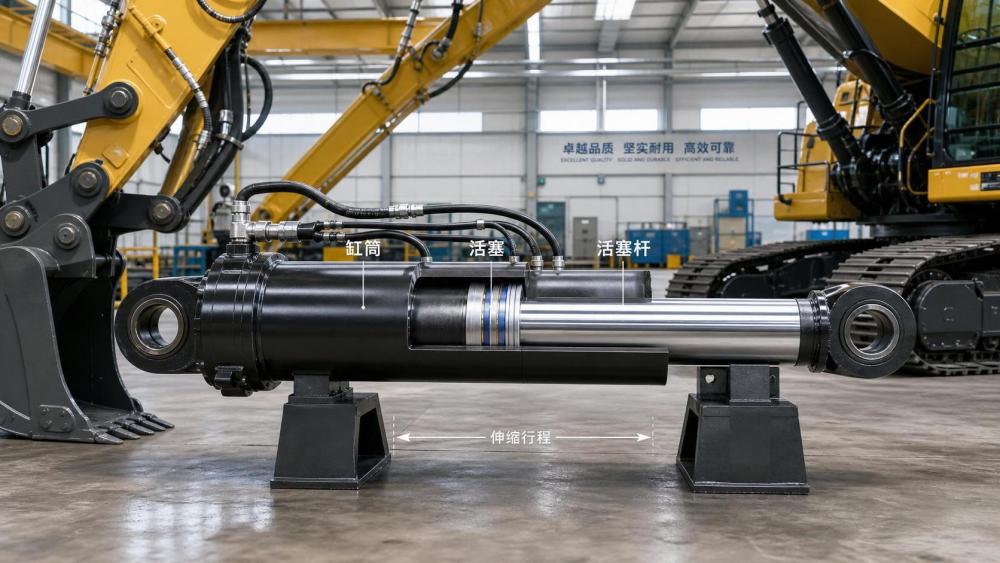
A sound evaluation starts with the machine function.
Is the cylinder lifting a boom, tilting a bucket, steering an axle, or stabilizing outriggers?
Each task changes force direction, motion speed, stroke demand, and expected cycle life.
For that reason, sizing construction equipment hydraulics cylinders is never only about bore diameter.
It is a system decision tied to pressure, geometry, mounting style, and contamination exposure.
Start with the Actual Load Case
The first step is to define the highest working load at the cylinder, not just the payload.
Machine linkages multiply forces.
A bucket cylinder may see much higher force than the bucket material weight suggests.
Include these inputs before sizing construction equipment hydraulics cylinders:
- Maximum payload or breakout condition
- Linkage leverage at worst arm angle
- Dynamic shock from digging, impact, or travel vibration
- Friction losses in pins, bushings, and guides
- Required holding margin for safety and stability
A common mistake is using average load instead of peak load.
For construction equipment hydraulics cylinders, peak events often define survival.
This is especially true in excavators, wheel loaders, cranes, and compact equipment working on rough terrain.
Force Calculation Basics
Cylinder extension force is pressure multiplied by piston area.
Retraction force is pressure multiplied by annular area.
This matters because retraction always has less effective area due to the rod.
Use a realistic working pressure, not only the relief valve maximum.
If the hydraulic system normally runs at 210 bar, design around that level first.
Then apply an appropriate margin for transients and pressure drop.
Match Bore, Rod, and Stroke to the Real Job
Once force is known, bore size becomes easier to narrow down.
Still, construction equipment hydraulics cylinders also need the right rod diameter and stroke length.
These three dimensions work together.
A large bore with a weak rod is not a robust selection.
Bore Size
Bore controls available force and oil volume.
Larger bores create more force at the same pressure.
They also need more flow for the same speed.
That tradeoff matters in mobile machines where pump flow is limited.
Rod Diameter
Rod diameter affects buckling resistance, bending strength, and seal support.
For long stroke construction equipment hydraulics cylinders, rod sizing often drives life more than bore sizing.
A thin rod under compression can fail long before pressure capacity is reached.
Stroke Length
Stroke should cover the full motion range with proper end margins.
Too little stroke limits function.
Too much stroke increases closed length, weight, and buckling risk.
In real machine packaging, stroke often becomes a geometric compromise.
Check Mounting Geometry and Side Load Risk
Many cylinder failures begin with geometry rather than material strength.
Construction equipment hydraulics cylinders must follow the linkage path without harmful misalignment.
Even a well-sized cylinder can wear quickly under side loading.
What to Review
- Pin-to-pin length at full retract and full extend
- Mount type, including clevis, trunnion, or cross-tube
- Angular movement across the stroke
- Rod exposure during compression
- External guides that can reduce side force
A practical review often reveals that the cylinder is being asked to guide the mechanism.
That is rarely a good design choice.
If guides, bearings, or pivots carry the lateral load, cylinder life usually improves.
Size for Cycle Life, Not Only Peak Force
This is where many sourcing decisions become more realistic.
Construction equipment hydraulics cylinders in high-cycle service need more than pressure capacity.
They need sealing systems, rod finishes, bearing lengths, and materials matched to repeated motion.
Duty Cycle Questions
- How many cycles per hour and per day?
- Are loads mostly steady, reversing, or shock-driven?
- How often does the cylinder dwell at high pressure?
- What are the contamination and temperature levels?
- Is the machine seasonal, intermittent, or continuous duty?
A boom cylinder on a utility machine may see moderate cycles but high holding pressure.
A compactor or material handler may see far more frequent cycling.
The best construction equipment hydraulics cylinders for those jobs may use different seals, bearings, and rod coatings.
Why Seal Life Changes with Sizing
If a cylinder is undersized, it operates near maximum pressure more often.
That accelerates seal wear and leakage risk.
If it is oversized, flow velocity and control behavior may become less efficient.
Both cases can reduce practical service life.
Use a Simple Evaluation Table Before Approval
Before approving construction equipment hydraulics cylinders, compare options with a structured review.
This keeps cost pressure from hiding technical risk.
Common Decision Errors in Construction Equipment Hydraulics Cylinders
Several patterns appear again and again during supplier evaluation.
- Choosing by bore only and ignoring rod compression strength.
- Using nominal system pressure without considering real pressure drop.
- Skipping linkage geometry checks at extreme arm positions.
- Assuming all seal packages suit abrasive jobsite environments.
- Comparing price without reviewing cycle life assumptions.
From a purchasing view, these look like small misses.
From a field reliability view, they become repeat failures and expensive service calls.
A Practical Sizing Workflow
A concise workflow helps keep construction equipment hydraulics cylinders aligned with machine performance goals.
- Define the worst load case and linkage angle.
- Set the normal operating pressure range.
- Calculate extension and retraction force requirements.
- Select a provisional bore and check flow-based speed.
- Verify rod diameter for buckling and bending margin.
- Confirm stroke and pin-to-pin lengths in the machine envelope.
- Review mounting alignment and side load control.
- Match seals and materials to duty cycle and environment.
- Compare supplier data against service life expectations.
This process is simple, but it filters out weak options quickly.
It also supports more defensible decisions across engineering, procurement, and after-sales teams.
Final Takeaway
Sizing construction equipment hydraulics cylinders correctly means balancing force, speed, geometry, and endurance.
The best choice is usually not the biggest cylinder or the cheapest cylinder.
It is the one that meets real load demands, fits the machine linkage, and survives the expected cycle life.
When reviewing construction equipment hydraulics cylinders, use load calculations and duty data together.
That approach reduces overspecification, lowers failure risk, and leads to stronger long-term equipment decisions.
Want to dive deeper into these market dynamics, or need data-driven support for your next business move? Drop a line below and let the analysts at PCTS provide customized insights.
We respect your privacy. Your information is strictly confidential.
Related News
- 00
0000-00
IndexBox Forecasts 3.8% Annual Growth for Global Radial Seals Market Through 2035 - 00
0000-00
How to assess the chemical compatibility of FFKM sealing sheets - 00
0000-00
IndexBox Forecasts 3.6% Annual Growth for Construction Bearings Market - 00
0000-00
When do hydraulic components require an export license? - 00
0000-00
How to size modular pneumatic valve systems for adequate airflow
Weekly Insights
Stay ahead with our curated technology reports delivered every Monday.