





A vane pump that is cavitating will usually announce itself before it fails completely. The earliest clues are a sharp rattling or crackling noise, unstable pressure or flow, rising vibration, and a pump housing that becomes unusually hot. Those symptoms matter because cavitation is not simply an efficiency problem: repeated vapor-bubble collapse can erode internal surfaces, damage vane tips and cam rings, contaminate the hydraulic circuit with wear debris, and shorten the life of downstream valves and actuators.
For maintenance teams, the practical question is whether the sound and performance change point to cavitation, air entrainment, mechanical wear, or a load-related pressure issue. These faults can overlap. A disciplined inspection of the inlet side, reservoir condition, fluid properties, and operating readings will usually separate them more reliably than replacing the pump based on noise alone.
Start with the sound, but do not stop there
Cavitation commonly produces a high-frequency growl, crackle, or sound often compared with gravel moving through the pump. It tends to become more obvious as pump speed rises, fluid temperature falls, or demand increases. In a vane pump, inadequate pressure at the inlet allows dissolved gases or fluid vapor to form cavities. When those cavities move into a higher-pressure area inside the pumping chambers, they collapse violently.
That collapse is the destructive part. It creates localized shock loads that can pit the cam ring, damage vane edges, wear the rotor slots, and disturb the thin oil film needed to separate moving parts. A pump may still deliver usable pressure during the early stages, so an operator can mistake the problem for normal machine noise or assume the pump is healthy because a gauge shows an acceptable pressure at idle.
Noise alone is not conclusive. Worn bearings, a loose drive coupling, relief-valve chatter, a blocked return filter, or air bubbles in the fluid can all create abnormal sound. The diagnosis becomes stronger when the noise changes predictably with inlet conditions: for example, it worsens with a low tank level, a cold start, a partially closed suction isolation valve, or a restricted suction strainer.
The operating symptoms that make cavitation more likely
A cavitating vane pump often shows several symptoms at once. The pattern is more important than any single sign.
- Intermittent or reduced flow: Cylinders may move unevenly, hydraulic motors may surge, and functions can become slower under demand.
- Pressure instability: A pressure gauge may flutter rather than hold steady, especially when the pump is loaded or a directional valve is operated.
- Excessive vibration: The pump, suction pipe, reservoir panel, or connected hoses may vibrate more than usual. Vibration can increase at particular speeds.
- Unusual heat: Energy lost through disturbed inlet flow and internal damage can raise pump and fluid temperature. Heat is usually a supporting indicator rather than proof by itself.
- Foamy or cloudy oil: Fluid that looks milky, frothy, or filled with fine bubbles points toward air entrainment. It may coexist with cavitation and should not be ignored.
- Rapid deterioration: Noise that begins mildly but becomes much louder over a short operating period deserves immediate attention, particularly in systems with continuous duty or critical lifting functions.
A useful field comparison is this: cavitation is often tied to insufficient inlet pressure or restricted fluid supply, while aeration is caused by air entering or remaining in the fluid. Cavitation can occur without obvious foam in the reservoir. Aeration more often produces foaming, spongy actuator motion, and a lower-pitched knocking or whining sound, although the two conditions can sound similar in a noisy plant.
The distinction matters because changing the pump may not solve either fault. If a new vane pump is installed on a suction line with an undersized hose, a collapsed inner hose liner, a contaminated strainer, or a leaking fitting, the replacement pump can be damaged in the same way.
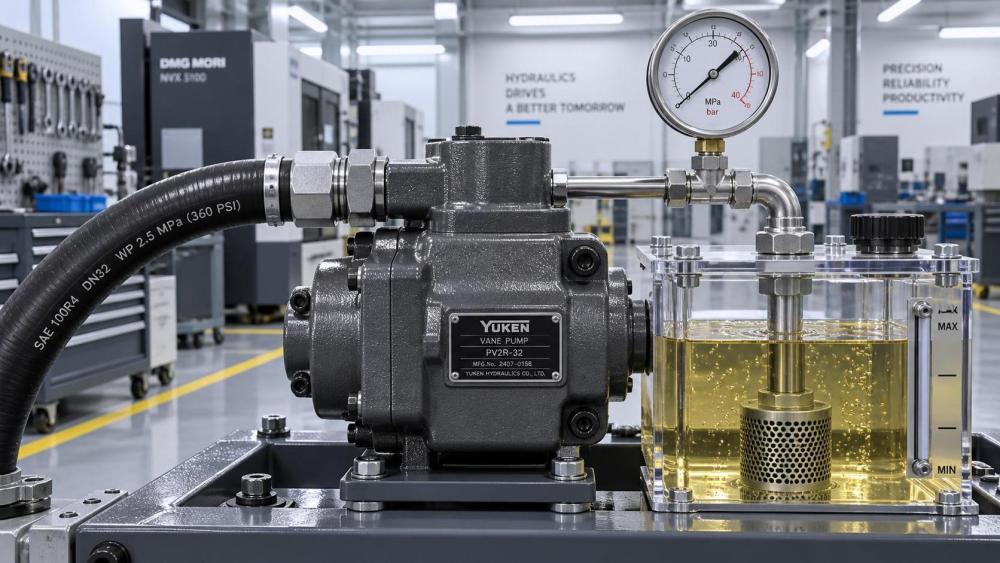
Inspect the inlet path before judging the pump itself
Most cavitation investigations should begin between the reservoir and the pump inlet. A vane pump depends on a stable, unrestricted supply of fluid. Any condition that lowers inlet pressure too far can create the environment for cavitation, particularly when viscosity is high or the pump is being driven near the upper end of its speed range.
Check the reservoir level under the actual operating condition, not only when the machine is stopped. A level that appears adequate at rest may fall below a safe point when cylinders are extended, attachments are raised, or a large volume of oil is held in external circuits. Low fluid level can also create a vortex near the suction connection, pulling air into the line even if there is no external fluid leak.
Then examine the suction hose and fittings. Look for crushed sections, tight bends, internally damaged hoses, blocked strainers, undersized pipework, and partially closed valves. Suction-side restrictions do not always leak oil outward because the line is under vacuum or below atmospheric pressure. Instead, they may draw air inward through a loose clamp, a damaged O-ring, a cracked hose, a flange joint, or a shaft seal.
Inlet plumbing deserves closer scrutiny after changes to hose routing, tank modifications, cold-weather operation, fluid conversion, or a pump replacement. A line arrangement that supported a lower-flow pump may be inadequate after a higher-capacity unit is fitted. Likewise, a suction strainer selected for clean oil can become restrictive when contamination accumulates or when cold fluid viscosity increases.
Fluid condition can create a false diagnosis
Oil condition changes the way a vane pump fills. Fluid that is too cold or too viscous can resist flow through the inlet line and strainer, producing symptoms that resemble a permanent suction restriction. In this case, the pump may be noisy only during warm-up and settle as the oil reaches its intended operating range. That does not automatically make the condition acceptable; repeated cold-start cavitation still imposes wear.
At the other extreme, fluid that is too hot or has degraded may lose viscosity and lubrication performance. It may also release dissolved air more readily. Verify that the fluid grade matches the equipment specification and that the reservoir, cooler, and return arrangement are managing temperature as intended. Mixing incompatible fluids can create foam-control problems even when the pump and pipework are mechanically sound.
Contamination complicates diagnosis further. Debris in a suction strainer can starve the pump, while abrasive particles already in the system may create wear noise that is mistaken for cavitation. Inspecting filter debris and taking a representative oil sample can help determine whether internal damage is already generating particles.
Use readings to separate inlet trouble from pressure-side trouble
A pressure gauge at the pump outlet is useful, but it cannot by itself confirm cavitation. A pump may maintain pressure against a relief valve while still suffering inlet starvation. The pressure reading should be interpreted alongside flow performance, fluid temperature, pump speed, load condition, and, where appropriate, inlet vacuum or pressure measurement.
An inlet vacuum measurement can be particularly informative when conducted using the pump and machine manufacturer's approved test points and limits. Excessive vacuum indicates that the pump is working too hard to pull oil from the reservoir. It does not identify the restriction by itself, but it directs attention to the suction circuit rather than the pressure side.
Flow testing can also expose a problem hidden by a pressure gauge. If pressure can be reached only with erratic flow, slow actuator response, or excessive temperature rise, the pump may not be filling its chambers consistently. Testing should be performed in a controlled manner because deadheading a pump or imposing an incorrect test load can damage equipment and introduce misleading results.
For crane hydraulics, treat the warning signs as an operational decision
On lifting equipment, the question “What hydraulic checks are required before crane operation?” is closely connected to cavitation risk. A pre-operation inspection should confirm sufficient hydraulic oil level, no visible leakage around pump connections and hoses, no damaged or kinked suction lines, no unusual pump noise during warm-up, and stable machine response through the functions permitted by the operating procedure.
Operators should also watch for drifting, jerky boom movement, inconsistent winch response, abnormal vibration, warning indicators, or fluid that appears aerated in the tank sight glass. These observations do not replace the crane manufacturer's required inspection process, but they provide an early decision point: if hydraulic behavior has changed, lifting should not proceed on the assumption that the issue is cosmetic.
A crane can be particularly unforgiving because a hydraulic supply fault may appear only when the system is asked to perform a high-demand movement. A pump that sounds acceptable at idle may cavitate when engine speed rises, multiple functions are used, or a load increases system demand. The suitable response is to remove the equipment from the affected duty, identify the cause, and verify normal operation after correction rather than relying on a brief no-load check.
Do not wait for visible pump damage
Once cavitation is severe enough to leave visible pitting or scoring, the issue has usually progressed beyond a simple operating nuisance. Internal wear can reduce volumetric efficiency, introduce debris into the circuit, and affect sensitive proportional valves, cylinders, motors, and seals. Repair scope may then include reservoir cleaning, filtration work, flushing decisions, and inspection of components exposed to contaminated fluid.
The most useful maintenance response is therefore staged. First, establish whether the symptom follows suction conditions, temperature, or speed. Next, correct clear inlet restrictions, leaks, fluid-level issues, and unsuitable fluid conditions. Then reassess noise, vibration, pressure stability, and machine response under controlled load. If the symptom remains, inspect the pump drive and internal condition rather than assuming the original cause has disappeared.
A vane pump should run with a consistent hydraulic sound and stable machine behavior. A new crackling noise, increasing vibration, fluctuating flow, or a tank full of bubbles should be treated as evidence to investigate the hydraulic supply path before the pump turns a minor inlet problem into a broader system repair.
Want to dive deeper into these market dynamics, or need data-driven support for your next business move? Drop a line below and let the analysts at PCTS provide customized insights.
We respect your privacy. Your information is strictly confidential.
Related News
- 00
0000-00
How sealing technology reduces contamination in semiconductor manufacturing - 00
0000-00
Where to install vibration sensors on rotating machinery - 00
0000-00
NTSB Probe Finds Boeing Warned of MD-11 Engine Bearing Risk Years Earlier - 00
0000-00
How to size pneumatic grippers for packaging system integration - 00
0000-00
How to size alloy steel power transmission chains for heavy loads
Weekly Insights
Stay ahead with our curated technology reports delivered every Monday.