





Why contamination control becomes decisive in excavator service life
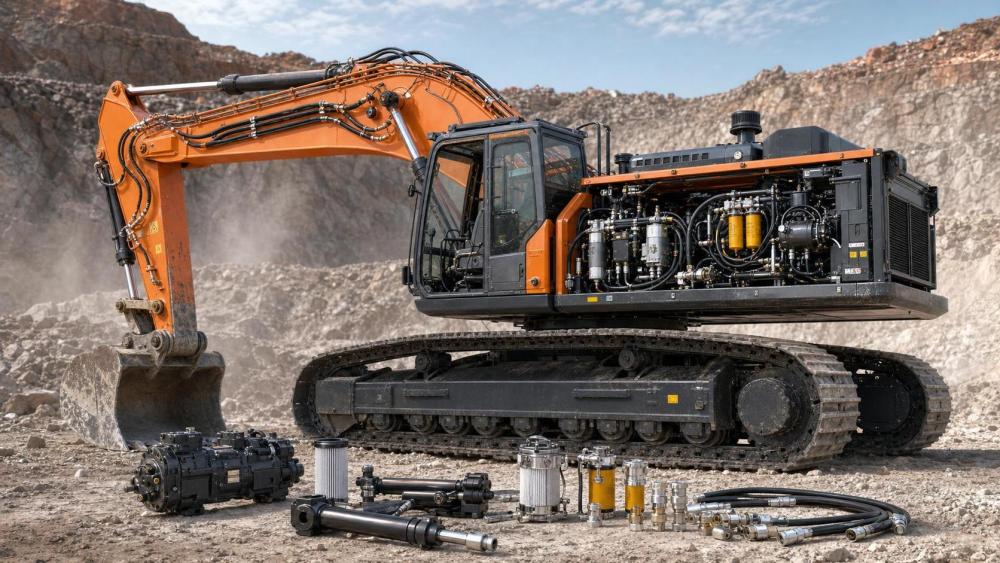
Excavator Hydraulic Systems contamination control often decides whether a machine delivers stable production or enters a cycle of repeated hydraulic failure.
In field equipment, contamination rarely appears as one dramatic event.
It usually builds through dust ingress, water intrusion, worn seals, careless oil transfer, and delayed filter replacement.
That is why premature pump wear, valve sticking, sluggish boom response, and overheated circuits often share the same hidden starting point.
For a platform centered on precision components, seals, bearings, fluid power, and industrial MRO, this topic sits at the intersection of reliability and lifecycle cost.
A contaminated hydraulic circuit does not only damage one pump.
It accelerates wear across cylinders, motors, spools, hoses, couplings, and sealing interfaces.
Excavator Hydraulic Systems contamination control therefore has to be judged by operating scene, not by filter specification alone.
A quarry machine, an urban demolition excavator, and a rental fleet unit may use similar components.
Their contamination paths, however, are very different.
Different work scenes create different contamination paths
In actual use, the first judgment is not oil grade.
It is how contamination enters the system under real working conditions.
Fine dust dominates in mining and earthmoving sites.
Moisture risk rises in coastal work, flood recovery, dredging support, and machines parked outdoors for long periods.
Metal particles become a larger issue where attachments create shock loads or where overdue maintenance already triggered component wear.
Service practice also changes the contamination profile.
A clean workshop with sealed transfer containers produces different outcomes from field refilling beside a dusty trench.
This is where Excavator Hydraulic Systems contamination control moves beyond theory.
The same machine model may require different inspection priorities, breathing arrangements, and flushing discipline depending on where it works.
Dust-heavy excavation and quarry loading
These scenes usually attack the system from the outside in.
Reservoir breathers, filler caps, rod seals, and hose connection points become high-risk locations.
The practical issue is not only airborne dust density.
It is repeated pressure cycling, which pulls contamination inward whenever the tank breathes.
In this scene, Excavator Hydraulic Systems contamination control should focus on breather efficiency, transfer cleanliness, and seal condition around moving rods.
Wet, intermittent, or low-utilization machines
A less obvious pattern appears when machines operate irregularly.
Water contamination can accumulate even without visible flooding.
Condensation forms during daily temperature swings, especially in partially filled reservoirs.
This reduces lubrication film strength and promotes corrosion inside precision surfaces.
In such conditions, particle counts alone are not enough.
Water content, oil appearance, and rust traces inside filters become equally important signals.
Where premature failure usually starts in the hydraulic circuit
Premature failure rarely begins at the component that fails first.
The root cause often begins upstream in contamination entry or debris circulation.
Pumps are commonly blamed because they lose efficiency early.
Yet the original damage may come from cylinder seal breakdown, poor hose replacement practice, or unflushed auxiliary attachment lines.
The table below helps separate the main scenes and their judgment points.
A useful insight is that similar failures can come from different contaminants.
Slow actuator response may point to varnish, water damage, or abrasive particles.
Good Excavator Hydraulic Systems contamination control depends on tracing the source before replacing expensive assemblies.
Service practices often decide whether contamination stays local or spreads
In many fleets, the most damaging contamination is introduced during maintenance rather than during operation.
Open drums, reused funnels, dirty rags, and uncapped hoses can undo a well-designed hydraulic system in one service event.
This matters even more after pump failure.
If metal debris remains in coolers, return lines, or attachment circuits, the replacement unit inherits the same failure path.
A recurring mistake is treating filter change as complete contamination control.
Filters are essential, but they do not correct bad oil handling or incomplete flushing.
In practical MRO work, cleaner transfer methods often produce faster reliability gains than simply moving to a finer filter grade.
Attachment changes and quick couplers need special attention
Machines that rotate between buckets, breakers, grapples, and compactors face a specific risk.
Every coupling event creates an opportunity for dirt ingress and mixed fluid contamination.
The issue is often underestimated because the volume appears small.
But repeated small contamination events steadily damage precision clearances inside valves and piston pumps.
Excavator Hydraulic Systems contamination control in these scenes should include capped connectors, clean connection zones, and flushing rules for rarely used tools.
What gets misjudged when teams only look at parts and specifications
One common misjudgment is assuming a higher-rated filter solves a contamination problem by itself.
If seal lips are damaged or breathers are overloaded, contamination entry continues.
Another mistake is treating all excavators in a fleet as one contamination category.
A machine in trenching service and another handling demolition debris may require different sampling intervals and inspection points.
Cost is also judged too narrowly.
Low-cost oil transfer tools or generic seals may look acceptable initially.
Over time, they increase leakage, dirt ingress, and unscheduled stops.
For anyone comparing hydraulic components, seals, and service practices, total ownership cost matters more than unit price.
- Do not judge contamination risk only by visible oil cleanliness.
- Do not install replacement parts without tracing debris origin.
- Do not ignore storage, transport, and refill conditions.
- Do not assume similar applications create identical hydraulic stress.
A workable contamination control plan looks different by scene
The best approach is not the most complicated one.
It is the one matched to failure history, environment, and service reality.
For dry and dusty service, start with the entry points.
Upgrade reservoir breathers, protect refill openings, and inspect wiper and rod seals on a shorter interval.
For humid or intermittently used equipment, test moisture regularly and avoid long storage with partially filled tanks.
For breaker and demolition service, focus on wear debris tracking, return-line filtration performance, and thorough post-failure flushing.
Where attachments are changed often, standardize connector cleaning and hose capping before the machine leaves the work zone.
A practical Excavator Hydraulic Systems contamination control plan usually includes four actions.
- Map contamination entry points for each operating scene.
- Set oil sampling and filter inspection by duty, not calendar alone.
- Define flushing rules after component failure or hose replacement.
- Match seals, breathers, and transfer tools to the actual environment.
That framework also aligns with broader industrial intelligence work around fluid power, sealing reliability, wear monitoring, and maintenance economics.
The next step is to judge the scene before the next hydraulic repair
Excavator Hydraulic Systems contamination control becomes effective when failure analysis starts with field conditions, not only damaged parts.
The most reliable decisions come from comparing operating scene, ingress route, contaminant type, and maintenance behavior together.
Before the next service cycle, review where dust, water, and wear debris are most likely entering.
Then check whether current filters, seals, breathers, hoses, and oil handling methods fit that reality.
That step usually reveals why one excavator keeps failing while another with similar specifications remains stable.
When the scene is understood clearly, Excavator Hydraulic Systems contamination control shifts from reactive repair to predictable reliability improvement.
Want to dive deeper into these market dynamics, or need data-driven support for your next business move? Drop a line below and let the analysts at PCTS provide customized insights.
We respect your privacy. Your information is strictly confidential.
Related News
- 00
0000-00
How to check vibration analysis software for sensor compatibility - 00
0000-00
IndexBox Forecasts 3.8% Annual Growth for Global Radial Seals Market Through 2035 - 00
0000-00
How to assess the chemical compatibility of FFKM sealing sheets - 00
0000-00
IndexBox Forecasts 3.6% Annual Growth for Construction Bearings Market - 00
0000-00
When do hydraulic components require an export license?
Weekly Insights
Stay ahead with our curated technology reports delivered every Monday.