





On July 25, 2026, U.S. Customs and Border Protection began enforcing a stricter import compliance requirement for selected industrial fluid power components. The change matters directly to importers, manufacturers, exporters, and supply chain teams handling Axial Piston Pumps, Electro-hydraulic Pumps, Pneumatic Grippers, and Rodless Cylinders, because customs clearance now depends not only on the goods themselves but also on whether the required compliance paperwork is complete at the time of entry.
What the New CBP Requirement Covers
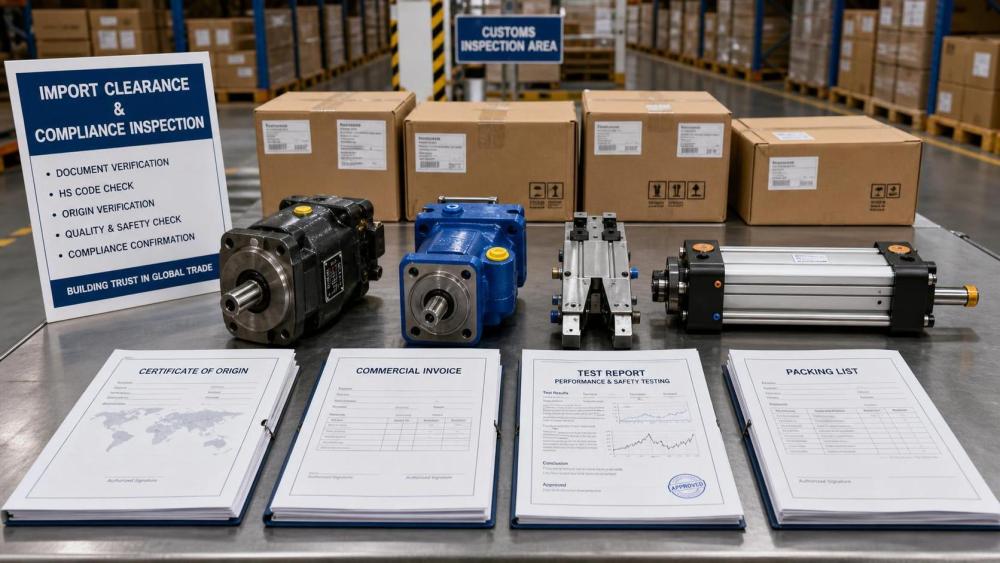
According to the information provided, CBP formally implemented the Industrial Fluid Power Components Import Compliance Reinforcement Guidance on July 25, 2026. Under this requirement, importers of Axial Piston Pumps, Electro-hydraulic Pumps, Pneumatic Grippers, and Rodless Cylinders must submit a manufacturer-signed Declaration of Conformity, or DoC, during customs clearance.
The same filing must also include testing reports issued by an accredited laboratory for RoHS 3 (EU 2021/1172) and the updated REACH SVHC requirements. The information provided also states that non-compliant shipments may face port detention, return, or fines.
Where the Immediate Pressure Will Be Felt
Export documentation moves closer to the shipping deadline
From an industry perspective, direct trading companies and exporters are likely to feel the impact first in documentation preparation. The requirement links customs release to a manufacturer-signed DoC and recognized laboratory reports, which means document readiness becomes part of shipment execution rather than a secondary compliance task.
Manufacturers face tighter coordination on test reports and declarations
Processing and manufacturing companies involved in these covered product categories may be affected through document issuance, internal verification, and coordination with accredited laboratories. What deserves closer attention is whether product files, signed declarations, and test reports are aligned before cargo reaches customs clearance.
Importers and distributors carry higher clearance risk
For importers, distributors, and channel operators serving the U.S. market, the main impact is likely to appear in customs timing, order fulfillment, and inventory planning. If the required files are incomplete or not accepted at clearance, the risk shifts quickly from paperwork delay to shipment detention, return, or financial penalty.
Supply chain service providers may face more pre-clearance checks
Logistics coordinators, customs brokers, and related service providers may need to pay closer attention to pre-shipment file collection and document consistency. Analysis shows that for covered products, compliance management is likely to become a more visible part of delivery scheduling and customer communication.
What Companies Should Watch Now
Confirm whether a product falls within the covered scope
Companies handling hydraulic pumps and pneumatic actuators should first focus on whether their products match the listed categories in the provided information. The practical issue is not broad market interpretation, but whether a specific shipment involves Axial Piston Pumps, Electro-hydraulic Pumps, Pneumatic Grippers, or Rodless Cylinders subject to the new filing requirement.
Check whether DoC and lab reports can be submitted together
The new requirement is described as a simultaneous submission obligation at customs clearance. That makes document completeness a key operational point. Businesses should pay attention to whether the manufacturer-signed DoC and accredited laboratory reports for RoHS 3 and updated REACH SVHC are available in the same workflow, rather than being prepared in separate stages.
Reassess lead times and communication with U.S. customers
The information provided states that the rule directly affects delivery cycles and documentation costs for Chinese exporters. Observably, this means suppliers and buyers may need to revisit order timing, shipment milestones, and communication around customs readiness, especially where delivery commitments were previously based on standard export paperwork.
Keep watching for official wording and practical enforcement details
Analysis shows that there can be a difference between a rule's headline requirement and how it is applied in daily customs operations. Companies should therefore continue monitoring whether there are further official clarifications, updated procedural expressions, or more detailed expectations around acceptable declarations and test reports.
Why This Looks Like More Than a One-Off Filing Change
This section is an editorial observation. Based on the provided information, it is more appropriate to understand the development as a concrete compliance tightening rather than a routine administrative update. The reason is that the rule connects product entry directly to manufacturer documentation and laboratory-backed substance compliance records.
At the same time, it should not yet be overstated as a broad market restructuring signal. What deserves closer attention is that the immediate burden appears in documentation readiness, delivery planning, and cross-border coordination. Whether the effect remains limited to the listed categories or signals wider enforcement practice still requires continued observation.
How the Market May Need to Read This Development
In practical terms, the July 25, 2026 change should be read as a compliance-driven operational issue with immediate consequences for customs clearance. For the affected product categories, the central question is no longer only product shipment, but whether the required declaration and testing package is ready at the same time. A neutral reading is that this is both a short-term execution challenge and a longer-term compliance signal worth tracking.
Basis of This Article and What Still Needs Verification
This article is based on the user-provided news title, event date, and event summary concerning the CBP requirement for DoC and RoHS/REACH compliance declarations for specified hydraulic pump and pneumatic actuator imports. No additional facts, data, or external case details have been added beyond the provided information.
For this type of industry development, commonly relevant source categories may include official notices, company announcements, industry association updates, authoritative media coverage, and standard or compliance documents. The specific official source link was not provided in the input, so continued verification remains necessary. Follow-up attention should focus on any official clarification of enforcement language, documentation expectations, and operational implementation for the covered product categories.
Want to dive deeper into these market dynamics, or need data-driven support for your next business move? Drop a line below and let the analysts at PCTS provide customized insights.
We respect your privacy. Your information is strictly confidential.
Related News
- 00
0000-00
How to check vibration analysis software for sensor compatibility - 00
0000-00
IndexBox Forecasts 3.8% Annual Growth for Global Radial Seals Market Through 2035 - 00
0000-00
How to assess the chemical compatibility of FFKM sealing sheets - 00
0000-00
IndexBox Forecasts 3.6% Annual Growth for Construction Bearings Market - 00
0000-00
When do hydraulic components require an export license?
Weekly Insights
Stay ahead with our curated technology reports delivered every Monday.