





On June 20, 2026, U.S. Customs and Border Protection (CBP) activated the dedicated F865 validation code in the Automated Commercial Environment (ACE), adding a more direct control point for HTS classification accuracy in selected hydraulic and pneumatic products. The change matters not only to exporters and import filing teams, but also to manufacturers, buyers, and supply chain service providers because a mismatch between declared tariff coding and a product’s physical features or functional description can now be stopped in the system before the entry moves into review.
What the ACE change now confirms
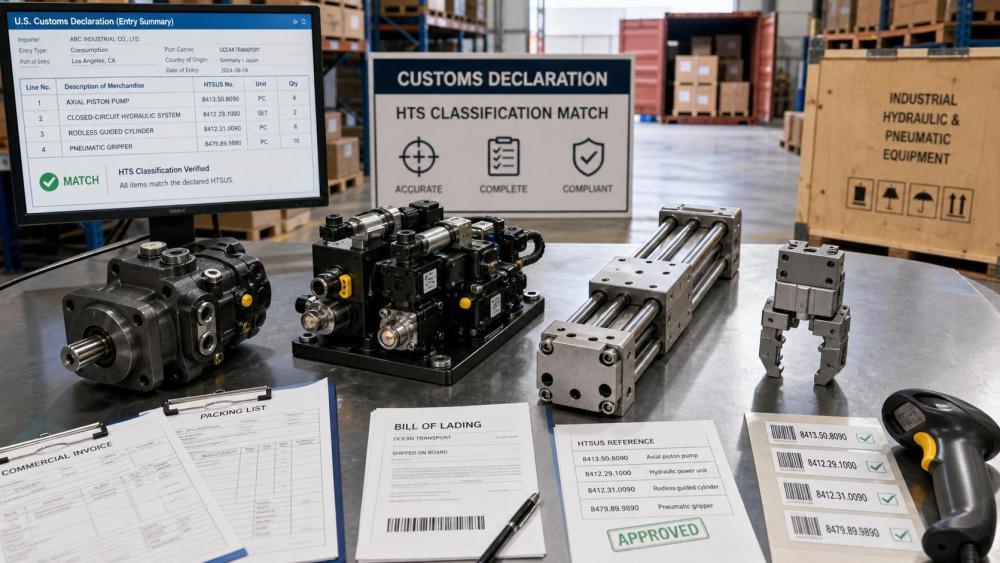
According to the information provided, CBP formally enabled the F865 code in ACE on June 20, 2026. The validation applies to Axial Piston Pumps, Closed-loop Hydraulics, Rodless & Guided Cylinders, and Pneumatic Grippers.
The stated control logic is product-specific HTS matching. If the HS code submitted in the declaration does not align with the product’s physical characteristics or functional description, ACE will automatically block the filing and mark it as “F865-Noncompliant.” In that case, the entry does not proceed into the document review workflow.
Where the pressure is likely to appear first
Classification work moves closer to the shipment stage
From an industry perspective, direct trading companies and export teams are likely to feel the impact first because the filing risk is no longer limited to later review or post-entry correction. What deserves closer attention is the front-end accuracy of HTS coding, product descriptions, and supporting shipment data for the covered hydraulic and pneumatic categories.
Manufacturing and technical documentation gain more trade relevance
For manufacturers and processing suppliers, the practical issue is not only what the product is called commercially, but whether the declared code can be consistently supported by technical descriptions of form and function. Analysis shows that product specifications, catalog language, and internal item definitions may become more important in customs-facing documentation where these products are involved.
Procurement and delivery planning may need tighter document alignment
For buyers, distributors, and channel operators, the main concern is execution risk in delivery schedules. If a filing is blocked at submission because the code and product description do not match, the immediate pressure may fall on shipment release timing, order coordination, and communication with suppliers or customs service partners. The key issue is not a new commercial rule in itself, but a stricter system gate tied to classification consistency.
Customs service providers face higher screening expectations
Supply chain service providers, including customs brokers and related compliance support teams, may need to pay closer attention to how product features are described before transmission into ACE. Observably, this change raises the operational importance of checking whether item-level descriptions and tariff selection are aligned before filing rather than relying on later clarification.
What companies should review now
Recheck item descriptions against tariff declarations
Analysis shows that companies handling the affected product groups should pay closer attention to whether internal product names, sales descriptions, and customs declarations describe the same physical and functional attributes. Where documentation uses broad or marketing-oriented wording, the filing risk may become harder to control.
Prepare support files that match product function
What deserves closer attention is the consistency of technical files used around export declarations, including product specifications, technical sheets, and other shipment-related support materials. The provided information does not define a required document set, so this should be understood as a compliance preparation point rather than a confirmed filing checklist.
Watch for execution guidance and interpretation details
Because the provided information confirms the system activation and rejection logic, but does not provide fuller implementation guidance, companies should continue monitoring how the rule is described in official communications and operational practice. This is particularly relevant for teams managing recurring shipments of the listed hydraulic and pneumatic products.
Factor possible filing interruptions into delivery planning
From a practical standpoint, exporters, purchasers, and after-sales support teams may wish to account for the possibility of filing disruption where classification accuracy is uncertain. This is not confirmation of a broader logistics outcome, but an operational reminder that declaration readiness may now have a more immediate effect on shipment timing.
Why this looks more like an execution signal than a general policy statement
Observably, this development is better understood as an execution-level compliance signal inside the customs filing system rather than a broad policy discussion. The key point is that the control is embedded in ACE and can stop a filing in real time when the declared HTS code does not match the product’s physical or functional description.
Analysis shows that the market should pay attention not only to the existence of the rule, but also to how consistently it is applied in practice, how product descriptions are interpreted, and whether supporting trade documents begin to change in response. At this stage, it is more appropriate to treat the update as a landed operational control with follow-up details still worth watching.
How the market may best read this development now
For the hydraulic and pneumatic product trade, this update points to a more immediate link between product definition and customs clearance eligibility. It does not by itself confirm broader commercial outcomes, but it does indicate that misalignment between HTS selection and product characteristics can now trigger an automatic stop earlier in the process.
It is more appropriate to understand this development as a rule already reflected in system execution, while the wider industry impact will still depend on how companies adjust documentation, classification review, and shipment preparation in day-to-day operations.
Basis of this article and what still needs verification
This article is based on the user-provided news title, event date, and event summary. For developments of this kind, relevant source types typically include official notices, releases from regulatory authorities, customs or trade administration updates, industry association communications, standard-setting documents, and reporting by authoritative trade media.
No specific official source link was provided in the input, so the precise official publication path still needs to be verified on an ongoing basis. Observably, the areas that warrant continued attention include any further implementation details, interpretation standards for classification matching, changes in bidding or procurement documentation, market feedback, and how companies are handling compliance in actual filings.
Want to dive deeper into these market dynamics, or need data-driven support for your next business move? Drop a line below and let the analysts at PCTS provide customized insights.
We respect your privacy. Your information is strictly confidential.
Related News
- 00
0000-00
How sealing technology reduces contamination in semiconductor manufacturing - 00
0000-00
Where to install vibration sensors on rotating machinery - 00
0000-00
NTSB Probe Finds Boeing Warned of MD-11 Engine Bearing Risk Years Earlier - 00
0000-00
How to size pneumatic grippers for packaging system integration - 00
0000-00
How to size alloy steel power transmission chains for heavy loads
Weekly Insights
Stay ahead with our curated technology reports delivered every Monday.