





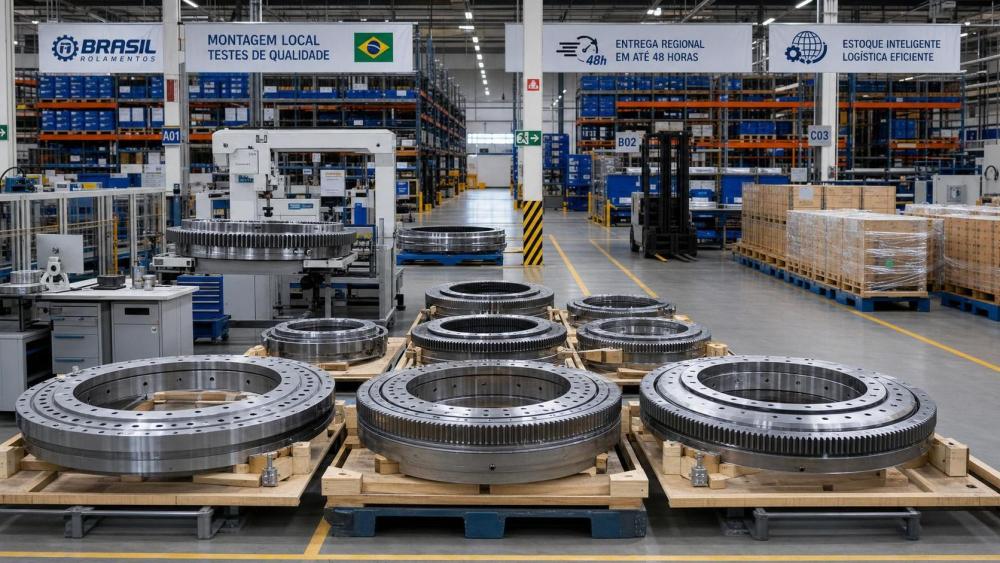
On June 3, 2026, Xiangyang Bearing brought its wholly owned plant in Sao Paulo state, Brazil, into operation, turning a single corporate development into a broader market signal for trade execution, localized service, and delivery rules in South America. The launch matters not only because it adds local assembly, testing, warehousing, and 48-hour regional dispatch capacity for selected bearing products, but also because it highlights how distributors, buyers, after-sales teams, and export-oriented suppliers may need to reassess tariff treatment, response-time commitments, technical support arrangements, and documentation expectations in a market where local fulfillment is becoming more relevant.
What Has Been Confirmed So Far
The confirmed facts are limited and clear. On June 3, 2026, Xiangyang Bearing officially started production at its wholly owned factory in Sao Paulo state, Brazil. The first phase focuses on the assembly of heavy-duty slewing bearings and wind power yaw bearings. The site supports localized testing, warehousing, and 48-hour regional direct dispatch. According to the event summary provided, this move fills a gap in localized service by a Chinese bearing company in South America and is positioned to provide overseas distributors with tariff-free supply, faster spare-parts response, and local technical coordination support.
Where the Practical Impact May Appear First
Procurement and distribution decisions may start to shift
From an industry perspective, distributors and procurement teams are likely to pay closer attention to whether supply can now be sourced through a localized route rather than through a purely cross-border delivery model. The practical impact may appear in quotation structures, delivery commitments, spare-parts planning, and the way buyers compare imported stock with locally supported inventory. What deserves closer attention is whether tender documents, purchase terms, or supplier evaluation criteria begin to place more weight on local warehousing, response times, and technical coordination.
Export and supply-chain planning may need a different compliance lens
Analysis shows that export-oriented manufacturers and supply-chain service providers may need to review how product flow, supporting documents, and delivery responsibilities are presented when local assembly and local dispatch become part of the commercial arrangement. The key issue is not a newly confirmed regulation in itself, but a possible change in how trade execution is organized in practice. Companies involved in shipping, order fulfillment, and customer service should therefore watch for changes in document requirements, delivery promises, and quality-traceability expectations tied to localized operations.
After-sales and technical service expectations may rise
For after-sales providers and technical support teams, the event suggests a possible shift in market expectations. If localized testing and technical coordination are available, customers and channel partners may increasingly expect faster troubleshooting, more direct parts support, and clearer service responsibility within the region. Observably, this can affect warranty workflows, service records, spare-parts stocking logic, and the evidence needed to support product performance or replacement decisions.
What Companies Should Watch in the Next Stage
Check how compliance claims are expressed
Analysis shows that companies should pay close attention to how localized testing, local dispatch, and tariff-related advantages are described in commercial materials and transaction documents. If market participants use these points in bids, procurement files, or customer communications, the wording should remain consistent with verifiable operating arrangements rather than broader claims that the current facts do not support.
Review technical files and service documentation
Where products involve heavy-duty slewing bearings or wind power yaw bearings, buyers, distributors, and service teams may need to review whether technical files, testing records, warehousing records, and after-sales documents are prepared in a way that matches a localized support model. This is especially relevant when response time, replacement handling, or technical coordination becomes part of the commercial commitment.
Watch for changes in purchasing and tender requirements
It is more appropriate to understand this as a signal that some buyers or channels may start adjusting practical requirements rather than as proof that the market has already adopted a new uniform standard. Companies should therefore monitor whether procurement notices, supplier qualification conditions, or technical bid alignment begin to reference local inventory, local testing support, or faster regional delivery as preferred conditions.
Track execution risks in delivery and traceability
Observably, localized warehousing and rapid regional dispatch can improve responsiveness, but they also place more attention on execution details. Companies should continue checking how product traceability, service responsibility, spare-parts records, and quality reporting are handled when fulfillment is split between original production, local assembly, and regional distribution.
Why This Looks More Like an Execution Signal Than a Finished Rule Shift
Analysis shows that the significance of this development lies less in a formally announced new regulation and more in the way it reflects changing commercial and compliance expectations in South American market execution. The confirmed information points to a more localized supply and service model, which can influence tariff treatment, delivery planning, and channel management in practice. At the same time, it would be premature to treat this event alone as a complete market rule reset. What deserves closer attention is how buyers, distributors, and service partners respond, and whether related requirements begin to appear more clearly in procurement language, certification practice, or service documentation.
How the Market May Best Read This Development Now
At this stage, the event is best understood as a concrete execution signal: localized capacity, local testing support, warehousing, and fast regional dispatch are becoming commercially relevant reference points in South America for certain bearing applications. The industry significance lies in the operational implications for sourcing, support, and fulfillment rather than in any single declared policy change. A cautious reading remains appropriate, because the longer-term effect still depends on how market participants translate this model into procurement rules, service expectations, and compliance practice.
Basis of This Article and What Still Needs Verification
This article is generated from the user-provided news title, event date, and event summary. For developments of this kind, commonly relevant source types may include company announcements, releases from regulatory authorities, customs or trade administration information, industry association updates, standards organization documents, and reporting by authoritative media. No specific official source link was provided in the input, so further verification remains necessary. Continued observation should focus on later policy details, certification interpretation, tender document changes, market feedback, and actual execution by participating companies.
Want to dive deeper into these market dynamics, or need data-driven support for your next business move? Drop a line below and let the analysts at PCTS provide customized insights.
We respect your privacy. Your information is strictly confidential.
Related News
- 00
0000-00
How sealing technology reduces contamination in semiconductor manufacturing - 00
0000-00
Where to install vibration sensors on rotating machinery - 00
0000-00
NTSB Probe Finds Boeing Warned of MD-11 Engine Bearing Risk Years Earlier - 00
0000-00
How to size pneumatic grippers for packaging system integration - 00
0000-00
How to size alloy steel power transmission chains for heavy loads
Weekly Insights
Stay ahead with our curated technology reports delivered every Monday.