





Wind Turbine Bearing Tribology: What Drives Wear, Friction, and Grease Failure
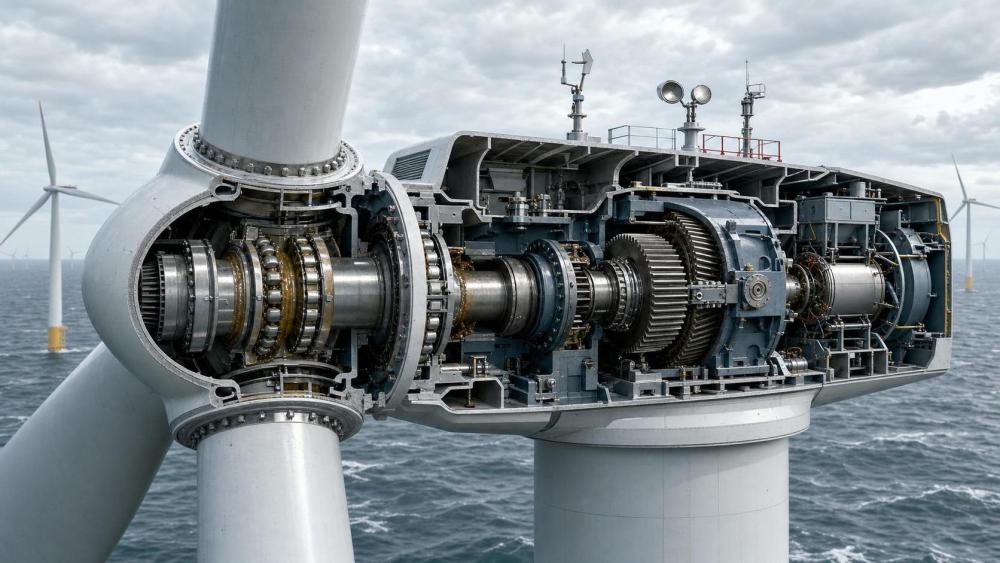
Wind turbine bearing tribology directly shapes uptime, service intervals, and lifecycle cost. In practice, small lubrication problems often become large reliability problems.
That matters because wind turbine bearings run under slow speed, high load, vibration, and changing weather. These conditions are difficult for any lubricant film.
From a technical evaluation standpoint, the key question is simple. What actually drives wear, friction, micropitting, and grease failure inside real wind turbine applications?
The answer is not one factor. Wind turbine bearing tribology depends on contact stress, surface condition, motion profile, contamination, lubrication behavior, and maintenance quality.
This also means bearing comparison cannot stop at load rating. Tribology reveals how a bearing will behave after thousands of hours in unstable operating conditions.
Why Wind Turbine Bearing Tribology Is So Demanding
Wind turbines do not run like constant-speed factory motors. Their loads shift with wind speed, grid response, blade control, and braking events.
Main shaft bearings, gearbox bearings, pitch bearings, and yaw bearings each face different tribological stress. Yet all can suffer when film thickness falls too low.
At low rotational speed, elastohydrodynamic film formation becomes weak. Metal surfaces come closer, and asperity contact starts to control friction and damage.
Transient loads make this worse. Sudden torque variation changes pressure distribution across the raceway, which can accelerate local stress and surface fatigue.
In offshore turbines, moisture, salt exposure, and access difficulty raise the risk further. Grease performance becomes a reliability variable, not just a maintenance item.
Key operating conditions that increase tribological risk
- Low speed combined with high contact load
- Frequent start-stop or oscillatory motion
- Shaft misalignment and housing deformation
- Water ingress, solid contamination, or grease aging
- Electrical effects and vibration-induced false brinelling
What Drives Wear and Friction in Wind Turbine Bearings
Wear in wind turbine bearing tribology usually begins when surfaces touch more often than expected. That happens when lubricant film thickness cannot separate the rolling contacts.
Once mixed or boundary lubrication appears, friction rises. Higher friction means more heat, faster oxidation, and a greater chance of surface distress.
Surface roughness is another important driver. A rougher raceway can tear through the grease film more easily, especially during low-speed loaded operation.
Contamination is often underestimated. Hard particles create three-body abrasion, while water reduces lubricant protection and promotes corrosion-driven wear.
Cage behavior also matters. Poor guidance or uneven load sharing can create smearing, sliding, and localized temperature spikes.
The main wear modes seen in service
- Adhesive wear from insufficient film separation
- Abrasive wear from dirt, debris, or damaged surfaces
- Corrosive wear linked to moisture and chemical attack
- Smearing caused by sliding under heavy stress
- False brinelling during vibration at standstill or low motion
In real evaluations, friction should be read together with wear indicators. A low-friction grease may still fail if it cannot resist water, shear, or bleed instability.
Why Micropitting Becomes a Critical Failure Mechanism
Micropitting is one of the most important issues in wind turbine bearing tribology. It begins as tiny surface fatigue cracks under repeated mixed lubrication conditions.
These cracks grow near the surface and release small particles. Over time, the raceway develops a gray, frosted appearance and roughness increases.
Once roughness rises, lubrication becomes even less effective. That creates a feedback loop where friction, stress concentration, and fatigue all intensify.
This failure mode is common in gearbox bearings because rolling and sliding occur together. It can also appear where alignment and load distribution are unstable.
Micropitting risk rises when lambda ratio is low, surfaces are rough, loads are high, and additive chemistry does not match the contact conditions.
Evaluation signals worth checking
- Raceway finish and superfinishing capability
- Lubricant film thickness under low-speed load
- Micropitting test data and additive package behavior
- Housing stiffness, alignment, and contact pattern control
How Grease Failure Starts in Wind Turbine Bearing Tribology
Grease is often treated as a consumable, but in wind turbine bearing tribology it behaves like a design parameter. Its failure can come long before bearing fatigue life.
One common issue is oil separation imbalance. If base oil release is too low, contacts starve. If it is too high, the grease structure collapses early.
Mechanical working also degrades grease. Repeated churning, vibration, and temperature cycling can soften the thickener network and reduce consistency.
Water contamination is especially harmful. It weakens film strength, accelerates oxidation, changes texture, and supports corrosion at the rolling interface.
Another practical issue is grease incompatibility. Mixing products during relubrication can trigger hardening, softening, or poor bleed performance.
Typical grease failure triggers
- Wrong base oil viscosity for speed and load
- Insufficient extreme-pressure or antiwear protection
- Excessive water washout or poor corrosion resistance
- Oxidation from thermal cycling and long service intervals
- Overgreasing or undergreasing during maintenance
In recent field practice, grease analysis is becoming more useful. Bleed rate, worked penetration, oxidation, water content, and wear debris can reveal failure before shutdown.
What to Compare During Technical Evaluation
A useful comparison model for wind turbine bearing tribology should combine bearing design, surface engineering, lubrication, sealing, and maintenance access.
Looking at one parameter alone usually leads to poor decisions. A strong steel grade cannot compensate for weak lubrication control in mixed film conditions.
More reliable evaluations ask how the whole system behaves under transient load, contamination, oscillation, and delayed relubrication.
Practical comparison points
Reducing Risk Through Better Tribology Decisions
The strongest approach to wind turbine bearing tribology is preventive, not reactive. Problems should be reduced at the design, lubricant, and maintenance stages together.
Start with the contact. Improve load distribution, alignment control, and surface finish so the bearing can maintain a healthier lubrication regime.
Then review grease selection against actual duty cycle. Slow speed, high load, water exposure, and long relubrication intervals need specific validation data.
Sealing strategy should not be treated as secondary. Better exclusion of water and debris can change the full wear pattern of the bearing system.
Finally, connect condition monitoring with maintenance planning. Grease sampling, vibration trends, and thermal drift can support smarter replacement timing.
A practical action list
- Verify low-speed film performance, not just catalog capacity.
- Check micropitting resistance with relevant test evidence.
- Review grease compatibility, bleed behavior, and water tolerance.
- Confirm sealing effectiveness for the actual operating environment.
- Use monitoring data to shorten the gap between symptom and response.
In the end, wind turbine bearing tribology is where mechanical design, lubrication chemistry, and field maintenance meet. Better decisions here usually lead to lower friction, slower wear, longer grease life, and more predictable turbine reliability.
Want to dive deeper into these market dynamics, or need data-driven support for your next business move? Drop a line below and let the analysts at PCTS provide customized insights.
We respect your privacy. Your information is strictly confidential.
Related News
- 00
0000-00
How sealing technology reduces contamination in semiconductor manufacturing - 00
0000-00
Where to install vibration sensors on rotating machinery - 00
0000-00
NTSB Probe Finds Boeing Warned of MD-11 Engine Bearing Risk Years Earlier - 00
0000-00
How to size pneumatic grippers for packaging system integration - 00
0000-00
How to size alloy steel power transmission chains for heavy loads
Weekly Insights
Stay ahead with our curated technology reports delivered every Monday.