





Why wind energy components China remains central in 2026
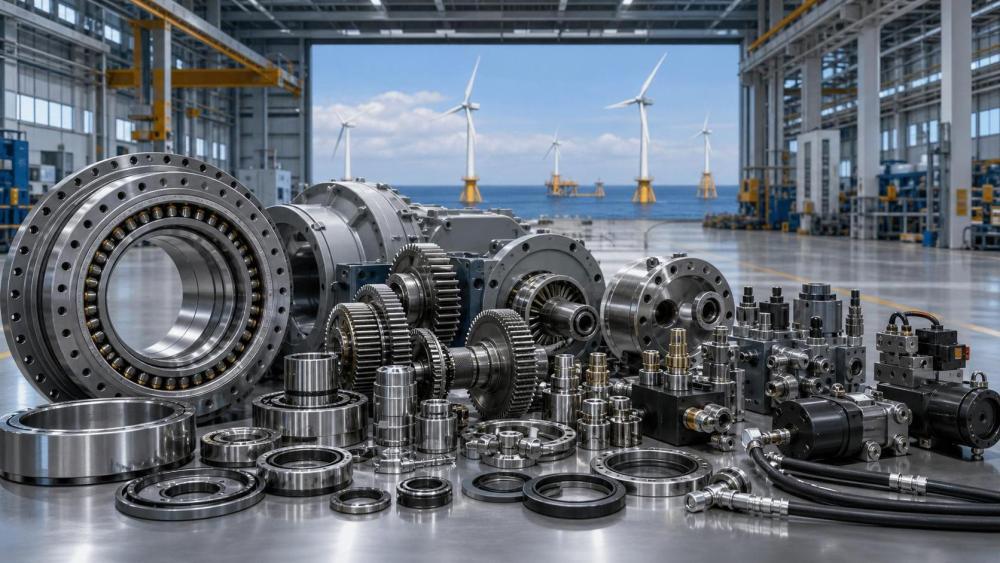
Wind energy investment is expanding again, but sourcing logic is no longer driven by price alone.
That is why wind energy components China stays at the center of global procurement discussions in 2026.
China still offers unmatched scale across bearings, castings, forgings, seals, transmission parts, fasteners, electrical assemblies, and maintenance-related industrial components.
Yet the conversation has changed.
Buyers now weigh delivered cost, export resilience, traceability, energy compliance, and lifetime performance much more carefully.
This shift matters because wind projects depend on long-life mechanical reliability, not just low unit pricing.
A delayed slewing bearing, inconsistent seal compound, or unstable gearbox component can disrupt installation plans and future service economics.
From a broader industrial perspective, wind energy components China also connect with supply chains for bearings, fluid power, sealing systems, power transmission, and MRO planning.
That overlap is becoming more important as operators compare total ownership risk across the full equipment lifecycle.
The market is not cooling, but it is becoming more selective
The strongest signal in 2026 is not lower demand.
It is sharper selectivity.
Developers, EPC groups, and equipment platforms continue to source from China, but approved supplier lists are narrowing.
This is especially visible in wind turbine bearings, yaw systems, pitch components, sealing packages, hydraulic units, and drivetrain support parts.
In previous cycles, capacity access was often the key issue.
Now the larger concern is whether capacity is stable, certifiable, and export-ready under changing policy conditions.
More contracts are also asking for deeper process visibility.
That includes heat treatment records, material origin, bearing raceway quality control, fatigue test data, corrosion resistance, and packaging discipline for long-distance shipping.
So the role of wind energy components China is not shrinking.
It is becoming more performance-dependent and more data-driven.
What is changing behind the quotes
Quoted prices still matter, but hidden cost layers are moving faster than many sourcing models expected.
This explains why wind energy components China can still look competitive on paper while becoming more complex in execution.
Several forces are pushing the supply landscape at once
The current shift is not caused by one factor.
It is the result of industrial, regulatory, and commercial pressures arriving together.
- Domestic competition in China is forcing component makers to improve yield, automation, and quality consistency.
- Export controls, tariff exposure, and localization rules are changing route choices and contract structures.
- Larger turbine platforms require higher precision in bearings, seals, couplings, hydraulic pitch parts, and drivetrain interfaces.
- Offshore and harsh-environment projects demand stronger corrosion control, lubrication performance, and condition monitoring compatibility.
- Lifecycle service expectations are lifting the importance of spare parts availability and MRO alignment.
More worth noting is how these forces interact.
A supplier may have attractive production capacity, yet still struggle with export documentation or long-term field support.
Another may have stronger engineering depth, but weaker cost resilience during raw material swings.
That is why wind energy components China should now be assessed as an operating ecosystem, not just a factory list.
The biggest impact is showing up in reliability-sensitive components
Not every part carries the same sourcing risk.
The pressure is highest where precision, fatigue resistance, sealing integrity, or field replacement cost are significant.
Where scrutiny is rising fastest
- Wind turbine bearings, especially large-diameter and high-load applications, where raceway finishing and lubricant compatibility affect service life.
- Sealing systems and O-rings used in hydraulic pitch systems, nacelle assemblies, and environmental barriers.
- Gearbox and transmission support components, where dimensional stability and metallurgy directly affect downtime risk.
- Hydraulic and pneumatic subassemblies linked to control response, leak prevention, and harsh-weather performance.
- Chains, couplings, and auxiliary mechanical transmission parts in maintenance and balance-of-plant applications.
In practical terms, this favors suppliers that can connect manufacturing quality with field reliability evidence.
That is also where industrial intelligence platforms become more useful.
Markets such as PCTS help frame wind energy components China within a wider component logic.
They show how bearings, seals, fluid power, transmission parts, and maintenance economics influence each other over time.
Supplier capability now matters more than simple country advantage
For years, buyers often treated China as a cost geography.
In 2026, that view is too narrow.
The more useful distinction is between suppliers that can scale responsibly and those that cannot.
Reliable wind energy components China sourcing increasingly depends on five capability signals.
- Process control depth, especially in machining, grinding, forging, heat treatment, and compound formulation.
- Documentation maturity, including batch traceability, inspection discipline, and export compliance readiness.
- Engineering responsiveness when specifications change for larger turbines or tougher environments.
- Aftermarket awareness, including spare parts continuity and failure analysis support.
- Financial and operational stability during cyclical swings in demand and freight conditions.
This has a direct effect on negotiation strategy.
A lower initial quote may lose value quickly if it leads to requalification, delayed installation, or premature service events.
What deserves close attention in the next planning cycle
The next phase is less about predicting one headline trend and more about reading several practical signals together.
The most useful watchpoints are often operational rather than rhetorical.
Priority signals to monitor
- Whether lead times are improving because processes are stronger, or only because orders have softened temporarily.
- Whether cost reductions come from automation gains, or from lower-grade inputs that create later reliability risk.
- Whether suppliers can support both serial production and replacement demand without quality drift.
- Whether export-facing documentation matches destination market expectations before shipment, not after delay appears.
- Whether condition monitoring and lifecycle data are being used to improve component design and MRO planning.
This is where a broader industrial lens helps.
Wind energy components China should be reviewed alongside lubrication practices, sealing material choices, transmission loads, and service interval assumptions.
Those links often reveal future cost faster than headline pricing does.
A stronger response starts with better component-level visibility
The 2026 sourcing environment rewards clarity.
Companies that perform best are usually the ones that understand where precision matters most and where substitution risk is acceptable.
For wind energy components China, that means mapping high-risk items by lifecycle impact, not by purchase price ranking alone.
It also means comparing suppliers on technical depth, process repeatability, and long-term service alignment.
A useful next step is to build a staged review around bearings, sealing systems, hydraulic units, transmission interfaces, and critical spare parts.
Then test each category against delivered cost, qualification burden, operating reliability, and replacement visibility.
The market still offers meaningful opportunity.
But in 2026, the advantage in wind energy components China belongs to those who read supply signals early, verify capability deeply, and plan beyond the first shipment.
Want to dive deeper into these market dynamics, or need data-driven support for your next business move? Drop a line below and let the analysts at PCTS provide customized insights.
We respect your privacy. Your information is strictly confidential.
Related News
- 00
0000-00
How sealing technology reduces contamination in semiconductor manufacturing - 00
0000-00
Where to install vibration sensors on rotating machinery - 00
0000-00
NTSB Probe Finds Boeing Warned of MD-11 Engine Bearing Risk Years Earlier - 00
0000-00
How to size pneumatic grippers for packaging system integration - 00
0000-00
How to size alloy steel power transmission chains for heavy loads
Weekly Insights
Stay ahead with our curated technology reports delivered every Monday.