





On July 1, 2026, a compliance change moved from technical documentation into bid access for wind turbine main shaft bearings in the EU market. TUV Rheinland has begun using EN 15804+A2:2026 for third-party carbon footprint declaration verification on this product category, and the requirement has already been embedded in tender documents for all new onshore and offshore wind projects within the EU. For bearing suppliers, exporters, project buyers, and certification-facing supply chain teams, this is worth close attention because the issue is no longer only whether carbon data can be prepared, but whether certified EPD documentation is available in time to avoid exclusion at the tender stage.
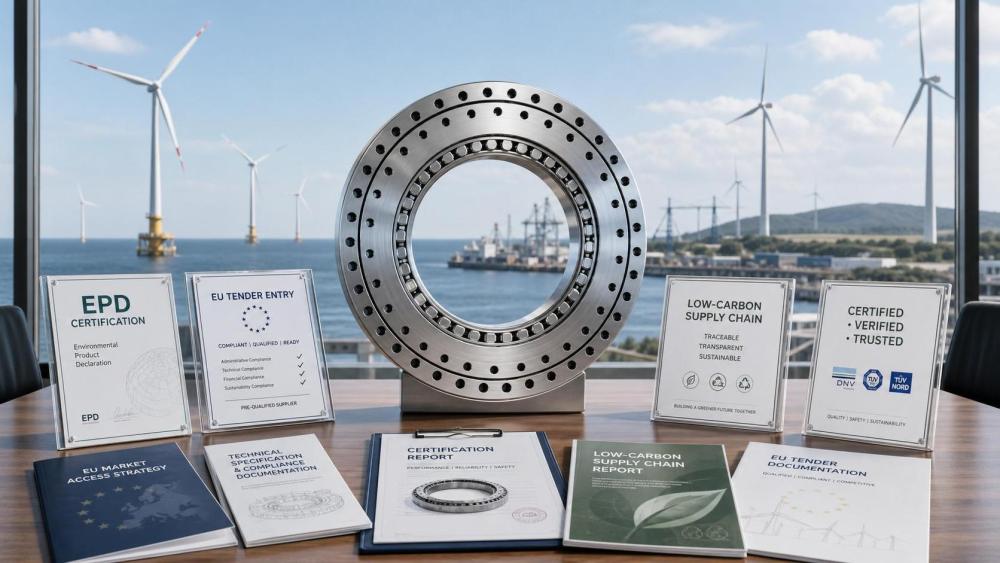
What Has Already Taken Effect in Tender Access
According to the provided information, TUV Rheinland has fully activated third-party carbon footprint declaration verification for wind turbine main shaft bearings under EN 15804+A2:2026 starting from July 1, 2026.
The same information states that tender documents for all newly built onshore and offshore wind projects within the EU have incorporated this requirement.
It is also confirmed that bearing suppliers that do not provide a certified EPD will be automatically excluded from those tenders.
Feedback cited from leading Chinese wind bearing exporters indicates that certification lead times have extended to 6-8 weeks, and overseas buyers are being advised to begin supplier carbon data coordination 12 weeks in advance.
Where the Pressure Now Appears Across the Supply Chain
For bearing exporters, market access now depends on documentation readiness
Analysis shows that the immediate exposure for export-oriented bearing manufacturers is not limited to product qualification in a general sense. The practical pressure point is tender eligibility. If a supplier cannot present a certified EPD aligned with the stated verification route, the consequence described in the provided information is direct exclusion rather than delayed supplementation. This means export sales teams, bid support teams, and compliance staff need to treat EPD readiness as a pre-bid requirement tied to delivery planning.
For project buyers and overseas procurement teams, sourcing timelines become tighter
From an industry perspective, buyers are affected because this requirement changes supplier onboarding and bid preparation timing. The reported 6-8 week certification cycle, together with the recommendation to start carbon data coordination 12 weeks in advance, suggests that procurement planning now has to account for document preparation and verification lead time earlier than before. What deserves closer attention is whether supplier selection, technical qualification review, and carbon data collection are being aligned early enough to avoid a late-stage compliance gap.
For certification and document-management functions, the burden shifts to data coordination
Observably, the rule change increases the operational importance of teams responsible for EPD preparation, supporting data collection, and document consistency. The issue is not only obtaining a certificate, but making sure carbon-related inputs, declaration materials, and tender-facing documentation are synchronized within the available window. For companies serving export projects, this may affect internal handoffs between technical, compliance, commercial, and customer-facing departments.
For supply chain service providers, delivery risk may begin before production starts
Analysis shows that logistics or delivery service providers are not the primary regulated party here, but they can still be affected when supplier qualification is delayed by missing or incomplete certified documentation. In practice, any slippage at the certification stage may feed into procurement release, production scheduling, and shipment timing. That makes document status a relevant upstream checkpoint for broader delivery coordination.
What Companies Should Watch in Current Execution
Check whether existing bid materials still meet the new entry threshold
Companies involved in EU wind project supply should review whether their current tender documentation already includes a certified EPD that matches the new requirement path described in the provided information. Where materials were prepared under earlier assumptions, the immediate concern is whether they remain acceptable once EN 15804+A2:2026-based verification has become part of tender access.
Bring carbon data preparation forward in the supplier workflow
Based on the reported extension of certification lead time to 6-8 weeks, firms should pay close attention to when supplier carbon data collection begins. The recommendation to start coordination 12 weeks in advance is especially relevant for buyers and exporters managing multiple upstream inputs, because any delay in data assembly may compress the formal verification window.
Review supplier qualification and bid calendars together
What deserves closer attention is the connection between certification timing and bid submission timing. Where procurement and sales teams treat EPD work as a parallel task rather than a gate for tender participation, the risk is not only a slower process but a lost opportunity to remain in the bidding pool. Companies should therefore examine whether certification milestones are being tracked alongside tender deadlines and technical submission requirements.
Continue monitoring how the requirement is reflected in documents and execution practice
The provided information confirms that the requirement has been embedded in tender documents, but it does not provide detailed execution language across different project files or procurement templates. For that reason, companies should continue checking how the requirement is being expressed in actual bidding documents, what supporting materials are requested, and whether any further clarification appears through certification practice or customer communication.
Why This Looks More Like an Execution Signal Than a Distant Trend
Analysis shows that this development is better understood as a live execution signal rather than a general sustainability direction. The key reason is that the requirement is described as already embedded in EU tender documents for new wind projects, with automatic exclusion attached to missing certified EPDs. That moves the issue out of long-range policy discussion and into immediate commercial qualification.
At the same time, it would be premature to treat every practical detail as settled. Observably, the market still needs to watch how certification capacity, document review expectations, and buyer-side implementation evolve in day-to-day tendering. The strongest current takeaway is that verification has become a real access condition, while the finer points of execution still warrant monitoring.
How This Update Is Best Understood Now
In practical terms, this event signals that carbon footprint documentation for wind turbine main shaft bearings has become directly tied to tender participation in the relevant EU new-build wind project context described in the provided information. For exporters, buyers, and compliance teams, the immediate issue is timing and document readiness rather than abstract policy positioning.
It is more appropriate to understand this as an implemented rule with active commercial consequences, while still keeping a close watch on how certification practice, tender wording, and market feedback continue to develop. The current message to industry is clear: certified EPD preparation is moving upstream in procurement and bid planning, and late action now carries a more visible exclusion risk.
Basis of This Article and What Still Needs Verification
This article is based on the user-provided news title, event date, and event summary. The available inputs identify the activation date, the use of EN 15804+A2:2026 by TUV Rheinland for third-party carbon footprint declaration verification on wind turbine main shaft bearings, the embedding of the requirement in relevant EU new-build wind project tender documents, the exclusion consequence for suppliers without certified EPDs, and market feedback on certification timing.
For this type of development, source categories typically worth checking include official notices, regulator or trade authority releases, industry association updates, standard organization documents, certification body communications, tender documents, and reporting by authoritative trade media. No specific official source link was provided in the input, so the exact official reference path remains to be verified on an ongoing basis.
What still requires continued observation includes any further detail on implementation wording, certification execution practice, tender document variation, market-side feedback, and how companies are adapting their compliance and delivery planning in response.
Want to dive deeper into these market dynamics, or need data-driven support for your next business move? Drop a line below and let the analysts at PCTS provide customized insights.
We respect your privacy. Your information is strictly confidential.
Related News
- 00
0000-00
How sealing technology reduces contamination in semiconductor manufacturing - 00
0000-00
Where to install vibration sensors on rotating machinery - 00
0000-00
NTSB Probe Finds Boeing Warned of MD-11 Engine Bearing Risk Years Earlier - 00
0000-00
How to size pneumatic grippers for packaging system integration - 00
0000-00
How to size alloy steel power transmission chains for heavy loads
Weekly Insights
Stay ahead with our curated technology reports delivered every Monday.