





Why offshore wind turbine bearing applications demand closer judgment
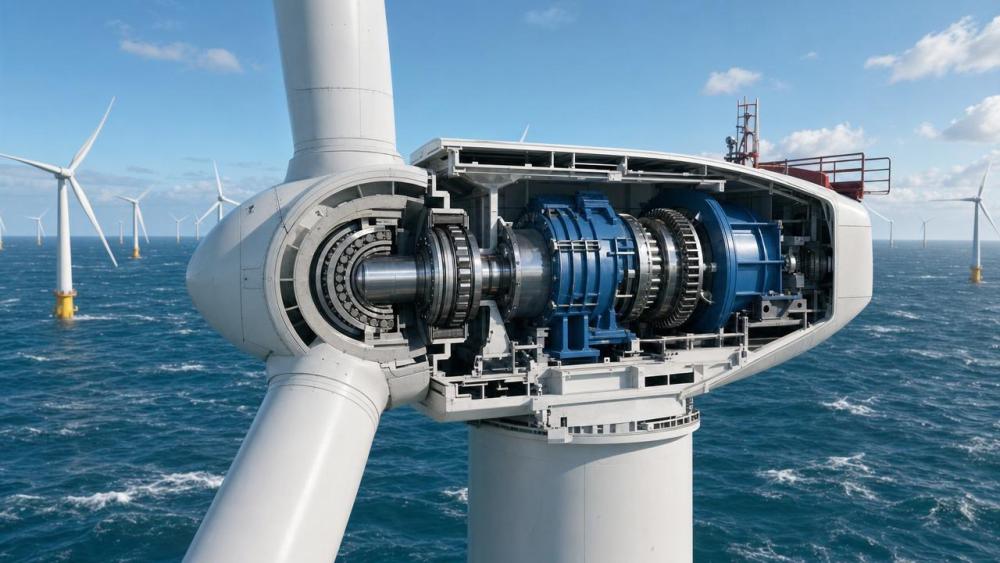
Offshore wind turbine bearing applications sit at the intersection of tribology, corrosion control, drivetrain loading, and maintenance economics.
That is why bearing selection offshore rarely works as a simple extension of onshore practice.
Salt spray, moisture ingress, pitch cycling, tower vibration, and difficult crane access reshape the real risk profile.
In practical terms, the main question is not only where a bearing fits.
It is whether the bearing can hold preload, lubrication quality, surface integrity, and sealing performance across long service intervals.
This makes offshore wind turbine bearing applications a useful lens for broader industrial reliability thinking.
PCTS often frames these issues through component interaction rather than isolated part data.
That approach matters offshore because bearings, seals, lubrication systems, condition monitoring, and replacement logistics influence one another.
Actual operating zones create very different bearing needs
Not all offshore wind turbine bearing applications face the same failure mechanisms, even within one turbine platform.
Load direction, rotational speed, oscillation angle, contamination exposure, and accessibility change the judgment criteria.
Main shaft positions favor fatigue control and load stability
Main shaft bearings see high radial loads, bending moments, and load reversals from turbulent wind and wave-induced motion.
Here, offshore wind turbine bearing applications usually focus on white etching cracks, micropitting, and lubrication film collapse.
A bearing that looks sufficient on rated load can still struggle under transient events and low-speed mixed lubrication.
Pitch systems care more about oscillation and false brinelling
Pitch bearings rotate through limited angles but face constant vibration and frequent adjustment cycles.
That combination raises the risk of fretting wear, grease displacement, and raceway indentation.
In these offshore wind turbine bearing applications, sealing and grease retention can matter more than chasing higher speed capability.
Gearbox and generator positions punish contamination faster
Gearbox and generator bearings run at different speeds, but both are sensitive to lubricant cleanliness and electrical effects.
Water ingress, particle contamination, and stray current can shorten life before obvious vibration alarms appear.
This is where bearing analysis overlaps with seals, breathers, filtration, grounding, and smart sensing.
Different offshore wind turbine bearing applications should not be evaluated the same way
A side-by-side comparison helps show why similar bearing sizes can require different engineering priorities.
The table also shows why offshore wind turbine bearing applications should be reviewed with full system context.
A bearing can be technically compliant yet poorly matched to the operating pattern around it.
Failure risks usually build from combined causes, not one isolated defect
In field service, failures offshore are often traced to several small weaknesses aligning over time.
That is why root cause work in offshore wind turbine bearing applications must stay broader than bearing geometry alone.
Corrosion and sealing gaps accelerate early damage
Salt-laden moisture reaches vulnerable zones through damaged seals, poor venting, or shutdown condensation.
Once moisture mixes with grease or oil, wear modes change quickly and inspection windows become narrow.
Transient loading defeats optimistic life calculations
Start-stop events, emergency braking, grid disturbances, and gust response can create local stress far above normal curves.
If those events are not included, offshore wind turbine bearing applications may appear safer on paper than in operation.
Lubrication practice matters as much as lubricant grade
Grease quantity, relubrication interval, purge behavior, and low-temperature pumpability all affect film formation.
The same bearing can perform very differently under disciplined relubrication and contaminated service conditions.
What to confirm before choosing a bearing strategy offshore
A useful selection process starts with application mapping, not catalog filtering.
In actual projects, these checks prevent many avoidable mismatches in offshore wind turbine bearing applications.
- Confirm whether the motion is continuous rotation, oscillation, or alternating low-speed duty.
- Review contamination paths around seals, housings, vents, and lubrication connection points.
- Check transient load cases, not only rated power conditions.
- Match coating, heat treatment, and material choices to corrosion and fatigue expectations.
- Compare replacement difficulty with expected inspection interval and vessel access limitations.
- Link bearing decisions with filtration, condition monitoring, and sealing design.
This broader view aligns with how PCTS covers rotating components across bearings, seals, transmission parts, and MRO planning.
It also improves lifecycle judgment because the true cost offshore is usually downtime plus access difficulty, not unit price alone.
Where decisions are often wrong in offshore wind turbine bearing applications
One common mistake is assuming similar turbine ratings create similar bearing needs.
In reality, foundation behavior, control strategy, wave climate, and service model can shift the dominant risk.
Another mistake is focusing on dynamic load rating while neglecting sealing, lubricant retention, and shaft alignment quality.
That shortcut often hides the real failure trigger.
It is also risky to treat offshore wind turbine bearing applications as purely mechanical issues.
Electrical discharge, sensor blind spots, hydraulic pitch behavior, and maintenance interval drift can all affect bearing life.
A final blind spot is replacement planning.
If a bearing requires difficult offshore intervention, even a moderate reliability gain can justify a different specification path.
A practical way to improve fit, risk control, and lifecycle cost
The most effective next step is to separate offshore wind turbine bearing applications by operating behavior, not by component name alone.
Then compare each location against four filters: load pattern, contamination risk, lubrication control, and replacement difficulty.
Where those filters point to uncertainty, add condition monitoring, seal review, and lubricant sampling early.
That creates a more realistic basis for supplier comparison, maintenance interval planning, and total cost evaluation.
For offshore wind turbine bearing applications, better decisions usually come from connecting bearing data with the wider transmission and MRO picture.
That is where long-term reliability becomes measurable instead of assumed.
Want to dive deeper into these market dynamics, or need data-driven support for your next business move? Drop a line below and let the analysts at PCTS provide customized insights.
We respect your privacy. Your information is strictly confidential.
Related News
- 00
0000-00
How sealing technology reduces contamination in semiconductor manufacturing - 00
0000-00
Where to install vibration sensors on rotating machinery - 00
0000-00
NTSB Probe Finds Boeing Warned of MD-11 Engine Bearing Risk Years Earlier - 00
0000-00
How to size pneumatic grippers for packaging system integration - 00
0000-00
How to size alloy steel power transmission chains for heavy loads
Weekly Insights
Stay ahead with our curated technology reports delivered every Monday.