





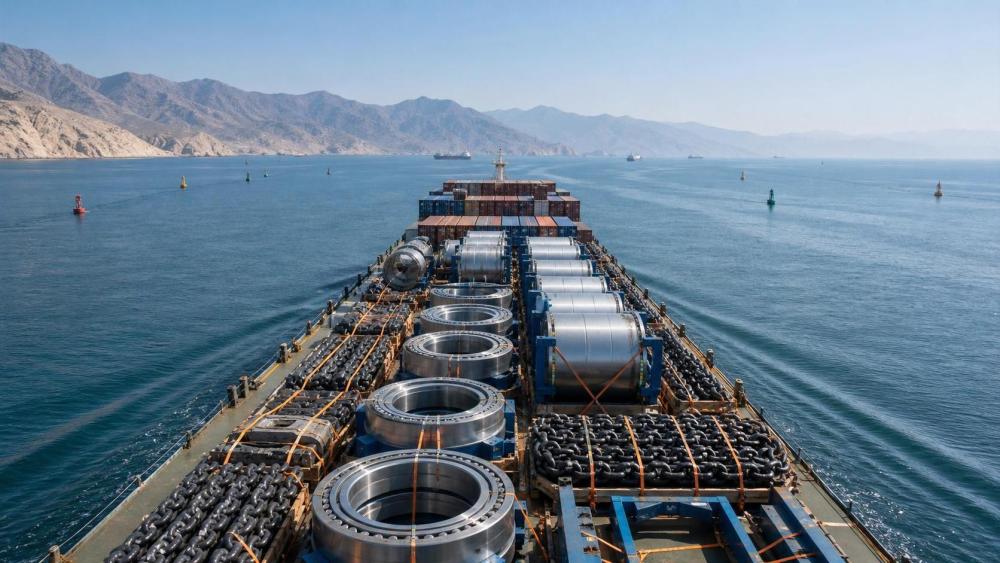
On June 20, 2026, the full activation of temporary shipping lanes in the Strait of Hormuz introduced a concrete operating change for regional maritime logistics rather than a purely political headline. Following the US-Iran agreement, Oman opened temporary northbound and southbound lanes in June 2026, while IMO launched a merchant-vessel evacuation safeguard mechanism. For exporters, carriers, buyers, and supply-chain teams handling wind power bearings, heavy roller chains, stainless steel cylinders, and other long-dimension or high-precision components, this matters because transit conditions on the Middle East-Far East route have begun to shift in ways that can affect booking decisions, delivery planning, and shipment risk management.
A confirmed operating change in the route environment
Confirmed information indicates that the temporary lanes were fully put into use on June 20, 2026. After the US-Iran agreement, Oman opened temporary dual north-south lanes in June 2026, and IMO simultaneously activated a merchant shipping evacuation protection mechanism.
The recovery in overall shipping capacity has still fallen short of expectations. Even so, average waiting time for container ships on the Middle East-Far East route has dropped by 42%.
The development is described as particularly favorable for exports of bulky, high-value cargoes, especially wind power bearings, heavy roller chains, and stainless steel cylinders, all of which typically place higher demands on cargo protection, schedule reliability, and handling precision.
Confirmed carrier-side changes are also part of the picture: Maersk and MSC have increased weekly service frequency on East China-Middle East routes and opened reservations for priority slots for precision equipment.
Where the practical impact appears first
Exporters of oversized and high-precision components
From an industry perspective, exporters are among the first to feel the change because reduced waiting time can directly influence delivery windows for cargoes that are difficult to substitute, expensive to hold in inventory, or sensitive to transport handling. The most relevant business links are shipment scheduling, vessel-space selection, and customer delivery commitments. What deserves closer attention is whether booking documents, packing lists, cargo descriptions, and technical shipment notes are aligned with carrier requirements for priority handling of precision equipment.
Procurement and project-delivery teams
Procurement teams and project coordinators may also be affected because any shortening of maritime lead time can alter purchase timing, buffer stock assumptions, and supplier coordination for project cargo or equipment sets. The practical issue is not simply faster transit, but whether purchasing and delivery plans should be adjusted only after confirming that the shorter timeline is repeatable rather than temporary. Attention should remain on order cut-off timing, delivery terms, and the consistency between shipping arrangements and project documentation.
Carriers and logistics service providers
For shipping lines and logistics intermediaries, the route change creates a more operational compliance question than a market-story question. With temporary lanes in use and an IMO safeguard mechanism in place, service providers need to track how routing, booking priorities, cargo acceptance, and contingency handling are implemented in practice. For cargoes such as bearings, heavy chains, and stainless steel cylinders, the business impact is concentrated in vessel allocation, cargo protection standards, and exception management when schedules remain uneven despite lower waiting time.
Buyers and downstream receiving parties
Buyers, distributors, and after-sales support teams may see an impact in inbound planning and installation scheduling, especially where equipment delivery is linked to project milestones or maintenance shutdown windows. Analysis shows that the key concern is not only whether cargo can arrive 5-7 days earlier, but whether receiving plans, inspection arrangements, and traceability documents remain synchronized with revised transport timing.
What companies should monitor now
Check how priority-slot rules are actually applied
It is more appropriate to understand the opening of precision-equipment priority slots as an actionable logistics signal, but not yet as a guaranteed outcome for every booking. Companies should closely monitor carrier booking terms, acceptance standards, and any operational conditions attached to priority-space reservations.
Revalidate documents tied to shipment accuracy
For long-size or high-precision exports, attention should stay on whether cargo descriptions, technical specifications, packing records, and transport handling instructions are complete and internally consistent. Observably, when transit conditions change, document quality becomes more important because carriers and customers may rely on those materials to confirm loading suitability and delivery coordination.
Adjust procurement and delivery plans cautiously
Analysis shows that a shorter route wait time does not automatically mean the entire supply chain has stabilized. Companies should therefore treat the reported 5-7 day improvement as a planning reference that still needs operational verification across orders, rather than immediately rewriting all procurement cycles or customer promises.
Keep watching execution language and market feedback
The current development should also prompt ongoing review of carrier notices, trade execution language, customer tender requirements, and any updates that affect how sensitive equipment shipments are prioritized or documented. Where input details remain limited, companies should avoid assuming that one route improvement has already produced a uniform execution standard across all shipments.
How this signal should be read at this stage
Observably, this development is best read as a tangible execution signal in maritime trade conditions rather than a complete normalization of the route. The confirmed elements point to an operational opening: temporary lanes are active, IMO has introduced a safeguard mechanism, waiting times on the route have fallen, and some carriers have already adjusted service frequency and booking options.
At the same time, analysis shows that the situation still calls for continued observation because overall capacity recovery remains below expectations. That means the industry should watch not only the existence of the lanes, but also the consistency of vessel deployment, the practical availability of priority space, and the market response from shippers of precision industrial components.
A logistics improvement, but not a final rule conclusion
The current event is significant because it links a route-management change and a maritime safeguard mechanism with real consequences for trade execution, especially for exporters of wind power bearings, heavy roller chains, stainless steel cylinders, and similar cargoes that depend on careful handling and predictable schedules.
What deserves closer attention is that this is not simply a story about faster shipping. It is more appropriate to understand it as an early-stage operational improvement with direct implications for booking strategy, delivery planning, and shipment control, while the broader stability of execution still requires observation.
Basis of this article and points still requiring verification
This article is generated based on the user-provided news title, event date, and event summary. The analysis is limited to the confirmed information provided in that input.
For events of this type, commonly relevant source categories may include official notices, regulatory releases, customs or trade-administration information, industry association updates, standard-setting documents, and reporting by established media outlets. However, no specific official source link was provided in the input, so the exact official references still need to be verified on an ongoing basis.
Further observation is still needed on implementation details, certification or compliance interpretation where applicable, tender-document changes, carrier execution practice, industry feedback, and how companies actually adjust delivery and procurement arrangements after the route change.
Want to dive deeper into these market dynamics, or need data-driven support for your next business move? Drop a line below and let the analysts at PCTS provide customized insights.
We respect your privacy. Your information is strictly confidential.
Related News
- 00
0000-00
IndexBox Forecasts 3.8% Annual Growth for Global Radial Seals Market Through 2035 - 00
0000-00
How to assess the chemical compatibility of FFKM sealing sheets - 00
0000-00
IndexBox Forecasts 3.6% Annual Growth for Construction Bearings Market - 00
0000-00
When do hydraulic components require an export license? - 00
0000-00
How to size modular pneumatic valve systems for adequate airflow
Weekly Insights
Stay ahead with our curated technology reports delivered every Monday.