





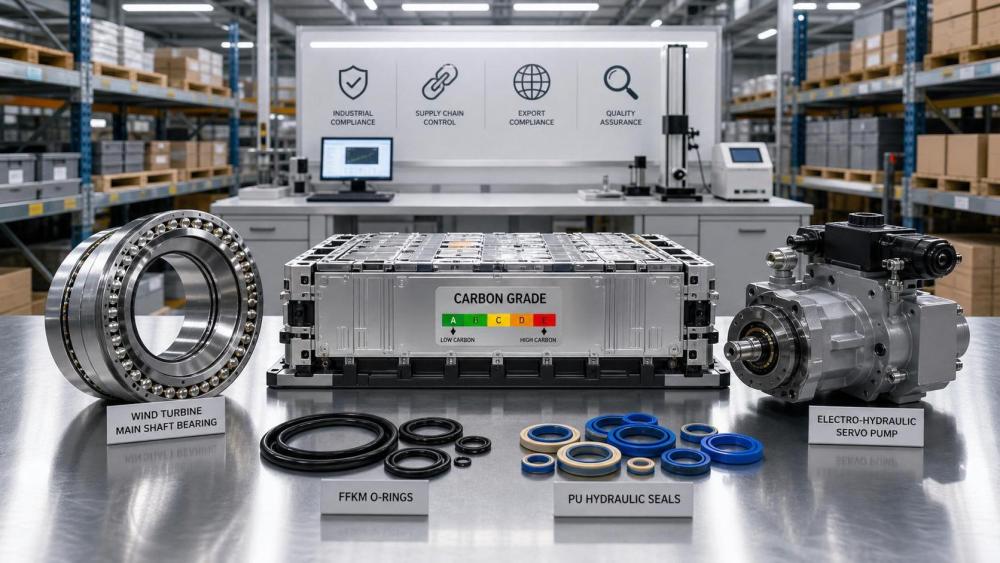
On August 18, 2026, the EU will begin enforcing carbon footprint performance grade labeling under Regulation (EU) 2023/1542 for rechargeable industrial batteries with capacity above 2 kWh, and the compliance requirement has also been extended to related system components such as wind turbine main shaft bearings, electro-hydraulic servo pumps, FFKM O-rings, and PU hydraulic seals. For exporters, manufacturers, procurement teams, and distribution channels serving the EU market, this is worth close attention because products without a certified EPD and the corresponding grade label may face customs rejection or removal from sale.
What the new requirement now covers
The confirmed information indicates that, from August 18, 2026, rechargeable industrial batteries above 2 kWh falling under Regulation (EU) 2023/1542 must carry a carbon footprint performance grade label. The requirement has been extended to supporting system components identified in the provided information, including wind turbine main shaft bearings, electro-hydraulic servo pumps, FFKM O-rings, and PU hydraulic seals. The stated compliance basis is the provision of a certified EPD together with the matching grade label. Where these materials are not provided, the products may be refused customs clearance or removed from sale in the EU market.
Where the pressure is likely to appear first
Export-facing product lines may see compliance become a shipment issue
From an industry perspective, direct trade companies shipping affected components into the EU may be the first to feel the impact because the requirement is tied not only to product characteristics but also to documentary readiness. The main business risk appears in customs handling, sales listing, and delivery execution, where missing certification or labeling could interrupt normal shipment flow.
Manufacturing and component integration teams need closer document control
Analysis shows that manufacturers of wind power and hydraulic system components may be affected at the stage where product data, environmental declarations, and product labeling need to remain consistent. For businesses supplying bearings, pumps, O-rings, or seals into larger systems, the issue is not only whether the part can be produced, but whether the part can be delivered with the required certified EPD and corresponding performance grade label.
Procurement and channel partners may face new screening thresholds
Observably, procurement teams, distributors, and channel operators serving the EU market may need to pay closer attention to supplier qualification and file completeness. The impact is likely to show up in supplier onboarding, order confirmation, and downstream sales compliance, especially where customers begin asking for proof that the label and supporting declaration are already in place before shipment.
What companies should monitor now
Watch the exact wording used in compliance practice
What deserves closer attention is the distinction between the regulation requirement itself and how it is applied in day-to-day customs clearance and market listing. Companies should track whether product descriptions, declarations, and grade labels are being requested in a uniform way across the affected categories named in the provided information.
Check whether affected product families are fully mapped
Businesses involved in wind power components and hydraulic sealing systems should review whether their exported product range includes the categories already mentioned in the event summary. This matters because the immediate issue is not broad sustainability positioning, but whether a specific shipment or stock-keeping unit falls into a category that now needs a certified EPD and grade label.
Prepare supplier files and delivery communication earlier
Analysis shows that supplier qualification documents, EPD certification status, labeling readiness, and customer communication timelines may become practical bottlenecks. Teams handling procurement, export documentation, and order fulfillment may need earlier internal checkpoints to avoid delays caused by incomplete compliance files close to shipment.
Separate policy signal from execution readiness
It is more appropriate to understand this development as both a regulatory requirement and an operational test. For companies, the key question is not only whether the rule exists, but whether internal processes are already able to support labeling, document retention, and customer-facing proof in a form accepted by the market.
How this development should be read
Observation: this is not just a narrow labeling update for batteries alone. Based on the provided information, the notable point is that the compliance expectation has reached related high-energy-use or high-embedded-carbon components in wind power and hydraulic systems. That makes the development relevant to a wider industrial supply chain than a headline reading of the battery regulation might suggest.
Observation: it is also more appropriate to understand this as an immediate compliance matter rather than a distant policy signal, because the provided summary links missing certified EPD documentation and grade labeling directly to customs rejection or removal from sale. At the same time, for broader market effects beyond the listed categories, continued verification is still necessary.
A compliance signal with wider supply-chain relevance
In practical terms, this update matters because it connects carbon footprint labeling to market access for specific industrial products and related system components. A cautious reading is that the clearest current implication lies in compliance execution, document preparedness, and supplier coordination for EU-bound business. It is more appropriate to understand this as a concrete near-term operational requirement, while continuing to monitor how broadly and consistently the extended scope is applied in actual trade and sales scenarios.
Basis of this article and points for continued verification
This article is based on the user-provided news title, event date, and event summary concerning the August 18, 2026 enforcement of carbon footprint performance grade labeling under Regulation (EU) 2023/1542 and its extension to specified supporting components. For this type of industry update, relevant source categories typically include official regulatory notices, company compliance notices, industry association releases, authoritative media reporting, and standards-related documents. No specific official source link was provided in the input, so the exact official reference path still requires ongoing verification. Follow-up attention should remain on official wording, category-specific implementation, and how EPD and labeling requirements are checked in customs and sales practice.
Want to dive deeper into these market dynamics, or need data-driven support for your next business move? Drop a line below and let the analysts at PCTS provide customized insights.
We respect your privacy. Your information is strictly confidential.
Related News
- 00
0000-00
How to check vibration analysis software for sensor compatibility - 00
0000-00
IndexBox Forecasts 3.8% Annual Growth for Global Radial Seals Market Through 2035 - 00
0000-00
How to assess the chemical compatibility of FFKM sealing sheets - 00
0000-00
IndexBox Forecasts 3.6% Annual Growth for Construction Bearings Market - 00
0000-00
When do hydraulic components require an export license?
Weekly Insights
Stay ahead with our curated technology reports delivered every Monday.