





On June 21, 2026, the European Commission issued the second-phase implementing detail for the CBAM transition period, setting a new compliance point from October 1, 2026 for selected products entering the EU. The update puts wind power bearing exporters and suppliers of industrial fluid system sealing products under closer operational scrutiny because customs filings for covered components must now include embedded carbon emissions data verified by an accredited third party, making documentation readiness and cross-border coordination an immediate practical issue rather than a background policy topic.
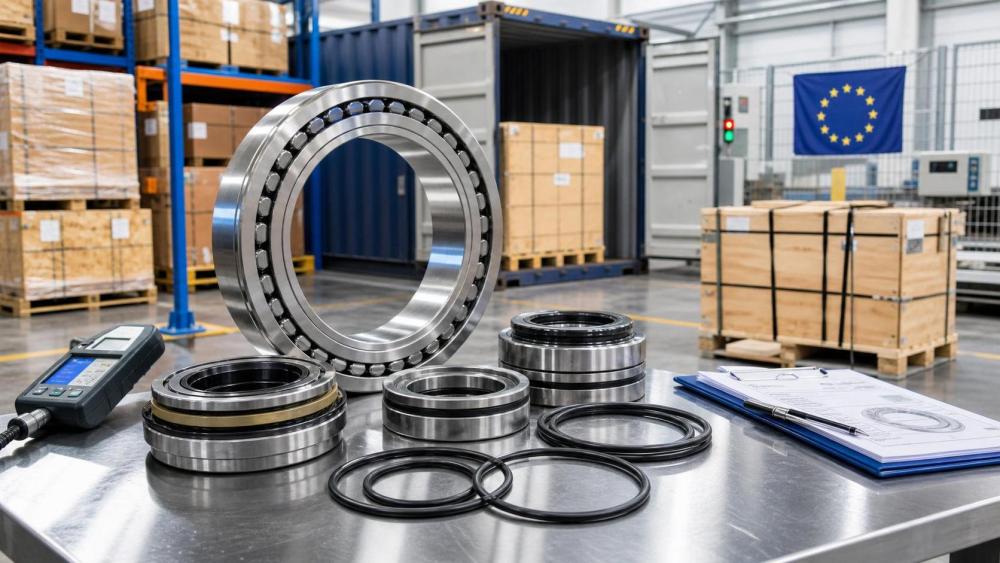
What the new requirement now covers
According to the information provided, the rule takes effect on October 1, 2026 and applies to key wind power equipment components imported into the EU, including main shaft bearings and pitch bearings, as well as sealing products used in industrial fluid systems, including PU hydraulic seals, FFKM O-rings, and mechanical seals.
The same information states that import declarations for these products must be accompanied by embedded carbon emissions data verified by an accredited third-party body. If the declaration is not compliant, customs clearance delays and additional checks may follow.
Where the pressure is likely to appear in the supply chain
Export-facing manufacturers may see compliance move into shipment execution
From an industry perspective, producers shipping covered bearings and sealing products to the EU may be affected first because the new requirement is tied to customs documentation. The practical impact is likely to show up at the point where technical product data, emissions-related records, and export paperwork must align before goods move.
Traders and distributors may need tighter document coordination
Analysis shows that companies acting as trading entities or distribution intermediaries may face pressure even if they are not the original manufacturer. Where a shipment includes covered products, they may need to confirm whether verified embedded carbon data is complete and usable in time for declaration, especially when multiple suppliers are involved.
Supply chain service providers may face greater timing risk
Observably, customs brokers, logistics coordinators, and other supply chain service roles may be affected through timing and process management. Because non-compliant filing can trigger delays and added review, document completeness may become a delivery-risk issue rather than a purely administrative one.
EU buyers may ask for earlier confirmation from suppliers
What deserves closer attention is that downstream buyers in the EU may place more emphasis on whether suppliers can provide verified carbon data alongside the goods. For covered components, procurement discussions may increasingly include documentary readiness as part of delivery assurance.
What companies should watch before October 2026
Confirm whether specific exported products fall within the covered scope
Companies should first focus on whether their shipments include the product categories named in the provided information, especially main shaft bearings, pitch bearings, PU hydraulic seals, FFKM O-rings, and mechanical seals entering the EU market.
Check verification readiness, not just internal data collection
The rule as described does not stop at self-prepared information; it requires embedded carbon data verified by an accredited third party. That means the readiness question is not only whether emissions data exists, but whether it can be validated in a form usable for customs filing.
Review handoff points between suppliers, exporters, and declarants
Analysis shows that a likely execution risk sits in document transfer. Businesses should pay attention to who prepares the emissions data, who secures third-party verification, and who finally submits the customs declaration, because gaps between these steps may affect clearance timing.
Watch for further official clarification in practical application
It is more appropriate to understand this update as a rule with immediate operational consequences but also with practical details that businesses will likely continue to monitor. Companies should therefore keep watching for later official wording, interpretive guidance, or procedural clarification related to filing and verification practice.
Why this matters beyond a single customs form
As an editorial observation, this development signals that carbon-related compliance for certain industrial components is moving closer to day-to-day trade execution. It is not only a policy headline; it connects emissions disclosure directly to whether covered goods can move through customs without added friction.
At the same time, it should not be overstated as a full picture of long-term market change based only on the information provided here. More appropriately, it can be read as a concrete short-term compliance shift and a longer-term signal that product-level carbon documentation is becoming more relevant in cross-border industrial trade.
How this update is best understood now
At this stage, the most balanced reading is that the October 1, 2026 effective date creates a clear near-term compliance checkpoint for exporters of covered wind power bearings and industrial sealing products into the EU. The immediate issue is document readiness tied to customs clearance, while the broader industry significance lies in how carbon data is becoming part of transaction execution for specific component categories.
Basis of this article
This article is based on the user-provided news title, effective date, and event summary. For this type of development, relevant source categories typically include official regulatory notices, company disclosures, industry association updates, authoritative media reporting, and standards-related documents. A specific official source link was not provided in the input, so the exact publication record should continue to be verified. Continued attention should focus on any follow-up clarification regarding scope, verification practice, and declaration procedures.
Want to dive deeper into these market dynamics, or need data-driven support for your next business move? Drop a line below and let the analysts at PCTS provide customized insights.
We respect your privacy. Your information is strictly confidential.
Related News
- 00
0000-00
How sealing technology reduces contamination in semiconductor manufacturing - 00
0000-00
Where to install vibration sensors on rotating machinery - 00
0000-00
NTSB Probe Finds Boeing Warned of MD-11 Engine Bearing Risk Years Earlier - 00
0000-00
How to size pneumatic grippers for packaging system integration - 00
0000-00
How to size alloy steel power transmission chains for heavy loads
Weekly Insights
Stay ahead with our curated technology reports delivered every Monday.