





On August 18, 2026, a new compliance point takes effect under the EU Battery and Waste Battery Regulation ((EU)2023/1542): rechargeable industrial batteries with a capacity above 2 kWh must carry a carbon footprint performance class label. For exporters tied to wind turbine equipment and related transmission systems, this matters beyond the battery itself, because procurement and market entry filings in the EU may be blocked if overseas buyers cannot obtain the required carbon data from the supply chain.
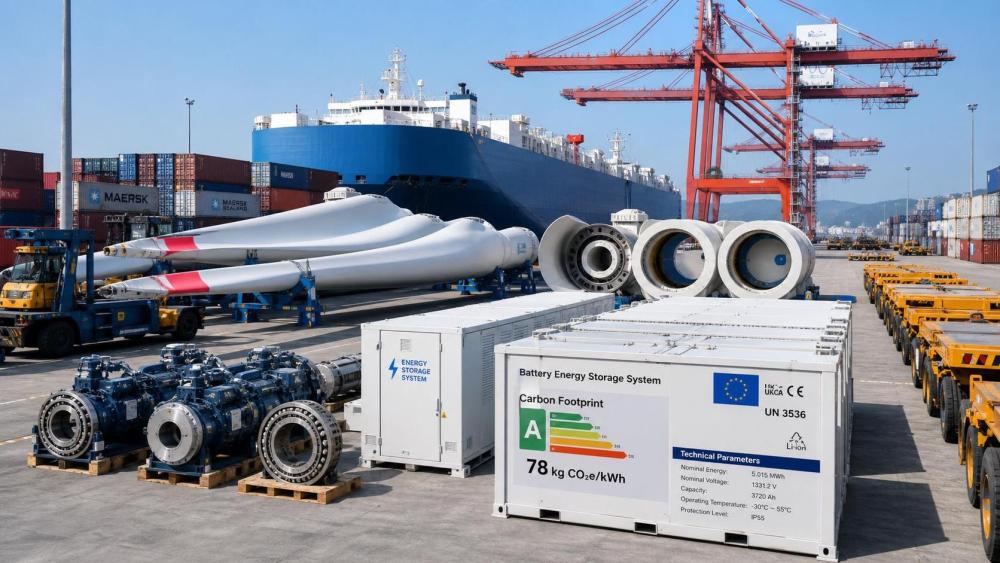
What takes effect on August 18
According to the information provided, from August 18, 2026, rechargeable industrial batteries with a capacity greater than 2 kWh are subject to a mandatory carbon footprint performance class label under the EU Battery and Waste Battery Regulation ((EU)2023/1542).
The requirement is directly connected to export compliance for wind turbine complete units and supporting transmission-related systems, including wind turbine bearings, electro-hydraulic pumps, and closed-loop hydraulics.
The same information states that if overseas buyers do not obtain the corresponding carbon data within the supply chain, they will be unable to complete EU market access declarations.
Why the impact extends beyond battery suppliers
Export-facing wind equipment suppliers
From an industry perspective, suppliers serving EU-bound wind projects may be affected because the rule links product access to the availability of carbon data. The immediate pressure is likely to appear in export documentation, customer inquiries, and pre-shipment compliance coordination rather than only in physical product delivery.
Manufacturers of bearings and hydraulic subsystems
For companies producing wind turbine bearings, electro-hydraulic pumps, and closed-loop hydraulics, the issue is not that these components are newly redefined, but that they are named in relation to export compliance risks. Analysis shows that these businesses may face closer scrutiny when customers map carbon data across the full supply chain for EU filings.
Overseas buyers and procurement teams
Buyers are also directly affected because the provided information makes clear that missing supply-chain carbon data can prevent completion of EU market access declarations. What deserves closer attention is the procurement stage: data availability may become a gating factor alongside price, delivery, and technical specifications.
Supply-chain service and compliance support roles
Observably, service providers involved in documentation, trade coordination, and supplier onboarding may see added workload where carbon-related records must be collected, checked, and aligned with customer requirements. The operational effect is likely to fall on document readiness and communication between multiple tiers of suppliers.
What companies should watch now
Whether product scope affects active EU business
Companies should first review whether their EU-facing business involves rechargeable industrial batteries above 2 kWh within wind equipment or related system deliveries. The practical question is whether existing export projects, component packages, or customer declarations already depend on this information flow.
Whether carbon data can move through the supply chain
What deserves closer attention is not only the labeling requirement itself, but also whether the corresponding carbon data can be obtained, organized, and passed to overseas buyers in time for market entry declarations. A weak handoff between suppliers and customers may create compliance friction even when commercial terms are otherwise settled.
Whether customer communication needs to change
Analysis shows that exporters may need to clarify earlier in the sales and order-confirmation process what carbon-related documents or data buyers will request. This is especially relevant where wind turbine bearings or hydraulic systems are supplied as part of broader equipment packages.
Whether official wording or implementation details evolve
The confirmed fact is the effective date and the core requirement described in the provided summary. At the same time, companies should continue monitoring official wording, customer interpretations, and any practical filing expectations, because policy language and on-the-ground compliance execution are not always identical.
How this should be understood at this stage
Observably, this development is more than a narrow battery-label update for companies connected to wind equipment exports. It signals that carbon data availability is becoming part of actual market access work, especially where EU declarations depend on information gathered across multiple suppliers.
It is more appropriate to understand this as both an immediate compliance change and a longer-term supply-chain signal. The rule already has a stated effective date, so it is not merely a distant policy discussion. At the same time, the full business impact will still depend on how buyers, suppliers, and filing processes interact in practice.
What the current signal means for the market
For the industry, the key point is not simply that a new label is required, but that export compliance for certain wind-related equipment chains may hinge on whether carbon data is accessible and transferable. That makes this development relevant to commercial teams, compliance staff, procurement functions, and subsystem manufacturers at the same time.
At present, it is more appropriate to view this as a concrete regulatory trigger with broader operational implications, rather than as a finished market outcome. The requirement is clear in direction, while its full effect on transaction pace and supplier screening still deserves continued observation.
Basis of this article
This article is based on the user-provided news title, event date, and summary regarding the EU Battery and Waste Battery Regulation ((EU)2023/1542), the August 18, 2026 effective date, the carbon footprint performance class label requirement for rechargeable industrial batteries above 2 kWh, and the stated implications for wind equipment exports and EU market access declarations.
For reporting of this kind, commonly relevant source types may include official regulatory notices, company disclosures, industry association updates, authoritative media reports, and standard or compliance-related documents. No specific official source link was provided in the input, so the precise official link remains to be verified. Continued checking should focus on formal regulatory wording, implementation details, and customer-side compliance requirements in actual EU market entry filings.
Want to dive deeper into these market dynamics, or need data-driven support for your next business move? Drop a line below and let the analysts at PCTS provide customized insights.
We respect your privacy. Your information is strictly confidential.
Related News
- 00
0000-00
How sealing technology reduces contamination in semiconductor manufacturing - 00
0000-00
Where to install vibration sensors on rotating machinery - 00
0000-00
NTSB Probe Finds Boeing Warned of MD-11 Engine Bearing Risk Years Earlier - 00
0000-00
How to size pneumatic grippers for packaging system integration - 00
0000-00
How to size alloy steel power transmission chains for heavy loads
Weekly Insights
Stay ahead with our curated technology reports delivered every Monday.