





Which Condition Monitoring Data Matters Most for Rotating Equipment?
Why does a vane pump become noisy after an oil change? The answer often lies in condition monitoring data that reveals how rotating equipment responds to changes in lubrication, pressure, alignment, and load.
For maintenance teams, the most valuable data is not always the largest data set. It is the information that identifies abnormal machine behavior early and supports a confident maintenance decision.
Vibration, temperature, lubricant condition, pressure, flow, ultrasound, and operating context each reveal different failure mechanisms. Their value depends on the asset, duty cycle, criticality, and likely fault mode.
This article explains which condition monitoring data matters most for pumps, bearings, motors, gearboxes, couplings, belts, chains, and other rotating equipment used in industrial operations.
Start With the Data That Explains Failure Risk
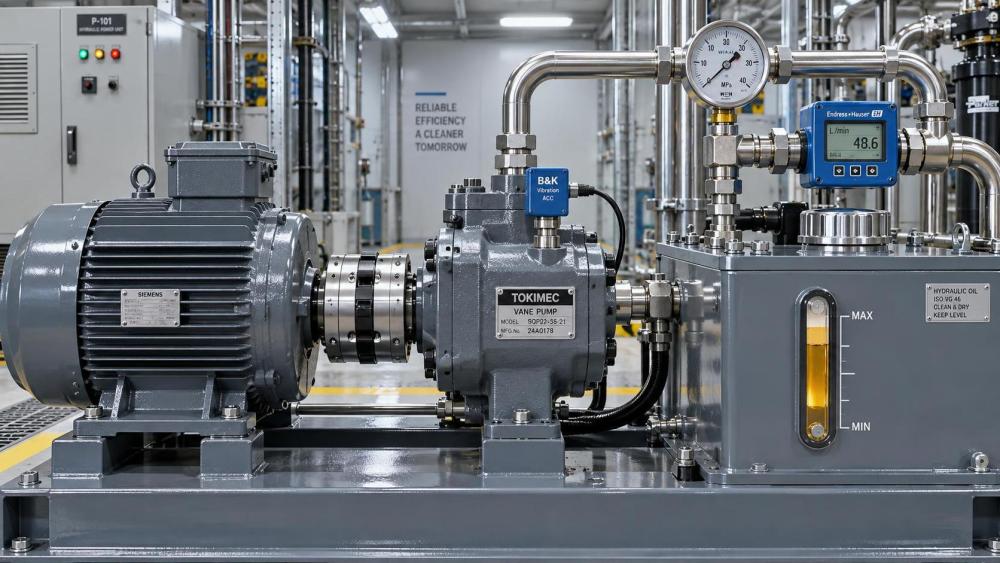
Condition monitoring should begin with a practical question: what failure would stop production, create safety exposure, damage expensive components, or increase lifecycle cost for this particular machine?
Critical rotating assets rarely fail without warning. However, warning signs may appear in different forms depending on whether the problem involves lubrication, imbalance, cavitation, contamination, overheating, or mechanical wear.
A bearing-driven fan may show vibration growth before temperature changes. A hydraulic vane pump may show noise, pressure instability, and aeration symptoms before conventional vibration limits are exceeded.
Therefore, maintenance teams should avoid collecting measurements merely because sensors are available. The priority is linking every measurement to a realistic failure mechanism and a maintenance response.
For most industrial plants, the highest-value data categories are vibration, lubricant condition, temperature, process performance, acoustic emissions, and operating context such as speed, load, pressure, and runtime.
These data sources become far more useful when reviewed together. A single alarm can indicate a concern, while several related indicators can identify the likely cause and urgency.
For example, rising bearing vibration combined with elevated lubricant particle counts suggests mechanical wear. Rising temperature alone may instead reflect increased ambient conditions, loading, or reduced cooling performance.
The goal is not perfect fault prediction in every case. The goal is earlier detection, better work planning, fewer unnecessary component replacements, and reduced risk of catastrophic equipment damage.
Vibration Data Remains the Primary Mechanical Health Signal
For bearings, motors, gearboxes, fans, pumps, and couplings, vibration monitoring remains the most broadly useful source of mechanical condition information across industrial rotating equipment fleets.
Overall vibration velocity is useful for identifying a general deterioration trend. It can reveal whether machine condition is stable, worsening gradually, or changing suddenly after maintenance intervention.
However, overall vibration alone is rarely enough for diagnosis. Spectrum analysis, waveform data, acceleration measurements, and bearing-frequency indicators provide more actionable insight into developing mechanical defects.
High-frequency acceleration and envelope analysis are especially valuable for rolling bearing defects. They can identify early raceway damage, lubrication distress, and surface fatigue before severe vibration develops.
Low-frequency vibration patterns commonly help identify imbalance, misalignment, looseness, bent shafts, soft foot conditions, and structural resonance affecting motors, pumps, fans, and transmission assemblies.
For gearbox applications, vibration frequency analysis can expose gear mesh defects, damaged teeth, eccentric gears, shaft problems, and bearing wear within enclosed transmission systems.
The most useful practice is trend-based monitoring. A machine may operate safely above a generic vibration guideline if stable, while a lower reading may demand attention if it increases quickly.
Maintenance teams should collect baseline vibration data after correct installation and commissioning. Without a reliable reference condition, it becomes harder to distinguish genuine deterioration from normal machine characteristics.
When evaluating vibration data, always compare measurements at similar speed, load, temperature, and process conditions. Changes in operating state can otherwise create misleading conclusions and false alarms.
Oil Condition Data Is Essential for Pumps, Bearings, and Gearboxes
Lubricant condition monitoring is particularly important where oil performs multiple jobs: reducing friction, transferring hydraulic power, removing heat, protecting surfaces, and carrying contamination away from components.
Oil analysis is often the fastest way to investigate why a vane pump becomes noisy after an oil change. The new oil may have incorrect viscosity, poor air-release performance, contamination, or incompatibility.
Viscosity is a critical measurement because it affects film strength, leakage, pump efficiency, bearing protection, and hydraulic response. Oil that is too thick or thin can create operational problems.
In a vane pump, excessively high viscosity can restrict inlet flow and increase suction stress. Low viscosity can reduce internal sealing, increase leakage, and weaken lubrication between moving surfaces.
Particle count measures contamination cleanliness and should be matched to the hydraulic system’s sensitivity. Fine particles can accelerate vane, rotor, cam ring, bearing, valve, and seal wear.
Water content matters because water reduces lubricity, promotes corrosion, accelerates oxidation, and damages additive chemistry. In hydraulic systems, it can also contribute to unstable control behavior and premature failures.
Air entrainment and foam characteristics deserve special attention after an oil change. Air in the oil can cause a noisy pump, erratic pressure, cavitation-like damage, reduced stiffness, and overheating.
When pump noise begins immediately after a lubricant service, inspect reservoir level, suction strainers, return-line placement, breather condition, seal integrity, and whether the system was properly bled.
Wear debris analysis can also identify whether an issue is already causing component damage. Iron, copper, chromium, aluminum, and silicon trends may point toward specific wear sources or ingested dirt.
Temperature Data Is Valuable, but Rarely Sufficient Alone
Temperature monitoring is simple, affordable, and useful for identifying excess friction, poor lubrication, overloaded motors, restricted cooling, slipping belts, damaged bearings, and hydraulic inefficiency.
Yet temperature data should usually be treated as a confirmation signal rather than a standalone diagnostic tool. Many mechanical faults produce measurable vibration changes before significant heat appears.
A bearing may run hotter because of over-greasing, under-greasing, incorrect preload, contamination, misalignment, excessive speed, or a developing raceway defect. Temperature cannot isolate these causes alone.
For hydraulic power units, rising oil temperature may indicate internal leakage, relief valve losses, blocked coolers, excessive pump pressure, wrong fluid viscosity, or a process demand change.
Infrared inspections can be useful for quick field screening, especially on bearing housings, motor terminals, couplings, belts, gearboxes, and hydraulic reservoirs. Repeatable measurement points are essential.
Permanent temperature sensors are most valuable on critical or inaccessible equipment. They can identify sustained drift and help maintenance teams distinguish gradual degradation from short-term operating variation.
Compare temperature between similar components whenever possible. A motor bearing operating ten degrees warmer than its counterpart may deserve investigation, even when both remain below an absolute limit.
Ambient temperature, load, process fluid temperature, and cooling conditions must be recorded with the measurement. Context prevents a normal seasonal or production change from becoming a false maintenance alert.
Pressure, Flow, and Power Data Reveal Hydraulic and Process Problems
Mechanical condition data becomes more powerful when paired with process data. Pumps, compressors, fans, and motors must be evaluated not only by sound and vibration, but by delivered performance.
For hydraulic vane pumps, pressure stability is particularly important. Pulsation, sudden pressure loss, delayed response, or fluctuating output can indicate air ingress, cavitation, wear, blockage, or control problems.
Flow measurements reveal whether a pump is producing the expected output at a known speed and pressure. Declining flow may indicate internal leakage, worn pumping elements, or suction restrictions.
Motor current and electrical power can show whether the driven machine is overloaded, underloaded, mechanically restricted, or operating outside its normal hydraulic or process duty point.
A noisy vane pump with normal pressure may still have a suction-side issue. A noisy pump with falling pressure and reduced flow presents a stronger case for immediate investigation.
Monitoring differential pressure across filters helps maintenance teams avoid both neglected filter blockage and premature element replacement. A blocked filter can restrict flow and contribute to pump starvation.
For belt, chain, and transmission systems, speed, torque, and power data can expose slip, overload, poor tension, worn sprockets, incorrect pulley alignment, and changing process resistance.
These measurements are especially useful for reliability managers because they connect component condition directly to production performance, energy consumption, and the cost of operating with degraded equipment.
Acoustic and Ultrasound Signals Help Find Early Fluid and Friction Issues
Sound is often the first symptom noticed by operators. A new whine, growl, hiss, rattle, or rhythmic knock can provide valuable information when captured systematically rather than dismissed.
Acoustic monitoring is highly relevant when investigating a vane pump that becomes noisy after an oil change. The sound may indicate aeration, cavitation, suction restriction, or abnormal internal contact.
Ultrasound tools can detect early bearing lubrication issues, compressed-air leaks, steam leaks, electrical arcing, valve problems, and friction events that may not appear clearly in standard vibration readings.
For slowly rotating bearings, ultrasound can be more sensitive than conventional vibration measurements. It can identify changes in friction or lubricant film condition at a relatively early stage.
Acoustic data works best when measurements are repeatable. Use a consistent sensor location, distance, machine state, and recording method so that changes represent equipment condition rather than test variation.
Machine-learning tools can classify sound patterns, but they require good baseline data and reliable labels. Plants should not depend on automated diagnosis without confirming likely fault mechanisms in the field.
Operator observations should be incorporated into the monitoring program. Experienced operators often recognize subtle differences in sound, startup behavior, response time, and machine feel before formal alarms are triggered.
A practical approach is to document reported noise with operating pressure, oil temperature, recent maintenance history, fluid batch information, and recorded vibration readings before replacing major components.
Operating Context Determines Whether an Alarm Is Meaningful
Condition data without operating context can lead to poor maintenance decisions. Every meaningful trend should be interpreted against speed, load, pressure, temperature, product, runtime, and maintenance history.
A pump may vibrate differently during low-pressure circulation than during peak production demand. A motor current increase may be normal during product changeover but concerning during stable operation.
Maintenance records are a form of condition data. Oil changes, filter replacements, bearing installations, alignment work, seal replacements, and software changes often explain sudden shifts in measurements.
When a vane pump becomes noisy after an oil change, the timing itself is critical evidence. It narrows the investigation toward fluid selection, contamination control, air ingress, filling practices, and suction conditions.
Asset criticality also affects monitoring priorities. A small standby fan may need periodic route-based checks, while a production-critical hydraulic power unit may justify continuous vibration, pressure, and oil monitoring.
Failure consequence should guide sensor investment. Equipment linked to safety, environmental containment, expensive product loss, or extended production outages deserves deeper monitoring and faster escalation procedures.
Maintenance teams should define alarm actions before alarms occur. Every threshold should lead to a clear response, such as recheck, inspect lubrication, verify alignment, sample oil, reduce load, or schedule repair.
Without defined actions, condition monitoring becomes a reporting exercise. With clear workflows, it becomes a reliability tool that improves planning, reduces emergency work, and protects spare-parts availability.
Build a Practical Monitoring Plan for Each Asset Class
There is no universal sensor package for every rotating asset. The right program combines condition data with asset criticality, failure history, accessibility, component cost, and available maintenance capability.
For rolling bearing applications, begin with vibration trends, temperature, lubrication condition, and periodic ultrasound where appropriate. Add continuous sensing for high-speed, critical, or difficult-to-access machinery.
For hydraulic pumps, prioritize fluid cleanliness, viscosity, water content, pressure stability, flow performance, suction conditions, temperature, and acoustic or vibration trends linked to pump operation.
For gearboxes, combine vibration spectrum analysis with lubricant wear debris, oil condition, temperature, and load data. Gear mesh trends become more meaningful when operating torque is known.
For motors and coupled systems, evaluate vibration, electrical current, bearing temperature, alignment condition, soft foot, coupling condition, and driven-equipment load rather than examining the motor in isolation.
For chains, belts, and conveyor drives, use visual inspection, elongation or tension checks, alignment verification, thermal scans, motor current, speed trends, and observations of noise or vibration.
Start with a limited number of high-value measurements and establish trustworthy baselines. Expanding a monitoring program is easier after teams demonstrate that findings produce measurable maintenance or production benefits.
Data quality matters more than dashboard complexity. Correct sensor installation, repeatable routes, calibrated instruments, clear naming conventions, and disciplined follow-up produce better outcomes than excessive data volume.
Use Condition Data to Make Better MRO and Procurement Decisions
The business value of condition monitoring extends beyond fault detection. It helps maintenance and procurement teams decide what to stock, when to replace components, and where supplier quality affects reliability.
Reliable trends support condition-based replacement instead of calendar-based replacement. This can prevent both premature disposal of usable components and costly operation beyond a safe service interval.
Oil analysis may reveal that repeated pump failures are caused by contamination control weaknesses rather than poor pump quality. That finding changes the required investment from replacement inventory to filtration improvement.
Vibration data may show that bearing failures originate from misalignment, structural looseness, or improper mounting. In those cases, buying premium bearings alone will not solve the root problem.
Supplier evaluation should include technical documentation, material compatibility, lubrication requirements, allowable contamination levels, sensor options, repairability, warranty conditions, and evidence from comparable applications.
For global industrial buyers, total cost of ownership matters more than purchase price. Monitoring data can quantify downtime exposure, energy loss, maintenance labor, spare-part consumption, and asset-life extension.
Condition records also improve communication between operations, maintenance, engineering, and suppliers. Decisions become easier to defend when they are supported by time-stamped trends rather than isolated opinions.
The most effective programs translate data into plain business choices: continue operating, inspect soon, schedule a shutdown, correct an operating condition, replace a component, or redesign the system.
Conclusion: Focus on Connected Data, Not Isolated Readings
The condition monitoring data that matters most is the data that identifies a credible failure mechanism and supports a timely maintenance decision for a specific rotating asset.
Vibration remains central for mechanical faults, while oil condition is indispensable for hydraulic pumps, bearings, and gearboxes. Temperature, pressure, flow, ultrasound, and operating context complete the diagnostic picture.
When asking why a vane pump becomes noisy after an oil change, do not focus only on the noise. Check viscosity, cleanliness, air release, water content, suction conditions, pressure behavior, and maintenance history.
For industrial reliability teams, the strongest approach is to establish baselines, trend the most relevant indicators, connect data sources, and define clear actions before equipment condition reaches a failure point.
Want to dive deeper into these market dynamics, or need data-driven support for your next business move? Drop a line below and let the analysts at PCTS provide customized insights.
We respect your privacy. Your information is strictly confidential.
Related News
- 00
0000-00
How sealing technology reduces contamination in semiconductor manufacturing - 00
0000-00
Where to install vibration sensors on rotating machinery - 00
0000-00
NTSB Probe Finds Boeing Warned of MD-11 Engine Bearing Risk Years Earlier - 00
0000-00
How to size pneumatic grippers for packaging system integration - 00
0000-00
How to size alloy steel power transmission chains for heavy loads
Weekly Insights
Stay ahead with our curated technology reports delivered every Monday.