





At 2:15 a.m., a packaging line begins to sound slightly different. The bearing housing is warmer than usual, a hydraulic power unit takes longer to build pressure, and the drive motor shows a vibration pattern that would be easy to miss during a busy shift. None of these signs necessarily triggers an alarm in a conventional maintenance program. Yet together, they may be the opening stage of a failure that stops production later in the week.
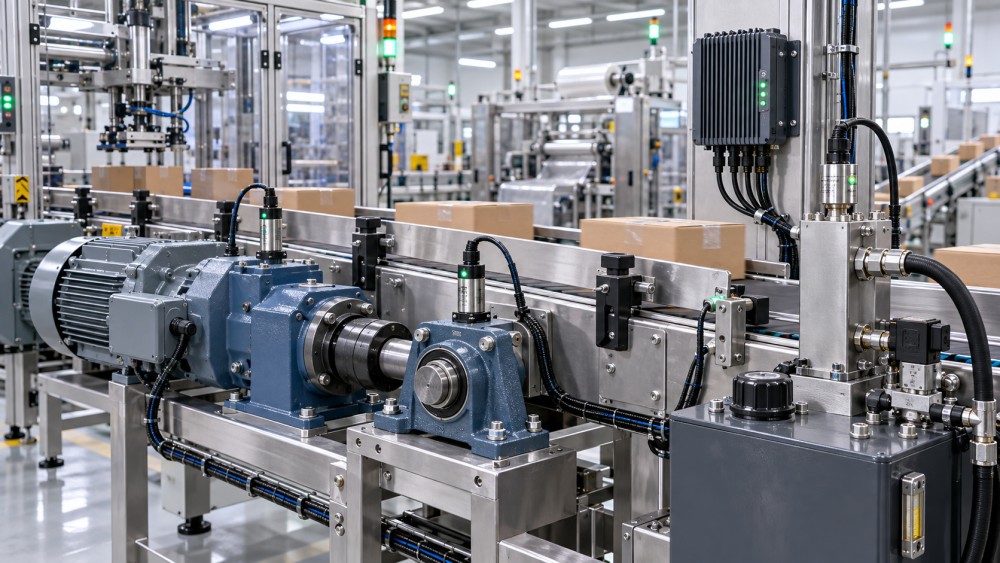
For after-sales maintenance teams, this is where edge computing diagnostics change the conversation. Instead of sending every vibration waveform, pressure reading, temperature signal, and acoustic event to a remote server for later review, edge devices process relevant data at or near the machine. The result is not simply “more data.” It is faster, more usable evidence about what is happening inside a bearing, hydraulic circuit, pneumatic actuator, chain drive, gearbox, seal system, or conveyor transmission.
Unplanned downtime rarely comes from one dramatic event. More often, it grows from small deviations that were not connected early enough: a lubrication interval that no longer fits the operating load, a pressure loss mistaken for a control issue, a coupling misalignment hidden behind stable average vibration values, or a seal beginning to admit contaminants into a critical assembly. Localized diagnostics help maintenance personnel see those deviations while there is still time to plan a repair rather than react to a shutdown.
Why the location of diagnosis matters
Cloud platforms remain valuable for fleet reporting, long-term trend analysis, supplier support, and multi-site comparisons. However, a machine does not always have the luxury of waiting for data to travel, be stored, processed, and returned as an actionable recommendation. Industrial equipment may also operate in areas with unstable connectivity, strict cybersecurity requirements, or limited bandwidth.
Edge computing diagnostics place analysis closer to the source. A sensor node, industrial gateway, controller-integrated application, or rugged local computer can filter raw signals and assess conditions in real time. It may calculate vibration envelopes, detect pressure decay, identify abnormal motor current signatures, compare operating states, or trigger a focused alert when a defined pattern appears.
This distinction matters most when the maintenance decision is time-sensitive. If a spindle bearing begins to generate high-frequency impact energy during a critical production run, the maintenance team needs to know whether the condition calls for immediate load reduction, an inspection during the next changeover, or a planned bearing replacement. A dashboard showing only a delayed average temperature may not provide enough confidence to make that call.
Local processing also reduces the burden of transmitting raw high-frequency data continuously. Rather than uploading every second of a vibration signal, the system can retain diagnostic features, event recordings, and exception data. That preserves useful evidence while making condition monitoring more practical across a large installed base of pumps, motors, conveyors, compressors, gearboxes, and automated handling equipment.
The failures that become visible earlier
Edge-based diagnosis is especially useful where normal operating variation can hide the beginning of a mechanical or fluid-power problem. Maintenance teams should not expect one sensor to solve every reliability issue. The value comes from combining the right measurement with machine context: speed, load, temperature, duty cycle, product type, pressure demand, lubrication state, and recent service history.
Bearing and rotating-equipment degradation
Bearings often give warning signs before catastrophic failure, but those signs can be subtle. A rising overall vibration level may indicate imbalance, looseness, misalignment, or a developing bearing defect. Edge analytics can go further by identifying changes in frequency bands associated with inner race, outer race, rolling element, or cage-related events. It can also distinguish a transient impact from a recurring pattern that follows shaft speed.
For after-sales teams, this improves the quality of the service visit. Instead of arriving with a general report that says “high vibration,” technicians can review operating conditions, alarm history, and captured event data before attending site. They can bring likely spare bearings, seals, lubrication tools, alignment equipment, or replacement couplings. This does not eliminate inspection; it makes inspection more targeted.
Hydraulic pressure loss and pump condition
A hydraulic system can lose performance long before it stops. Internal leakage, worn pump elements, contaminated fluid, sticking valves, air ingress, and cylinder seal damage may all produce pressure instability, increased cycle time, temperature rise, or abnormal pump behavior. Looking at one pressure value at one moment is rarely enough.
With edge computing diagnostics, pressure and flow trends can be evaluated against the machine’s actual operating phase. A system may be healthy at idle but fail to maintain pressure during clamp, lift, injection, or heavy-load movement. Local algorithms can flag unusual pressure decay after a hold command, repeated recovery delays, or a changing relationship between pump speed and delivered pressure. These are meaningful clues for diagnosing whether the problem is likely hydraulic, mechanical, electrical, or control-related.
Pneumatic leakage and actuator inconsistency
Compressed air losses are often treated as an energy issue, but they can also become a reliability issue. A leaking circuit may slow an actuator, reduce gripping force, create inconsistent end-of-stroke timing, or force a compressor to cycle excessively. In high-speed automation, a minor delay can cause rejects, jams, or intermittent faults that are difficult to reproduce during a planned inspection.
Edge devices can compare cylinder cycle time, supply pressure, valve response, and repeated motion patterns at the machine level. When an actuator that normally completes a stroke within a stable range starts drifting only under certain loads, technicians gain a clearer reason to inspect fittings, tubing, valve islands, piston seals, cushioning adjustment, or mechanical binding.
Transmission faults before a line stops
Chain elongation, belt slip, sprocket wear, coupling misalignment, and gearbox distress do not always create a single obvious alarm. A conveyor may continue moving while tracking poorly. A belt-driven fan may retain speed but consume more power. A chain drive may develop irregular motion only at a particular load point.
Edge diagnostics can correlate speed feedback, motor current, vibration, temperature, and start-stop behavior. That correlation is important. A temperature increase alone may reflect ambient conditions; a temperature increase combined with changing motor current and shaft-frequency vibration is more persuasive. The maintenance team can then schedule tension adjustment, alignment work, lubrication review, or component replacement before damaged transmission parts affect upstream and downstream processes.
From alarm fatigue to decisions that technicians can use
Many maintenance teams are understandably skeptical of monitoring projects because they have seen alarm systems that generate noise without guidance. If every temperature fluctuation becomes an alert, people stop trusting the system. If the alert does not identify the equipment state, likely failure mode, severity, and recommended next check, it becomes another item in an already crowded inbox.
Effective edge computing diagnostics should be designed around decisions, not sensor counts. A useful alert answers practical questions:
- What asset or component is affected?
- What operating condition was present when the anomaly appeared?
- Is the condition worsening, stable, or intermittent?
- What evidence supports the diagnosis: vibration feature, pressure decay, thermal change, current signature, or cycle-time shift?
- How soon should the equipment be inspected, and what should the technician check first?
Severity should reflect consequence as well as signal strength. A mild bearing anomaly on a redundant fan may justify routine observation. The same anomaly on a high-speed spindle, main hydraulic pump, or single-point conveyor drive may require a planned intervention at the earliest safe window. This prioritization is where local diagnostics become connected to maintenance economics rather than remaining a technical experiment.
A practical deployment path for after-sales maintenance teams
The best starting point is usually not a factory-wide sensor rollout. Begin with assets that combine high downtime impact, recurring service demand, expensive spare parts, difficult access, or known failure patterns. This might include critical pump skids, gearbox-driven conveyors, precision spindles, hydraulic presses, large fans, automated palletizers, or sealing systems operating in high-temperature or chemically demanding environments.
Before selecting hardware, define the failure questions. For example: Can we detect early bearing damage on this motor-pump assembly? Can we distinguish a blocked filter from internal leakage? Can we identify a pneumatic cylinder whose cycle performance is degrading? Can we capture the event that occurs only during a high-load transition? The measurement method should follow the failure mode, not the other way around.
A small pilot should include a baseline period. Machines are not identical, even when they share the same model number. Installation quality, load profile, lubrication practice, product mix, ambient temperature, and operator behavior all influence normal signals. A baseline helps prevent rigid thresholds from misclassifying ordinary variation as a fault.
It is also important to define who owns each response. The service technician may validate a mechanical diagnosis, the controls engineer may review automation signals, and the reliability planner may decide when the work order is released. When ownership is unclear, even good diagnostics can stall between departments.
Connect findings to the maintenance workflow
Diagnostics create value only when they change the next action. The local system should feed a practical workflow: alert review, verification, inspection task, spare-parts check, service scheduling, repair record, and post-repair confirmation. If a hydraulic pump shows progressive pressure instability, the work order should reference the observed operating phase and suggest checks such as fluid cleanliness, suction condition, filter differential pressure, valve leakage, pump case drain, or cylinder seal condition where relevant.
For component suppliers and OEM after-sales organizations, this link is equally important. Diagnostic insight can improve spare-parts forecasting without forcing customers into unnecessary replacements. A flagged bearing condition may justify reserving the correct bearing, seal, locknut, lubricant, and installation tools for the next shutdown. A recurring pneumatic issue may reveal that a seal kit, valve assembly, or tubing specification needs to be available locally.
What edge computing does not replace
Local diagnostics are not a substitute for sound mechanical practice. A sensor cannot correct poor alignment, contaminated lubricant, improper shaft fit, excessive belt tension, damaged hose routing, or an incorrectly selected seal material. It also cannot compensate for incomplete asset records or a maintenance team that has no feasible window to act on findings.
Nor should teams treat a diagnostic result as an automatic verdict. Edge models, rules, and thresholds need validation against physical inspection. A vibration anomaly may be caused by a bearing defect, but it may also reflect structural resonance, looseness, a mounting problem, or a process change. The technician’s experience remains essential, particularly in mixed-age equipment fleets where installation history is imperfect.
Cybersecurity and data governance deserve equal attention. Edge devices should be segmented appropriately, access-controlled, maintained with approved software updates, and integrated according to site IT and operational technology policies. The goal is to bring intelligence closer to the equipment without introducing an unmanaged connection into a critical production environment.
How to judge whether the approach is working
The clearest measure is not the number of alerts generated. Look instead at whether the team is finding defects earlier, reducing emergency callouts, avoiding secondary damage, improving planned-work completion, and arriving at service visits with better preparation. A useful program should also reveal where routine preventive tasks are too frequent, too generic, or focused on the wrong components.
Review every confirmed event. Did the system identify a real condition? Was the warning early enough to plan work? Did the diagnosis point technicians toward the right inspection? Was the required bearing, hydraulic seal, coupling, belt, chain, or valve available? These reviews gradually improve thresholds, diagnostic logic, spare-parts strategy, and confidence across the maintenance organization.
Unplanned downtime will never disappear entirely. Industrial systems operate under load, contamination, thermal stress, vibration, and human variability. But edge computing diagnostics give after-sales maintenance teams a more immediate view of the machine’s condition at the point where failure begins. When that information is tied to skilled inspection, realistic service planning, and the right MRO components, maintenance shifts from responding to a stopped machine toward protecting the next available production window.
Related News
- 00
0000-00
Where are axial piston pumps used in mining equipment? - 00
0000-00
Embodied AI Robotics and Drive Control Forum Held in Shanghai - 00
0000-00
How does seal service life affect the total cost of ownership? - 00
0000-00
Schaeffler to Cut 3,460 Jobs and Close Five European Plants - 00
0000-00
How does system size affect the price of a belt drive system?
Weekly Insights
Stay ahead with our curated technology reports delivered every Monday.