





Why Early Vibration Changes Matter Before Machines Actually Fail
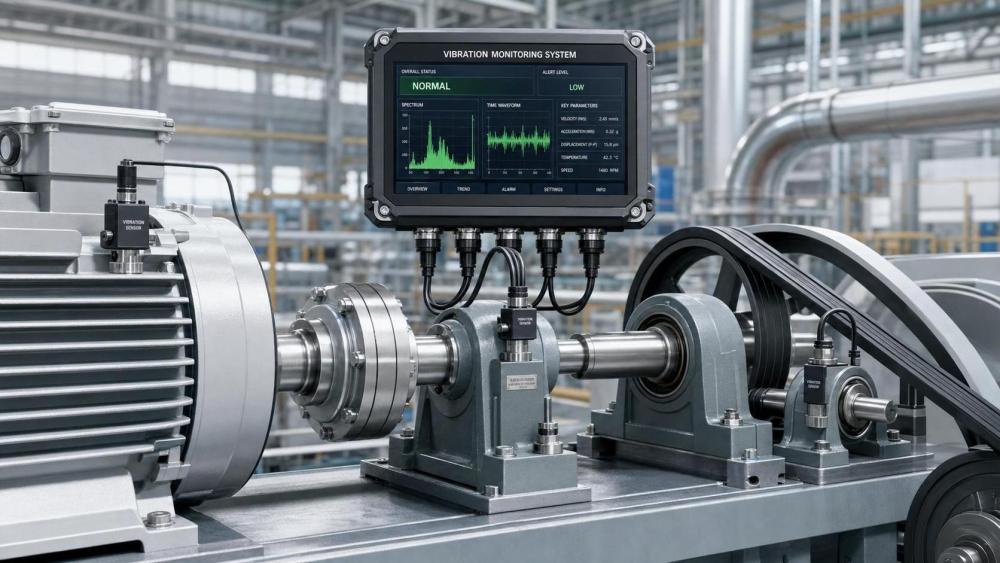
Breakdowns rarely begin with one dramatic event. In most industrial systems, failure starts as a small shift in vibration, temperature, or load behavior.
That is why online vibration monitoring systems have become more than a maintenance accessory. They help expose hidden mechanical change while equipment still appears productive.
Across bearings, hydraulic drives, belt transmission lines, couplings, chains, and sealed rotating assemblies, the same lesson appears repeatedly. Small signals often arrive long before downtime does.
In practical use, the real value is not just data collection. It is the ability to tell whether a rising vibration pattern means normal variation, process instability, or a developing fault.
This matters in a market where reliability, component life, MRO timing, and total ownership cost are connected. A bearing issue can become a shaft issue, then a seal issue, then a shutdown.
For platforms focused on precision components and transmission systems, vibration data is useful because it links mechanical condition with service planning, spare parts logic, and operating risk.
Different Operating Conditions Change What Online Vibration Monitoring Systems Need to Detect
Not every machine produces the same vibration story. A high-speed spindle, a hydraulic power unit, and a conveyor drive may all show abnormal signals for different reasons.
The judgment point changes with speed range, load variation, mounting stiffness, lubrication method, contamination risk, and process criticality. That is where many monitoring projects succeed or fail.
In a stable rotary application, online vibration monitoring systems often focus on trend clarity and fault progression. In variable-load equipment, context matters as much as the amplitude itself.
A system installed on rolling bearings in clean, constant-speed service can use simpler alarm logic. The same thresholds may be misleading in pumps, compressors, or mobile hydraulic assemblies.
More advanced setups combine vibration with temperature, speed, pressure, and operating state. That approach is especially useful where fluid power, transmission behavior, and sealing performance interact.
A quick comparison helps clarify the difference
In Rotating Bearing Assemblies, the Earliest Warnings Are Usually Subtle
Bearing applications are where online vibration monitoring systems often show their clearest value. Defect growth usually starts as a trend, not an emergency alarm.
A slight change in envelope data may suggest lubrication film loss. A repeating frequency line may point to raceway damage. Broadband growth may indicate contamination or mounting looseness.
In real operating environments, it is rarely enough to know that vibration increased. The more useful question is whether the change follows speed, load, or a specific bearing element frequency.
That distinction affects service decisions. If the pattern suggests lubrication degradation, intervention may be short and localized. If defect frequencies are rising, replacement planning becomes more urgent.
This is especially relevant for spindle bearings, wind turbine bearings, and other precision components where secondary damage can multiply quickly once surface fatigue begins.
Fluid Power Equipment Creates a Different Monitoring Challenge
Hydraulic and pneumatic equipment do not behave like simple constant-speed rotating assets. Pressure pulses, valve actions, and intermittent cycles can distort the signal picture.
In these systems, online vibration monitoring systems work best when vibration is interpreted with process state. A pump at low demand and the same pump at peak pressure should not share one alarm rule.
A hydraulic motor may show vibration growth from cavitation, coupling wear, or foundation looseness. Without pressure and flow context, those conditions are easy to confuse.
The same applies to cylinders and pneumatic actuators with repetitive motion. Impacts, end-stop behavior, and mounting compliance may look abnormal unless the monitoring logic reflects the motion profile.
Where fluid power performance and mechanical transmission overlap, condition monitoring becomes more valuable. It helps determine whether a problem begins in the power source or in the driven component.
Chains, Belts, and Couplings Need Trend Interpretation More Than One-Time Readings
Transmission components often fail through progressive wear rather than sudden fracture. That makes online vibration monitoring systems useful for detecting deterioration before efficiency visibly drops.
On belt-driven lines, abnormal vibration may reveal pulley misalignment, belt slip, or uneven tension. On chain systems, the signal may reflect sprocket wear, elongation, or lubrication inconsistency.
Flexible couplings create another common case. A coupling can mask misalignment for a period, while the connected bearings absorb the long-term consequence.
That is why trend history matters more than isolated snapshots. A single acceptable reading does not rule out a problem that appears only during startup, peak load, or shift changes.
In many MRO settings, this is where remote monitoring supports better parts planning. It helps avoid replacing belts, chains, or couplings on fixed schedules that ignore real wear behavior.
What Usually Gets Misread During Implementation
One frequent mistake is assuming similar machines need identical thresholds. Two pumps with the same nameplate may produce very different baselines because of mounting, piping stress, or duty pattern.
Another mistake is watching only overall vibration values. Early-stage defects often appear first in frequency content, kurtosis, envelope trends, or operating-state deviation.
Some installations also focus too much on sensor specification and too little on placement. Poor mounting location can hide bearing damage or exaggerate structural resonance.
There is also a cost misconception. Low purchase cost may look attractive, yet missed faults, false alarms, and manual verification time can raise lifecycle cost quickly.
- Do not compare assets only by model number. Compare duty cycle, mounting, lubrication, and environmental contamination.
- Do not treat online vibration monitoring systems as standalone tools when load, speed, and temperature strongly influence signal meaning.
- Do not assume a clean commissioning baseline remains valid after process, tooling, or throughput changes.
Choosing the Right Fit Depends on Maintenance Reality, Not Feature Lists Alone
The better selection approach starts with failure mode and intervention window. If a component degrades slowly, trended alerts may be enough. If failure escalates rapidly, deeper diagnostics are needed.
Online vibration monitoring systems should also match the service model. Some sites need local alarms for immediate response. Others benefit more from centralized analysis across many distributed assets.
Where bearings, seals, drives, and hydraulic units interact, integration has practical value. It creates one condition picture instead of isolated maintenance signals from separate component groups.
A useful evaluation framework often includes these checks:
- Which fault develops first in this asset: imbalance, looseness, lubrication loss, cavitation, or alignment drift?
- How much time exists between first signal change and unacceptable production risk?
- What supporting data is required to avoid false interpretation?
- Can maintenance actions be scheduled around the process, or must alerts trigger immediate inspection?
- Will spare parts strategy change once real condition data becomes available?
This kind of assessment is more useful than comparing systems only by sensor count, dashboard appearance, or communication protocol.
A Practical Next Step Is to Build Monitoring Around the Most Consequential Failure Paths
The strongest use of online vibration monitoring systems begins with asset grouping, not blanket installation. Start where failure creates expensive downtime, quality loss, or secondary component damage.
Then compare operating conditions, likely fault modes, and response time requirements. That process usually reveals that high-speed bearings, hydraulic drives, and transmission assemblies need different alarm logic.
From there, define sensor locations, baseline periods, supporting process data, and maintenance decision rules. Those steps turn monitoring from passive data collection into a working reliability tool.
For industrial environments shaped by bearings, fluid power, seals, and mechanical transmission, the value is straightforward. Earlier visibility into machine condition supports better timing, better parts decisions, and fewer avoidable failures.
The next move is usually not broader data collection. It is a clearer map of which applications need attention first, what signals matter most, and how each operating scenario should be judged.
Want to dive deeper into these market dynamics, or need data-driven support for your next business move? Drop a line below and let the analysts at PCTS provide customized insights.
We respect your privacy. Your information is strictly confidential.
Related News
- 00
0000-00
How sealing technology reduces contamination in semiconductor manufacturing - 00
0000-00
Where to install vibration sensors on rotating machinery - 00
0000-00
NTSB Probe Finds Boeing Warned of MD-11 Engine Bearing Risk Years Earlier - 00
0000-00
How to size pneumatic grippers for packaging system integration - 00
0000-00
How to size alloy steel power transmission chains for heavy loads
Weekly Insights
Stay ahead with our curated technology reports delivered every Monday.