





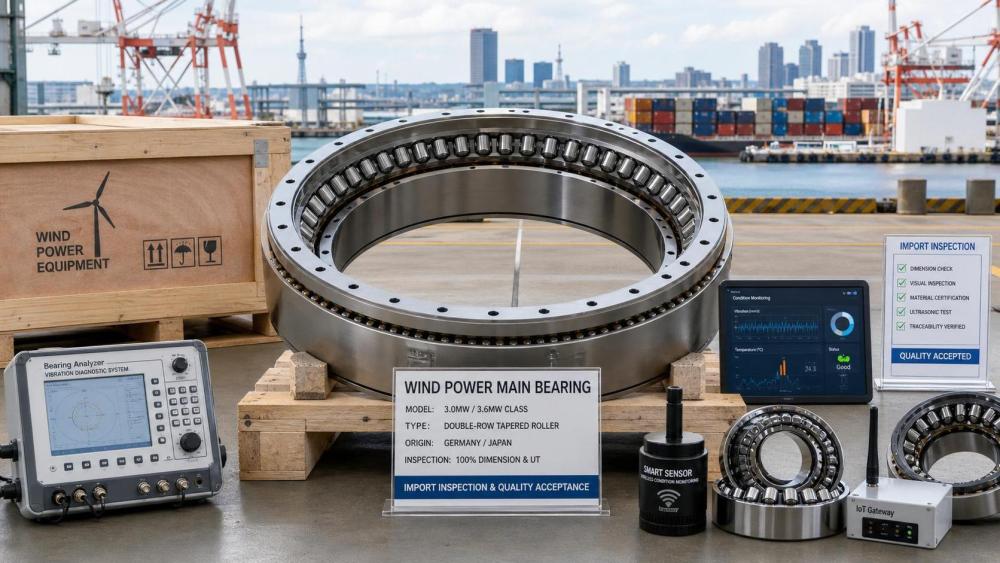
Japan’s first-week feedback after the mandatory rollout of JIS B 1556:2026 on July 1, 2026 has drawn attention across the wind power supply chain. Preliminary monitoring data released by NEDO on July 12 shows that 12% of imported wind turbine main shaft bearings were rejected at Tokyo Port inspection for failing to meet the Z2 vibration requirement of RMS ≤ 0.28 mm/s. The development matters not only for bearing exporters and Japanese OEM buyers, but also for procurement, quality control, delivery planning, and replacement sourcing decisions now unfolding in the market.
What the first-week data confirms
According to the information provided, JIS B 1556:2026 became mandatory on July 1, 2026. NEDO then released preliminary monitoring data on July 12 indicating that imported wind turbine main shaft bearings faced a 12% rejection rate at Tokyo Port quality inspection because their vibration level did not meet the Z2 standard. The threshold cited in the reported screening result is RMS ≤ 0.28 mm/s. The summary also states that the affected products mainly involved some small and mid-sized bearing manufacturers in China. At the same time, Japanese OEMs are accelerating the introduction of Smart Sensor Bearings with edge vibration analysis functions as an alternative sourcing option.
Where the pressure is likely to be felt first
Export-facing bearing suppliers may face a tighter quality gate
From an industry perspective, the most direct impact is on manufacturers and exporters shipping wind turbine main shaft bearings into Japan. If port inspection is rejecting products based on failure to meet the Z2 vibration threshold, the pressure will likely show up first in outgoing quality checks, shipment qualification, and customer acceptance risk. What deserves closer attention is whether suppliers can demonstrate vibration compliance in a way that aligns with the new mandatory standard before cargo reaches the destination port.
Japanese OEM procurement teams may shift sourcing criteria faster than expected
For Japanese OEM buyers, the issue is not limited to a single inspection result. Analysis shows that a 12% first-week rejection rate can raise immediate concerns around continuity of supply, approved vendor lists, and incoming quality stability. The reported move toward Smart Sensor Bearings suggests that procurement teams may now weigh embedded monitoring capability and vibration-related data visibility more heavily when evaluating substitute products or future purchase decisions.
Logistics and delivery coordination could become more sensitive
Supply chain service providers, traders, and delivery coordinators may also be affected because inspection rejection can create delays, rescheduling, and additional communication between buyers and sellers. Observably, the business impact would center on arrival planning, acceptance timing, and claims handling rather than on headline market sentiment alone. For companies involved in cross-border fulfillment, the operational question is whether documentation, pre-shipment testing records, and contingency arrangements are sufficient under the new enforcement environment.
What companies should watch now
Track how official wording evolves after the initial monitoring phase
Analysis shows that the current figure comes from preliminary monitoring data released shortly after the standard became mandatory. Companies should therefore pay close attention to whether later official statements refine the interpretation of inspection outcomes, clarify testing practice, or provide additional detail on enforcement consistency. The first-week signal is meaningful, but it is still tied to an early-stage implementation window.
Focus on product categories exposed to Japanese port acceptance checks
Businesses supplying wind turbine main shaft bearings into Japan should review which shipments, product batches, and customer programs are most exposed to acceptance checks tied to the Z2 vibration requirement. What deserves closer attention is not just the standard text itself, but the practical point at which a product can be delayed, rejected, or replaced in an actual import workflow.
Separate standard compliance from commercial substitution risk
The reported acceleration toward Smart Sensor Bearings should be read carefully. As a confirmed fact, the trend is pushing Japanese OEMs toward alternative sourcing solutions with edge vibration analysis capability. Analysis shows, however, that companies should distinguish between compliance with the mandatory vibration requirement and the broader commercial risk that buyers may revise procurement preferences more quickly than expected when supply reliability is questioned.
Prepare customer communication and delivery contingencies
For exporters, traders, and account teams, a practical priority is communication discipline. If inspection-related disruption occurs, customers will likely focus on lead time, replacement options, test evidence, and shipment status. Observably, this makes supplier qualification records, vibration test documentation, and pre-agreed response plans more important in contract execution and day-to-day account management.
Why this looks like more than a one-day port incident
Analysis shows that this development should not be read simply as an isolated customs or inspection event. The combination of a newly mandatory standard, a measurable first-week rejection rate, and a reported shift by Japanese OEMs toward Smart Sensor Bearings points to a broader signal about how quality verification and component intelligence may become more closely linked in wind power sourcing. At the same time, it is more appropriate to understand this as an early implementation signal rather than a settled long-term market outcome, because the data cited is preliminary and limited to the first stage after enforcement began.
How this update is best understood at this stage
At this point, the industry significance lies in the immediate proof that enforcement under JIS B 1556:2026 is affecting import acceptance for wind turbine main shaft bearings. The confirmed facts point to real short-term friction in quality compliance and procurement decisions. The broader market meaning still requires continued observation, especially around whether rejection patterns persist, whether supplier responses narrow the gap, and how far OEM substitution behavior extends. For now, it is more appropriate to understand this as an early but credible operational signal with possible longer-term sourcing implications.
Basis of this article and what still needs verification
This article is based on the user-provided news title, event date, and event summary. For this type of industry update, relevant source categories typically include official notices, company statements, industry association information, authoritative media reporting, and standard organization documents. The specific official source link was not provided in the input, so the underlying publication and any later updates still need ongoing verification. Continued attention should be paid to follow-up statements from relevant institutions, any clarification tied to JIS B 1556:2026 enforcement, and further evidence on procurement shifts toward Smart Sensor Bearings.
Want to dive deeper into these market dynamics, or need data-driven support for your next business move? Drop a line below and let the analysts at PCTS provide customized insights.
We respect your privacy. Your information is strictly confidential.
Related News
- 00
0000-00
How sealing technology reduces contamination in semiconductor manufacturing - 00
0000-00
Where to install vibration sensors on rotating machinery - 00
0000-00
NTSB Probe Finds Boeing Warned of MD-11 Engine Bearing Risk Years Earlier - 00
0000-00
How to size pneumatic grippers for packaging system integration - 00
0000-00
How to size alloy steel power transmission chains for heavy loads
Weekly Insights
Stay ahead with our curated technology reports delivered every Monday.