





On July 1, 2026, the mandatory implementation of JIS B 1553:2026 marked a concrete compliance change for smart sensor bearings in Japan. The revised standard raises EMC requirements for bearings with integrated vibration or temperature sensing functions and links those requirements directly to new PSE certification applications. For automation equipment OEMs, importers, component suppliers, testing-related businesses, and procurement teams, the immediate issue is not only the technical threshold itself, but also the effect on certification timing, specification alignment, acceptance criteria, and delivery planning before older certifications expire at the end of 2026.
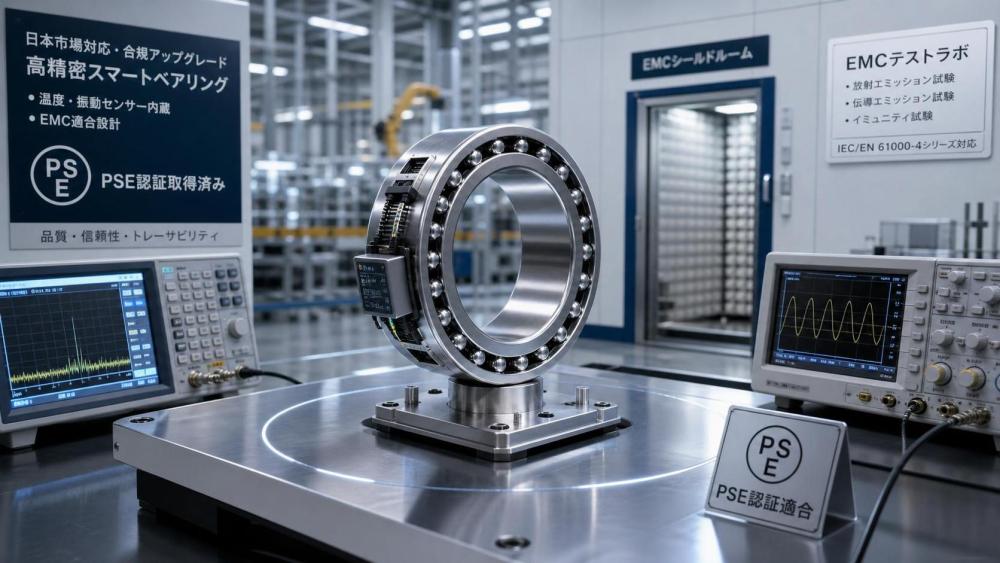
What the revised JIS B 1553:2026 now requires
According to the provided information, the Japanese Industrial Standards Committee (JISC) made JIS B 1553:2026 mandatory on July 1, 2026. The revision applies to smart sensor bearings that integrate vibration and temperature sensing functions.
The updated standard introduces stricter EMC requirements in two specific areas: radiated immunity at IEC 61000-4-3 Level 4 and conducted emission limits at CISPR 32 Class A.
The new rule applies to all new applications for PSE certification involving smart sensor bearings. The provided information also states that certifications issued under the previous version will expire on December 31, 2026.
In parallel, Japanese automation equipment OEMs and importers are required to update technical specifications and acceptance agreements to reflect the revised standard.
Where the immediate pressure is likely to appear
Specification alignment between component suppliers and equipment buyers
From an industry perspective, suppliers of smart sensor bearings may be affected because the standard change is tied to measurable EMC thresholds and to new PSE applications. The likely pressure point is the handoff between component technical data and equipment procurement requirements. Buyers and sellers will need to check whether specifications, test references, and acceptance terms still match the revised JIS B 1553:2026 baseline.
Certification and testing workflows around new applications
Certification-related businesses and testing service providers may see closer scrutiny of EMC documentation because the rule explicitly affects new PSE certification applications. What deserves closer attention is whether existing technical files, test reports, and compliance submissions are still usable for products intended for new applications after July 1, 2026. Even where the product category remains the same, the compliance evidence may need to reflect the revised immunity and emission requirements.
Import and delivery coordination for the Japanese market
Importers and market-entry teams may be affected because the change is not limited to product design; it also touches acceptance documentation and timing. Observably, any shipment or sourcing plan tied to Japan now has to account for the expiration of legacy certifications on December 31, 2026. That creates a practical review point for procurement schedules, supplier qualification checks, and contract language used for products intended for the Japanese automation equipment market.
After-sales and traceability considerations
After-sales and quality teams may also need to pay attention where installed products, replacement parts, or follow-on deliveries depend on the certification status and technical description of the bearing. Analysis shows that the main issue is not a confirmed service disruption, but the need for cleaner traceability between product version, certification route, and the technical standard referenced in sales and acceptance records.
What companies should review now
Check which products fall within the revised scope
Companies handling bearings with integrated vibration or temperature sensing functions should first identify which product lines are intended for new PSE certification applications in Japan. Analysis shows that scope confirmation is the practical starting point, because the rule change is product-specific rather than a general update affecting every bearing category.
Review technical files and acceptance language
The provided information explicitly notes that Japanese automation equipment OEMs and importers need to update technical specifications and acceptance agreements. In practice, companies should pay attention to whether technical datasheets, procurement specifications, bid documents, and incoming inspection criteria still reference the correct standard version and EMC requirements.
Reassess certification timing before the legacy deadline
Because older certifications will expire on December 31, 2026, businesses should closely watch the timing of new certification applications, product transitions, and delivery commitments. It is more appropriate to understand this as a scheduling and compliance coordination issue rather than only a laboratory testing issue.
Watch for execution details and market practice
The provided information does not include detailed enforcement procedures or official interpretive guidance. For that reason, companies should continue monitoring how certification practice, procurement documents, and acceptance language develop in response to the mandatory standard. The immediate task is to avoid assuming that older documentation will remain sufficient through the transition period.
Why this matters beyond a technical test update
Analysis shows that this development is best read as a rule implementation signal with direct commercial consequences, not merely as a routine standards revision. The combination of tighter EMC thresholds, application to new PSE certification filings, and a fixed expiry date for older certifications means the change can move quickly from engineering review into sourcing, contracting, and delivery management.
Observably, the most important point for the market is that compliance expectations are becoming more explicit at the interface between component performance and certification readiness. Continued attention is warranted because the provided information confirms the rule change itself, while operational interpretation across certification review, tender documents, and buyer acceptance practice may still evolve.
How the market may need to read this stage
At this stage, the event is more appropriately understood as an implemented compliance change with a defined transition consequence, rather than a policy discussion still awaiting activation. At the same time, it should not be overstated beyond the confirmed facts provided. The most reasonable reading is that affected companies now need to align product documentation, certification planning, and procurement terms with JIS B 1553:2026, while continuing to watch how the market applies the revised requirements in day-to-day transactions.
Basis of this article and what still needs verification
This article is based on the user-provided news title, event date, and event summary. For developments of this type, relevant source categories typically include official notices, regulatory or certification body releases, standards organization documents, industry association updates, trade or customs-related guidance, and reporting by authoritative industry media.
No specific official source link was provided in the input, so the exact official reference path still needs to be verified on an ongoing basis. What still deserves continued monitoring includes detailed implementation language, certification interpretation, changes in tender and specification documents, industry feedback, and how affected companies carry out the transition in practice.
Want to dive deeper into these market dynamics, or need data-driven support for your next business move? Drop a line below and let the analysts at PCTS provide customized insights.
We respect your privacy. Your information is strictly confidential.
Related News
- 00
0000-00
How sealing technology reduces contamination in semiconductor manufacturing - 00
0000-00
Where to install vibration sensors on rotating machinery - 00
0000-00
NTSB Probe Finds Boeing Warned of MD-11 Engine Bearing Risk Years Earlier - 00
0000-00
How to size pneumatic grippers for packaging system integration - 00
0000-00
How to size alloy steel power transmission chains for heavy loads
Weekly Insights
Stay ahead with our curated technology reports delivered every Monday.