





From October 1, 2026, exporters shipping certain industrial components to the EU will face a more demanding conformity path after the European Commission updated Annex II of the Machinery Directive (2006/42/EC). The change covers smart sensor bearings with integrated condition monitoring, closed-loop electro-hydraulic pump systems, and FFKM/PU composite sealing assemblies, and it matters because it directly affects certification sequencing, export documentation, labeling, and delivery planning for bearing manufacturers, hydraulic system suppliers, sealing technology exporters, and their downstream buyers.
What Changed in the Annex II List
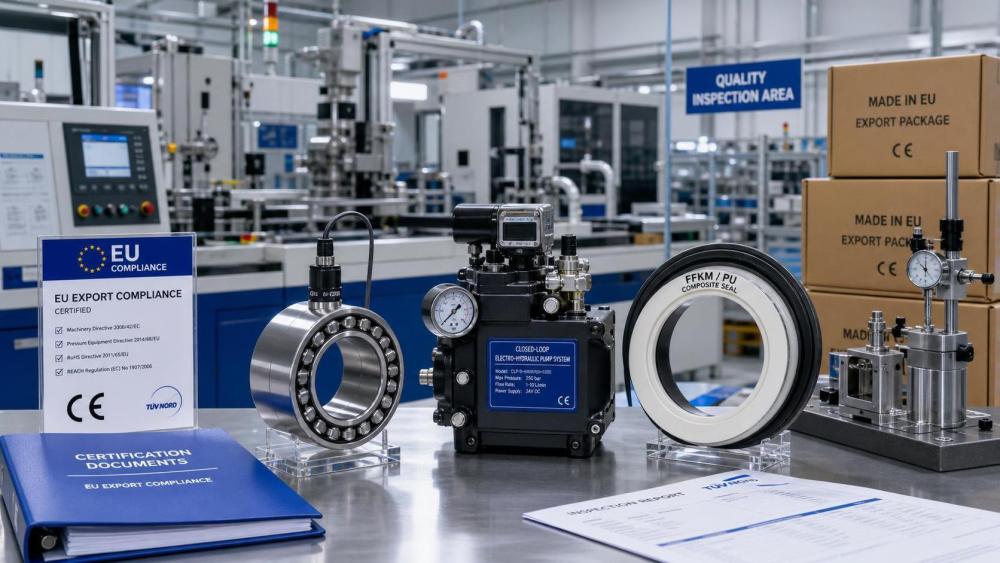
According to the information provided, the European Commission issued Regulation (EU) 2026/1389 on July 22, 2026, revising the Annex II product list under the Machinery Directive. The revised list adds three categories of high-risk industrial components: smart sensor bearings with integrated condition monitoring functions, closed-loop electro-hydraulic pump systems, and FFKM/PU composite sealing assemblies.
The same information states that, starting on October 1, 2026, products in these categories exported to the EU must undergo CE type examination by a Notified Body (NB). The products must also carry dual UKCA/CE marking. The stated direct impact falls on bearing manufacturers, hydraulic system suppliers, and sealing technology exporters through changes to their compliance path and delivery cycle.
Where the Pressure Will Appear First
Export transactions will need earlier compliance coordination
From an industry perspective, exporters are likely to feel the impact first because the rule change affects whether covered products can move into the EU market under the updated conformity route. What deserves closer attention is the sequencing of NB involvement, CE type examination, and labeling readiness before shipment. For export teams, this is not only a technical matter; it can also affect trade documentation, contract timing, and shipment release planning.
Manufacturing and engineering teams face tighter document control
Analysis shows that manufacturers of the newly listed products may need to review whether existing technical files, product descriptions, and internal compliance records are sufficient for the revised Annex II treatment. The immediate business effect is likely to appear in product classification, technical documentation preparation, and handoff between engineering, quality, and compliance functions. For companies supplying products with integrated monitoring functions or composite sealing structures, product scope definition may become a practical issue in tenders and customer qualification reviews.
Procurement and project buyers may need to recheck supplier status
Buyers sourcing these components for equipment assembly or industrial projects may also be affected because supplier selection can no longer be assessed only on price and lead time. Observably, procurement teams should pay closer attention to whether suppliers can complete NB-related conformity steps and provide the required marking status for EU-bound orders. This can influence approved vendor lists, order confirmation timing, and the acceptance of substitute products during ongoing deliveries.
Testing, certification, and supply chain service providers may see workflow changes
It is more appropriate to understand this as a rule change that can alter service demand around certification support, test preparation, and shipment compliance review. Certification-related firms, inspection support providers, and supply chain coordinators may need to monitor how customers interpret product coverage, what documents are requested in cross-border transactions, and whether delivery schedules need to be adjusted to reflect the added examination step.
What Companies Should Review Now
Check whether products fall within the newly listed categories
Analysis shows that the first practical step is confirming whether a company’s exported products match the three newly added categories as described in the provided information. This matters especially where product descriptions combine mechanical functions with sensing, control, or advanced material structures, because internal naming and customer-facing naming may not always align cleanly with regulatory categories.
Reassess certification timing and contract commitments
What deserves closer attention is the effect on delivery promises. Because the provided information states that NB-based CE type examination becomes mandatory from October 1, 2026, companies with EU-bound orders should review whether existing project schedules, production slots, and contractual delivery dates still match the revised compliance sequence. Where certification timing is not yet fixed, businesses should avoid treating prior timelines as unchanged.
Prepare technical and trade documentation for stricter review
Observably, firms should examine whether technical files, test records, labeling materials, declarations, and shipment-related paperwork are organized for a conformity process involving a Notified Body. The input does not provide detailed execution requirements, so this should be treated as a compliance readiness issue rather than as confirmation of any final documentation checklist.
Watch for changes in customer specifications and tender language
From an industry perspective, one likely near-term effect is a change in how customers describe acceptable supplier qualifications and product certification status in procurement documents. Companies serving EU-linked projects should monitor whether bid documents, purchase specifications, or supplier onboarding requirements begin to refer more explicitly to NB examination, marking status, or evidence of conformity for the covered components.
How This Signal Should Be Read
Analysis shows that this development is better understood as an implemented compliance change rather than a distant policy discussion, because a specific effective date has been provided and the covered product categories have been identified. At the same time, it remains necessary to observe how the market applies the new requirement in practice, especially in certification interpretation, documentation expectations, and buyer-side qualification language.
Observably, the most important unresolved area is not whether the rule exists, but how consistently it will be reflected in commercial execution. Industry participants therefore have reason to keep tracking official wording, certification practice, tender updates, and enterprise-level implementation responses before treating every procedural detail as settled.
A Practical Reading of the Update
This update matters because it shifts certain industrial components into a more formal compliance track for EU exports and places certification timing closer to the center of trade execution. For affected suppliers and buyers, the issue is less about headline policy change and more about how conformity review, labeling, procurement qualification, and shipment planning now connect.
It is more appropriate to understand this as a rule change that has already crossed into operational relevance, while still requiring continued observation of detailed execution practice. The immediate task for the market is to align product scope, compliance preparation, and delivery planning with the October 1, 2026 requirement without assuming that all implementation details are already fully standardized.
Basis and Ongoing Verification
This article is based on the user-provided news title, event date, and event summary. For developments of this kind, commonly relevant source types may include official regulatory notices, releases from supervisory authorities, customs or trade administration updates, industry association communications, standard-setting documents, and reporting by established professional media.
No specific official source link was provided in the input, so the exact official link still needs to be verified on an ongoing basis. What also requires continued monitoring includes detailed policy language, certification enforcement interpretation, tender document changes, market feedback, and how affected companies implement the new requirements in practice.
Want to dive deeper into these market dynamics, or need data-driven support for your next business move? Drop a line below and let the analysts at PCTS provide customized insights.
We respect your privacy. Your information is strictly confidential.
Related News
- 00
0000-00
How sealing technology reduces contamination in semiconductor manufacturing - 00
0000-00
Where to install vibration sensors on rotating machinery - 00
0000-00
NTSB Probe Finds Boeing Warned of MD-11 Engine Bearing Risk Years Earlier - 00
0000-00
How to size pneumatic grippers for packaging system integration - 00
0000-00
How to size alloy steel power transmission chains for heavy loads
Weekly Insights
Stay ahead with our curated technology reports delivered every Monday.