





AI predictive maintenance technologies are entering a proof-first phase
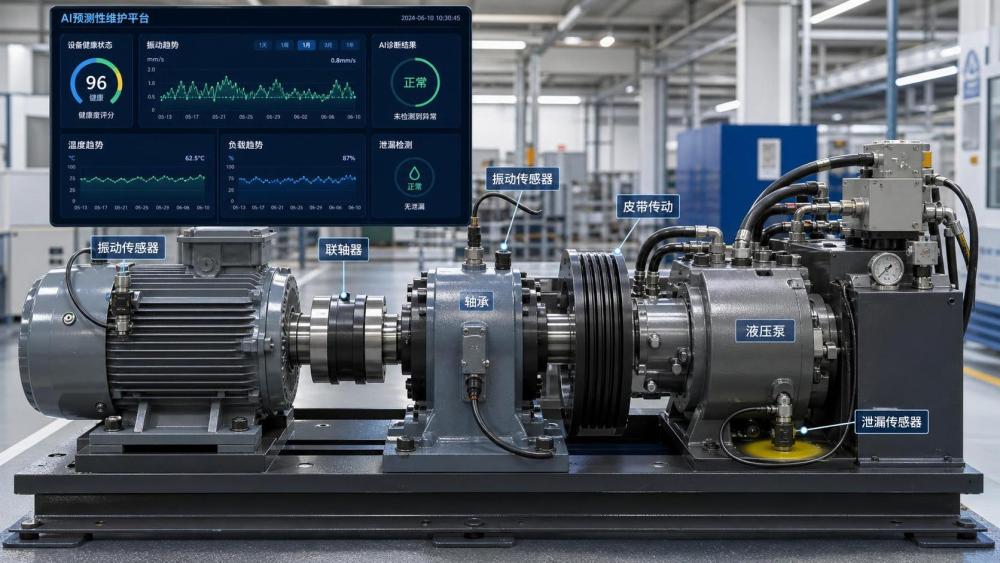
In 2026, the conversation around AI predictive maintenance technologies looks very different from two years ago.
The market no longer rewards impressive dashboards alone.
It rewards fewer bearing failures, fewer seal leaks, fewer hydraulic interruptions, and faster maintenance decisions on the plant floor.
That shift matters across precision components, transmission systems, fluid power, and industrial MRO.
The strongest signal is simple.
AI predictive maintenance technologies are finally being judged against asset behavior, maintenance economics, and uptime risk, not software ambition.
For operations involving spindle bearings, wind turbine bearings, hydraulic pumps, cylinders, couplings, chains, belts, and high-performance seals, this is a meaningful reset.
It favors systems that understand vibration drift, lubrication loss, temperature instability, pressure fluctuation, leakage onset, and wear progression under real operating loads.
It also favors industrial intelligence sources that connect condition data with component design, service intervals, and lifecycle cost.
What is actually changing in 2026
From recent deployments, the biggest change is not better AI language.
It is better fit between models, sensors, and failure modes.
Earlier projects often tried to predict everything across every machine.
That approach created noise, alert fatigue, and weak trust.
In 2026, AI predictive maintenance technologies work best when tied to narrow, high-cost events.
- Rolling element bearing defects detected through combined vibration and temperature signatures.
- Hydraulic pump wear identified through pressure ripple, flow deviation, and contamination trends.
- Belt slip and chain elongation tracked through torque variation and speed mismatch.
- Seal degradation flagged through leakage patterns, thermal cycling, and chemical exposure history.
- Pneumatic actuator issues recognized through cycle-time drift and air consumption anomalies.
This narrowing of scope is not a retreat.
It is what makes AI predictive maintenance technologies commercially credible.
Plants are moving from broad experimentation toward repeatable use cases with measurable maintenance outcomes.
The better systems now share three traits
First, they combine physics context with machine learning.
Pure pattern recognition still struggles when load, lubricant condition, or duty cycle changes sharply.
Second, they run closer to the asset.
Edge-based analytics reduce latency and improve resilience where connectivity is uneven.
Third, they connect alerts to action logic.
A useful prediction tells maintenance teams what inspection, lubrication, alignment check, or replacement decision comes next.
Why the strongest results are appearing now
Several forces are making AI predictive maintenance technologies more effective in 2026.
Sensor costs have improved, but cost is not the whole story.
The quality of industrial data pipelines is finally better aligned with maintenance reality.
More importantly, asset owners have become more selective.
They are asking whether AI predictive maintenance technologies can explain failure progression within the context of lubrication, contamination, pressure, heat, and material stress.
That pressure is improving solution quality.
Where value is already proven across industrial components
Not every asset class benefits equally.
The clearest returns appear where failure is frequent, expensive, or safety-critical.
Bearings and rotating assemblies
This remains the most mature field for AI predictive maintenance technologies.
High-frequency vibration analysis, lubrication condition tracking, and thermal trend modeling are producing reliable warning windows.
That is especially useful for spindle bearings, turbine bearings, and high-load industrial motors.
Hydraulic and pneumatic systems
Here, performance gains come from combining sensor streams rather than relying on one variable.
Pressure alone rarely tells the whole story.
When pressure, temperature, contamination level, cycle count, and energy consumption are analyzed together, fault isolation improves sharply.
Chains, belts, couplings, and power transmission
These systems were often under-monitored in earlier programs.
That is changing because transmission faults create hidden efficiency loss before visible failure appears.
AI predictive maintenance technologies are helping identify slip, stretch, misalignment, and uneven load transfer earlier than manual routines can.
Seals and leakage-prone environments
This remains harder, but the progress is real.
The best results come where seal material data, thermal cycling, media exposure, and pressure swings are tracked together.
For chemical service, semiconductor processes, and high-temperature lines, this can reduce both contamination risk and emergency shutdowns.
The market is also getting better at spotting what does not work
A useful trend in 2026 is stronger skepticism.
That skepticism is healthy because it exposes common failure patterns in AI predictive maintenance technologies.
- Models trained on clean demo data but deployed into unstable operating environments.
- Alert systems that identify anomalies without ranking business criticality.
- Programs that ignore maintenance records, lubricant history, or prior replacement quality.
- Platforms that predict failure but cannot support root-cause interpretation.
- Implementations with no connection to spare parts timing or service execution.
The practical lesson is clear.
Anomaly detection alone is not enough.
Working AI predictive maintenance technologies need to support maintenance judgment, not just model output.
What deserves closer attention over the next planning cycle
From a strategic view, the next gains will come from better decision architecture, not just better algorithms.
That means asking sharper questions before scaling.
- Which asset classes create the highest unplanned downtime cost per event?
- Which failure modes already show measurable precursor signals?
- Where is data quality strong enough to support trustworthy models?
- Can alerts be tied directly to inspection methods and intervention thresholds?
- Does the solution improve parts planning, not only fault visibility?
This is where component intelligence becomes important.
For sectors covered by PCTS, useful evaluation increasingly depends on linking AI signals with tribology, seal material behavior, fluid power dynamics, and transmission wear mechanisms.
A system that flags vibration without understanding lubrication regime is limited.
A system that tracks pressure instability without contamination context is equally limited.
A grounded way to judge the next wave
The most credible AI predictive maintenance technologies in 2026 are not promising universal foresight.
They are narrowing uncertainty around specific industrial failures.
That is a more modest claim, but it is far more valuable.
The next step is to review assets where downtime cost, service complexity, and failure recurrence already justify deeper monitoring.
Then compare whether current AI predictive maintenance technologies can read those assets in the language of real mechanics and maintenance action.
For industrial organizations tracking bearings, hydraulics, seals, and transmission systems, that discipline will separate durable value from expensive noise.
Over the coming quarters, the smartest move is to build a short list of failure-critical use cases, validate model performance against maintenance history, and watch how quickly each alert turns into a better operating decision.
- fluid power dynamics
- wind turbine bearings
- hydraulic pumps
- industrial MRO
- vibration analysis
- spindle bearings
- precision components
- transmission systems
- pneumatic systems
- predictive maintenance
- Predictive Maintenance Technologies
- Tribology
- hydraulic and pneumatic systems
- AI predictive maintenance technologies
Related News
- 00
0000-00
Where are axial piston pumps used in mining equipment? - 00
0000-00
Embodied AI Robotics and Drive Control Forum Held in Shanghai - 00
0000-00
How does seal service life affect the total cost of ownership? - 00
0000-00
Schaeffler to Cut 3,460 Jobs and Close Five European Plants - 00
0000-00
How does system size affect the price of a belt drive system?
Weekly Insights
Stay ahead with our curated technology reports delivered every Monday.