





Lubricant starvation is usually the most immediately destructive lubrication mistake in high-speed angular contact bearings because it removes the film separating the rolling elements from the raceways. A blocked oil supply, failed metering unit, or grease that cannot replenish the contact can quickly lead to surface distress, smearing, and seizure. However, there is no universal ranking: severe contamination or excessive grease can also cause rapid failure under the wrong operating conditions.
Consider a spindle that runs hotter after maintenance and begins losing machining accuracy. Adding grease might seem reasonable, but it could worsen an overfilled bearing arrangement. The practical answer to “What lubrication mistake causes the fastest bearing wear?” starts with distinguishing inadequate lubricant delivery from excess lubricant, unsuitable viscosity, and contamination before making an adjustment.
Why starvation can damage angular contact bearings so quickly
Angular contact bearings carry combined radial and axial loads. In precision spindle arrangements, preload helps control stiffness and running accuracy, but it also creates contact loading before external machining forces are applied. These loaded rolling contacts depend on a sufficiently thick elastohydrodynamic lubricant film.
Starvation occurs when too little lubricant reaches the contact inlet to sustain that film. The bearing does not have to look dry. Grease may remain around the housing while its base oil fails to replenish the running track; an oil system may show normal reservoir level while a downstream restriction prevents delivery.
Once separation becomes inadequate, surface asperities interact more frequently. Friction and local temperature rise, lubricant viscosity falls, and the contact becomes harder to protect. Depending on speed, load, sliding, and material condition, this can progress from surface distress to adhesive damage and seizure. It is not simply a gradual loss of bearing life.
Lubricant quantity in the housing is therefore not proof of lubrication at the contact. Delivery, distribution, and replenishment matter as much as the amount installed.
Comparing the mistakes: which becomes critical first?
The following comparison describes typical mechanisms rather than a fixed failure-speed ranking. A heavily contaminated bearing can deteriorate faster than a mildly starved one, while excessive grease can create the heat that eventually causes film failure.
Overgreasing: the mistake that resembles insufficient lubrication
An overfilled high-speed bearing must displace and work excess grease. The resulting drag can raise temperature, which changes operating clearances and may increase preload in a thermally sensitive spindle arrangement. Higher contact loading then adds further heat.
A temperature rise immediately after regreasing makes overfill a strong suspect, but not a diagnosis. Incorrect grease, mounting changes, blocked cooling, or excessive preload can produce a similar response. Do not assume that a hot bearing needs another grease shot.
Some grease-lubricated spindle bearings require a controlled running-in procedure to distribute grease and establish stable operation. This is not permission to keep running through an uncontrolled temperature rise. Use the equipment manufacturer’s speed stages, stabilization criteria, and shutdown limits.
Wrong viscosity: enough lubricant, insufficient protection
A lubricant can reach the bearing and still provide inadequate film thickness. Base-oil viscosity falls as temperature rises, so selection must account for expected operating conditions rather than ambient conditions alone. Conversely, selecting a much thicker oil “for protection” can increase friction and impair delivery.
For grease, the NLGI consistency grade does not identify base-oil viscosity. Two greases with the same consistency can behave very differently in a high-speed angular contact bearing. Base-oil viscosity, thickener system, oil release behavior, and application suitability all need review.
Contamination: a separate route to early failure
Hard particles can dent raceways and rolling elements, creating local stress concentrations that promote fatigue damage. Other debris can cause abrasion. Water can promote corrosion and alter lubricant performance. A good nominal viscosity does not compensate for either problem.
Contamination deserves priority when symptoms follow seal damage, coolant exposure, or a bearing change performed without adequate cleanliness. Increasing lubricant supply may not address the ingress route and cannot reverse existing surface damage.
Read the sequence of events, not just the temperature
A single housing temperature reading cannot separate these mechanisms. Housing temperature also lags conditions inside the bearing and depends on sensor position, cooling, and surrounding heat sources. The sequence leading to the change is often more useful.
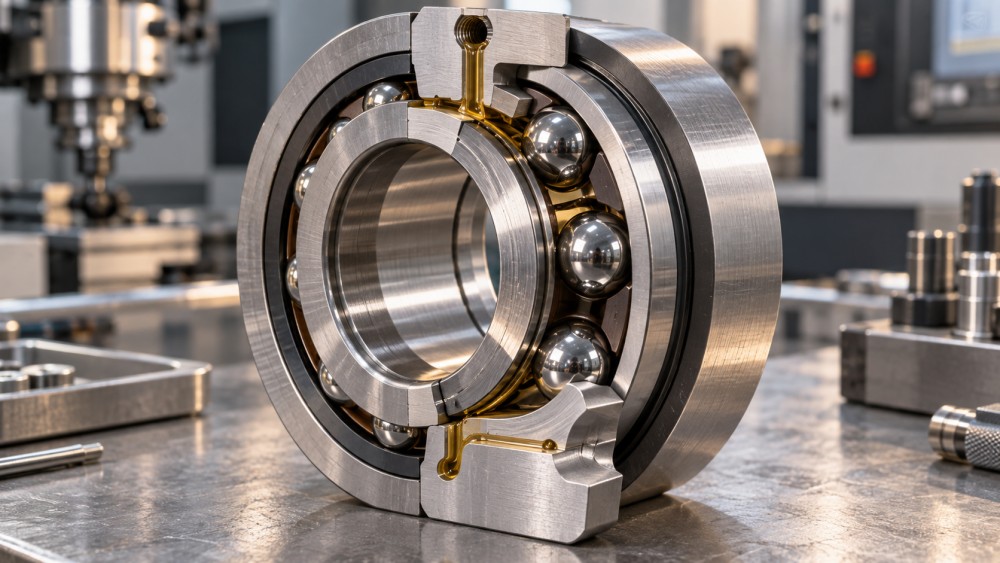
- Heating begins immediately after greasing: investigate excess quantity, wrong product, blocked purge paths, and omitted running-in steps.
- Heating follows an oil-system interruption: verify pump operation, metering, line condition, and delivery at the affected branch.
- Noise or vibration develops after coolant exposure: inspect sealing and check for water or process-fluid ingress.
- Problems appear only at higher speed: review lubricant drag, replenishment capacity, preload, and cooling rather than judging the lubricant from low-speed behavior.
- Distress follows a lubricant substitution: confirm viscosity, compatibility, delivery characteristics, and approval for the bearing arrangement.
These patterns guide investigation; none proves a cause by itself. Correlate temperature with speed, load, motor current, vibration trends, and lubrication-system status. Changes in vibration can indicate developing distress, but they do not uniquely identify starvation, overfill, or contamination.
A practical inspection sequence before adding lubricant
-
Establish whether continued operation is acceptable. Rapid temperature escalation, abnormal noise, increasing vibration, or loss of spindle accuracy warrants a controlled stop under the machine’s operating procedure. Isolate equipment before opening guards or disconnecting lubrication lines.
-
Identify the bearing arrangement and lubrication method. Record bearing designation, arrangement, preload specification, speed range, and whether lubrication is grease, circulating oil, oil-air, or another controlled system. A general-purpose relubrication habit may be unsuitable for a precision spindle.
-
Check the last intervention. Review the product used, measured quantity, application point, line reconnection, seal replacement, and changes to control settings. “Greased during service” is not enough information to distinguish underfill from overfill.
-
Verify delivery rather than assuming it. For oil systems, follow the approved procedure for checking metered output, air supply where applicable, restrictions, leaks, and nozzle condition. Upstream pressure does not prove that each bearing receives lubricant. For grease systems, inspect distribution and blocked passages where the design permits.
-
Inspect lubricant condition and possible ingress. Look for debris, water, unusual consistency, separation, or evidence of incompatible products. Appearance is only a screening tool; oil analysis or grease examination may be needed. Preserve samples before flushing or cleaning removes evidence.
-
Check mechanical contributors before restarting. Excessive preload, misalignment, fitting errors, cooling loss, and load changes can cause overheating even when lubrication is correct. Lubricant changes should not be used to mask these faults.
Where inspection confirms surface distress, restoring lubricant flow does not restore the damaged raceway. The decision to reuse or replace the bearing requires condition assessment appropriate to the machine’s accuracy and failure consequences.
Correct the mechanism, not merely the symptom
When starvation is confirmed
Repair the delivery fault first: restore metering, clear or replace restricted components using approved procedures, correct leaks, and verify the required supply. In oil-air systems, both oil dosing and the air transport path matter. Do not compensate for one blocked branch by indiscriminately increasing the entire system’s output.
Grease starvation requires a different review. The installed amount may be insufficient, the replenishment interval may be wrong, or the grease may not release and transport oil suitably under the operating conditions. Increasing quantity is justified only after establishing which limitation exists.
When excessive grease is the likely cause
Return the assembly to the specified grease quantity and distribution using the manufacturer’s service method. Removing excess grease may require disassembly in sealed or precision assemblies; opening a seal or forcing grease through a spindle is not a universal remedy.
Record grease quantity by mass where specified, not merely by grease-gun strokes. Gun output varies, and the correct fill depends on bearing design, housing space, speed, and lubrication arrangement. There is no single fill percentage suitable for every angular contact bearing.
When viscosity or contamination is responsible
Review viscosity using bearing dimensions, operating speed, load, and expected temperature through the bearing supplier’s selection method. For grease, evaluate the complete formulation rather than matching only consistency or color. A substitution should also account for seals and the existing lubricant.
Contamination control starts at the entry point. Repair sealing defects, correct storage and handling, and service filtration where fitted. Flushing may remove loose contamination, but it does not erase raceway indentations or corrosion. Inspect affected components before treating clean replacement lubricant as a complete repair.
Make the lubrication instruction specific enough to follow
A reliable maintenance instruction should identify the approved lubricant, measured quantity or metered delivery setting, application location, replenishment trigger, cleanliness requirements, and any running-in procedure. It should also state which observations require stopping rather than adding lubricant. This prevents the common cycle of heat, extra grease, and still more heat.
After correction, verify behavior at comparable speed and load. Track temperature stabilization, vibration, and spindle performance against an established healthy baseline rather than an arbitrary universal temperature limit. Where symptoms remain, investigate preload and mechanical condition before further lubrication adjustments.
The decisive distinction is between lubricant present and an effective film maintained at the rolling contacts. An empty supply line calls for delivery repair; a hot bearing immediately after an excessive grease charge calls for quantity correction. Treating those two conditions with the same extra shot of grease is precisely the mistake to avoid.
Related News
- 00
0000-00
Where are axial piston pumps used in mining equipment? - 00
0000-00
Embodied AI Robotics and Drive Control Forum Held in Shanghai - 00
0000-00
How does seal service life affect the total cost of ownership? - 00
0000-00
Schaeffler to Cut 3,460 Jobs and Close Five European Plants - 00
0000-00
How does system size affect the price of a belt drive system?
Weekly Insights
Stay ahead with our curated technology reports delivered every Monday.