





Why Supplier Evaluation Has Become a Reliability Issue
Selecting a high-precision bearings supplier is a reliability decision before it becomes a purchasing decision.
Bearing accuracy influences spindle runout, thermal behavior, vibration levels, lubrication stability, and the service life of connected components.
That is why supplier quality affects far more than the bearing itself.
In machine tools, automation systems, wind equipment, pumps, motors, and transmission assemblies, small bearing deviations can become large operating losses.
A weak source may still offer an impressive catalog, acceptable samples, and competitive pricing.
Long-term reliability, however, depends on repeatability across batches, process control, traceability, and application knowledge under real loads.
This is also why platforms such as PCTS matter.
They connect bearing performance with tribology, sealing, transmission behavior, maintenance economics, and lifecycle risk instead of treating parts in isolation.
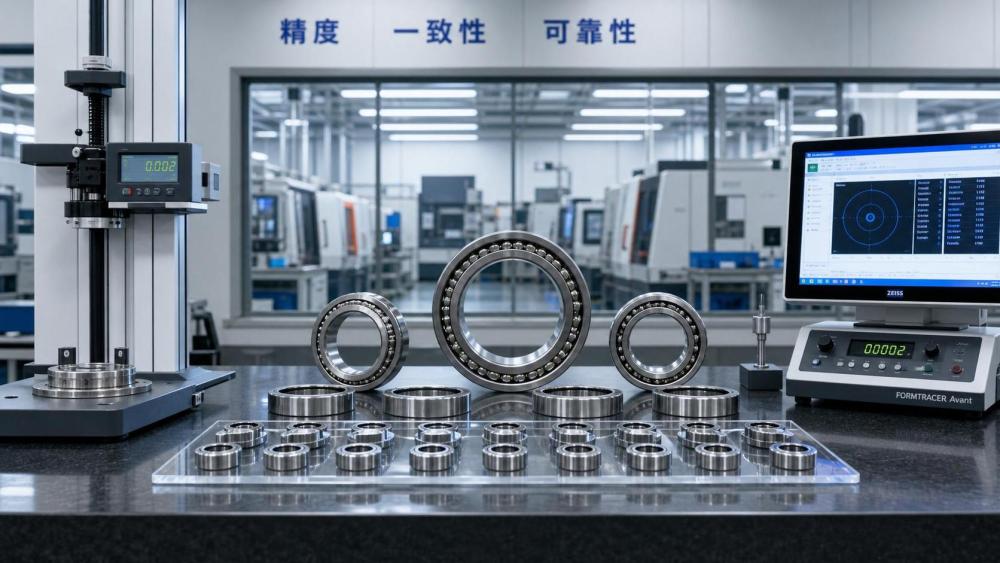
Viewed this way, evaluating a high-precision bearings supplier means asking whether the source can support machine reliability over years, not only at shipment.
What “High Precision” Really Means in Supply Terms
Precision is often reduced to tolerance class, but supply evaluation needs a wider lens.
A capable high-precision bearings supplier controls geometry, surface finish, heat treatment, material cleanliness, cage stability, and lubrication compatibility as one system.
Raceway grinding quality matters because it shapes friction, noise, and fatigue behavior.
Internal clearance matters because it affects preload, heat generation, and speed capability.
Contamination control matters because micron-level debris can shorten life dramatically.
In other words, high precision is a manufacturing discipline, not a label.
This distinction becomes critical in sectors where bearings interact with hydraulic pumps, couplings, belts, seals, or sensor-based monitoring systems.
If one component behaves inconsistently, the full machine loses stability.
The First Questions Worth Asking
Early evaluation should focus on evidence, not claims.
A reliable high-precision bearings supplier should be able to answer practical questions with technical depth and clean documentation.
- Which tolerance classes, preload options, and material grades are standard, and which are custom?
- What process controls are used for grinding, superfinishing, heat treatment, and cleanliness?
- How are vibration, noise, radial runout, and axial runout measured?
- What batch traceability exists for rings, rolling elements, cages, grease, and inspection data?
- What field performance history is available in similar duty cycles?
When answers stay vague, the risk usually sits deeper than the missing document.
It often points to uneven production maturity or weak feedback from installed applications.
How to Read Manufacturing Consistency
Consistency is the center of long-term reliability.
One successful lot proves little if the next shipment behaves differently in speed, temperature, or vibration response.
A strong high-precision bearings supplier usually shows discipline in several areas.
Documents alone are not enough, but they reveal whether the supplier manages quality as a controlled process or as an end-of-line inspection exercise.
Quality Systems Matter, but Field Evidence Matters More
Certifications can support confidence, yet they should not be mistaken for proof of application reliability.
A high-precision bearings supplier may hold recognized quality approvals and still struggle in demanding operating environments.
The stronger signal comes from field performance under comparable conditions.
That includes speed range, load pattern, lubrication method, sealing arrangement, duty cycle, contamination level, and thermal exposure.
For example, spindle bearings in high-speed equipment face a different failure logic than bearings used in wind systems or heavy transmission assemblies.
The supplier should be able to explain those differences clearly.
It is useful to request application references, failure analysis examples, and any condition monitoring data linked to vibration or temperature trends.
That kind of evidence aligns with the broader PCTS view of reliability, where bearings, lubrication, sealing, and smart sensing influence one another.
Application Support Is Part of the Product
In practice, many bearing failures start outside the bearing.
Incorrect fits, preload errors, poor lubrication selection, seal mismatch, shaft issues, and housing distortion can all lead to early damage.
That is why a high-precision bearings supplier should be judged partly on technical support quality.
Useful signs of strong support
- Clear guidance on mounting, preload, lubrication intervals, and contamination control
- Ability to review shaft and housing tolerances against operating conditions
- Recommendations for seals, greases, or monitoring methods matched to the duty profile
- Structured failure analysis when returned parts show wear, scuffing, flaking, or overheating
This matters across integrated systems.
A bearing supporting a hydraulic motor, conveyor drive, or servo transmission does not operate alone.
Support quality often determines whether the final installation reaches design life.
Traceability, Change Control, and Supply Risk
Long-term reliability is damaged quickly when silent changes enter the supply chain.
A different steel melt, cage source, grease formulation, or finishing route can change performance without changing the part number.
A dependable high-precision bearings supplier should have clear change notification rules and lot-level traceability.
That expectation is especially important where downtime costs are high or replacement access is difficult.
It is also relevant for global sourcing, where logistics delays can push buyers toward substitute lots with limited validation history.
Reliable traceability improves warranty handling, root-cause analysis, and spare parts planning.
It also supports cleaner comparisons between suppliers when performance problems appear months after installation.
Comparing Suppliers by Total Operating Value
Price still matters, but unit price rarely reflects operating value.
A lower-cost bearing may increase heat, shorten lubricant life, raise vibration, or require earlier replacement.
Those effects spread into maintenance labor, spare stock, line stoppage, and adjacent component wear.
A better comparison uses total cost of ownership.
Useful comparison factors
- Expected life under the actual duty cycle
- Failure rate consistency across batches
- Support response during installation and troubleshooting
- Lead time stability and emergency supply capability
- Compatibility with current lubrication, sealing, and monitoring practices
This is where the best high-precision bearings supplier often separates from the cheapest source.
The advantage appears over months of operation, not on the first quotation sheet.
A Practical Way to Move Forward
A sound evaluation process usually starts with the application, not the catalog.
Define load, speed, accuracy target, thermal limits, lubrication method, contamination exposure, and maintenance constraints.
Then compare each high-precision bearings supplier against those realities using the same scorecard.
Shortlist sources that can provide process evidence, field references, traceability, and credible technical support.
Where risk is high, pilot testing and monitored field trials are usually worth the time.
The goal is not simply to approve a vendor.
It is to build a dependable supply relationship that protects machine accuracy, service intervals, and long-term operating confidence.
Using that framework, the next step is clear: turn technical requirements into measurable criteria, compare evidence across sources, and keep reliability at the center of the decision.
Want to dive deeper into these market dynamics, or need data-driven support for your next business move? Drop a line below and let the analysts at PCTS provide customized insights.
We respect your privacy. Your information is strictly confidential.
Related News
- 00
0000-00
How to check vibration analysis software for sensor compatibility - 00
0000-00
IndexBox Forecasts 3.8% Annual Growth for Global Radial Seals Market Through 2035 - 00
0000-00
How to assess the chemical compatibility of FFKM sealing sheets - 00
0000-00
IndexBox Forecasts 3.6% Annual Growth for Construction Bearings Market - 00
0000-00
When do hydraulic components require an export license?
Weekly Insights
Stay ahead with our curated technology reports delivered every Monday.