





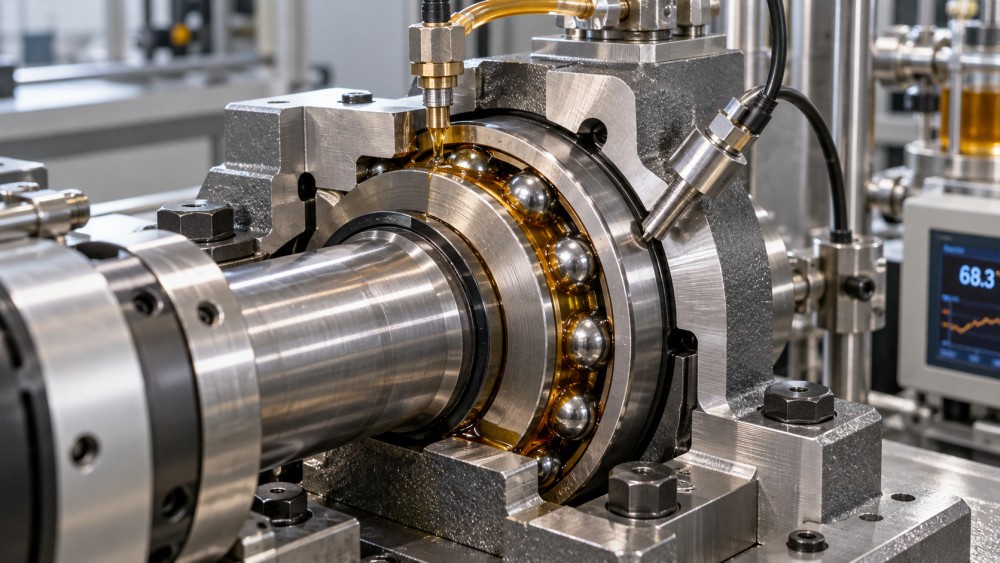
A bearing can satisfy its load and speed ratings yet develop inadequate lubrication after the machine reaches thermal equilibrium. As operating temperature rises, lubricant viscosity generally falls, reducing the film that separates rolling elements from raceways. The resulting surface interaction can increase wear, friction, and susceptibility to surface-initiated fatigue, even when the lubricant grade appears suitable on paper.
The practical answer is to evaluate viscosity at the bearing’s actual operating conditions, not simply its catalog viscosity at 40°C. Lubricant film thickness also depends on speed, contact geometry, pressure–viscosity behavior, surface roughness, and lubricant availability. A temperature increase is therefore a reason to recalculate lubrication adequacy—not, by itself, proof that the bearing needs a heavier oil.
From temperature rise to a thinner separating film
Most rolling-element bearings operate through elastohydrodynamic lubrication, usually abbreviated EHL. Lubricant entering a rolling contact is drawn into a highly loaded region, where pressure raises its viscosity and the contacting surfaces deform elastically. Together, these effects allow a very thin fluid film to carry the contact load.
Temperature changes the starting conditions for that process. Warmer oil has lower viscosity before it enters the contact, so it generally develops less film thickness at the same entrainment speed, load, and geometry. The pressure–viscosity response also changes with temperature and lubricant chemistry; two oils with similar atmospheric-pressure viscosity need not generate identical films.
For a simplified, fully flooded, isothermal point-contact estimate, film thickness often scales approximately with inlet dynamic viscosity raised to a power near 0.67–0.70, with other model inputs held constant. This is a sensitivity relationship, not a universal bearing equation.
As an illustrative calculation: if inlet viscosity falls to half its original value, a viscosity exponent of 0.67 predicts a film thickness ratio of approximately 0.63. The film would be about 37% thinner, rather than 50% thinner. Actual predictions require the appropriate contact model and may need thermal, starvation, and non-Newtonian corrections.
This relationship explains why an apparently modest temperature increase can matter when the original separation margin is already small. It also explains why temperature alone cannot reveal the remaining film thickness: the lubricant’s viscosity–temperature curve must be known.
Which temperature belongs in the calculation?
A housing sensor measures a useful condition-monitoring variable, but not necessarily the temperature governing film formation. Heat flows through the rings, shaft, housing, and lubricant at different rates. A sensor mounted on the outside of a housing may understate internal temperatures, particularly during load changes or warm-up.
Localized contact heating adds another complication. Sliding, spin, and lubricant shearing can raise temperature within the contact above the bulk lubricant temperature. At high speed or substantial sliding, an isothermal calculation may overpredict film thickness. Use a thermal EHL approach or a validated manufacturer calculation method when these effects are significant.
For grease-lubricated bearings, ring temperature is often a practical starting point, but grease distribution and base-oil replenishment still need separate assessment. A precise temperature reading cannot compensate for an incorrect assumption that the contact is fully supplied.
Judge separation against surface roughness
A film thickness value becomes more useful when compared with the roughness of the two contacting surfaces. The film parameter, commonly written as lambda, expresses that relationship:
λ = hmin / √(Rq12 + Rq22)
Here, hmin is minimum lubricant film thickness, and Rq1 and Rq2 are the root-mean-square roughness values of the mating surfaces. Both numerator and denominator must use consistent units. Do not substitute central film thickness for minimum thickness, or Ra for Rq, without a justified conversion or a method that explicitly permits it.
As a broad engineering interpretation, lambda below approximately 1 suggests substantial asperity interaction; values around 1–3 commonly indicate mixed lubrication; and values above roughly 3 suggest more complete separation. These are indicative ranges, not universal acceptance limits. Surface texture, running-in, contamination, sliding, and additive chemistry influence actual damage risk.
A temperature increase that moves an application from comfortably separated surfaces into mixed lubrication deserves attention even if the absolute temperature remains below the lubricant’s published limit. Conversely, a relatively high temperature does not automatically imply insufficient film when viscosity, speed, surface finish, and lubricant supply remain adequate.
Anti-wear and extreme-pressure additives may protect surfaces when separation is incomplete, but they do not restore the missing fluid-film thickness. Their effectiveness should not be treated as evidence that the original EHL margin remains intact.
Turn lubricant data into an operating assessment
ISO viscosity grade identifies a viscosity range at 40°C under ISO 3448; it does not describe the complete viscosity–temperature curve. Two products in the same grade can have different viscosities at the bearing’s operating temperature because their viscosity indices and base-stock formulations differ.
Obtain the lubricant’s kinematic viscosities at 40°C and 100°C, together with density information where required. ASTM D341 provides a viscosity–temperature relationship commonly used for petroleum oils and applicable liquid lubricants. Treat extrapolation beyond the supported temperature range cautiously, especially for unusual formulations or degraded oil.
- Define operating points. Include stabilized production, the hottest sustained condition, low-speed loaded operation, and relevant transients. Record bearing load, rotational speed, lubricant flow or grease arrangement, and temperature evidence for each point.
- Determine operating viscosity. Use supplier data or an appropriate viscosity–temperature calculation. EHL models generally require dynamic viscosity; convert from kinematic viscosity using density at the relevant temperature.
- Select the correct contact model. Ball and roller contacts require different geometric treatment. Include effective elastic properties, entrainment speed, contact loading, and pressure–viscosity inputs rather than relying on bearing bore size alone.
- Calculate film and separation margin. Estimate minimum film thickness and lambda, documenting whether the calculation assumes full flooding, isothermal behavior, and smooth surfaces.
- Test sensitivity. Repeat the assessment for plausible temperature uncertainty, reduced speed, increased load, and lubricant-property variation. A result that changes classification after a small input adjustment has limited design margin.
Many bearing selection workflows also use the viscosity ratio κ, defined as actual kinematic viscosity at operating temperature divided by a reference viscosity determined by the applicable bearing method. This is a useful screening parameter, but it is not the same as lambda and does not directly calculate film thickness.
ISO 281 bearing-life calculations can incorporate lubrication and contamination through their specified methods and assumptions. A favorable viscosity ratio or adjusted rating-life result does not independently prove adequate lubricant supply, acceptable transient behavior, or freedom from surface distress. Keep the calculation’s scope visible in technical comparisons.
Why higher speed does not always rescue a hot bearing
Increasing entrainment speed generally increases EHL film formation. In a machine whose speed and temperature rise together, however, the effects compete: speed promotes film formation while heating reduces viscosity. The net result must be calculated at the same operating point, not inferred from either trend separately.
At sufficiently high speeds, churning, shear heating, and inlet starvation can further reduce the expected benefit. Adding lubricant may increase drag and temperature without improving contact replenishment. This is especially relevant when an overfilled grease cavity is mistaken for a guarantee of adequate lubrication.
Grease introduces a supply mechanism that oil viscosity alone cannot describe. Film formation is often assessed initially using base-oil properties, but actual performance also depends on oil release, replenishment, channeling, and mechanical stability. Higher temperature can initially improve oil mobility while also accelerating oxidation or increasing leakage and depletion over time.
Temperature can additionally alter bearing internal clearance or preload through differential thermal expansion. Increased preload can raise friction and local loading, producing further heating. When temperature keeps climbing after an apparently suitable lubricant change, check fits, clearance, alignment, and thermal expansion rather than repeatedly increasing viscosity.
Choose the correction that addresses the failed assumption
The appropriate intervention depends on whether the problem is low operating viscosity, excessive heat generation, or inadequate lubricant delivery. These conditions can produce similar symptoms but require different remedies.
A higher-viscosity lubricant is not automatically a safer choice. It may increase frictional heating, impair cold delivery, or create excessive starting torque. A higher viscosity index can help preserve viscosity at elevated temperature, but selection must still account for pressure–viscosity behavior, air release, oxidation resistance, and compatibility with seals and existing lubricant.
Verify the change across the thermal cycle
After an adjustment, compare operation at equivalent speed, load, ambient conditions, and warm-up duration. Track bearing temperature together with vibration, lubricant condition, and delivery behavior. Temperature alone cannot distinguish improved separation from reduced friction caused by an unrelated operating change.
Evaluate hot restart and loaded low-speed periods separately from steady production. A bearing may have adequate film at full speed yet lose separation during deceleration while the lubricant remains hot. Conversely, cold oil may provide ample theoretical viscosity but fail to reach the contact promptly.
For a technical approval, retain the operating-temperature basis, lubricant-property data, film model, roughness assumptions, and supply limitations. Where thermal preload, severe sliding, or starvation dominates, a simple viscosity correction is insufficient; bearing-specific thermal and lubrication analysis is needed before accepting the revised operating envelope.
Want to dive deeper into these market dynamics, or need data-driven support for your next business move? Drop a line below and let the analysts at PCTS provide customized insights.
We respect your privacy. Your information is strictly confidential.
Related News
- 00
0000-00
IndexBox Forecasts 3.8% Annual Growth for Global Radial Seals Market Through 2035 - 00
0000-00
How to assess the chemical compatibility of FFKM sealing sheets - 00
0000-00
IndexBox Forecasts 3.6% Annual Growth for Construction Bearings Market - 00
0000-00
When do hydraulic components require an export license? - 00
0000-00
How to size modular pneumatic valve systems for adequate airflow
Weekly Insights
Stay ahead with our curated technology reports delivered every Monday.