





High Speed Spindle Bearings: When Precision Loss Signals Replacement Risk
When high speed spindle bearings begin to lose precision, the warning signs often appear long before catastrophic failure.
Small shifts in vibration, heat, sound, and surface condition usually come first.
That matters because replacing high speed spindle bearings too late can damage shafts, housings, and tooling accuracy.
Replacing them too early also creates avoidable cost, lost production hours, and spare parts waste.
In real service work, the challenge is not spotting failure.
The challenge is deciding when precision loss becomes a true replacement risk.
This guide breaks down how to read those signals and make better service decisions around high speed spindle bearings.
Why Precision Loss in High Speed Spindle Bearings Escalates Fast
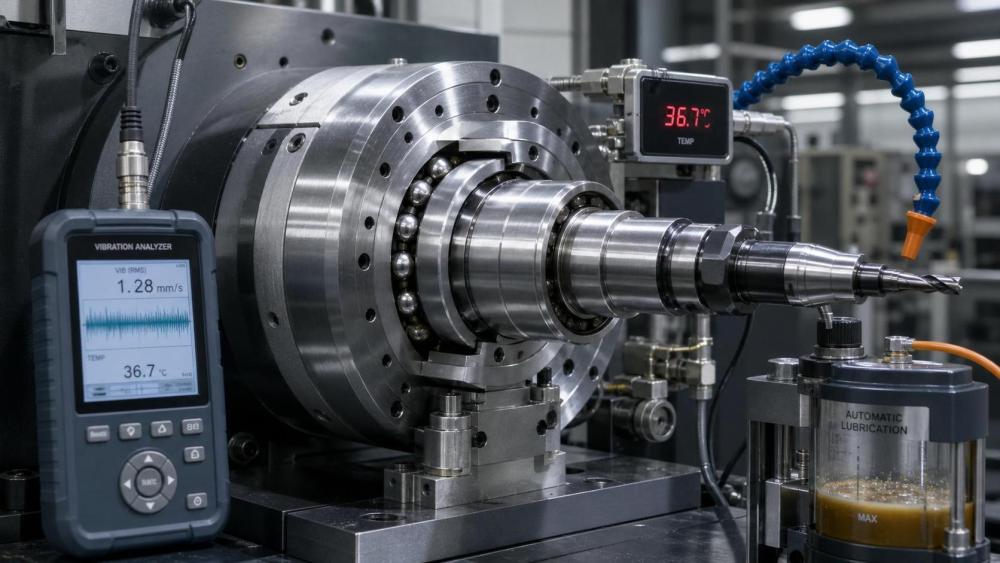
High speed spindle bearings operate under tight tolerances, high rotational loads, and demanding thermal conditions.
A minor loss of preload, lubrication quality, or raceway integrity can quickly affect running accuracy.
Once that accuracy changes, the spindle no longer behaves as a stable precision system.
Surface finish may drift first.
Then runout, tool life, repeatability, and machine confidence begin to decline.
From a maintenance point of view, this also means the bearing problem often spreads beyond the bearing itself.
Heat can migrate into adjacent parts.
Debris can contaminate lubrication paths.
Imbalance can stress the motor, tool holder, and sealing system.
That is why high speed spindle bearings should be judged by trend direction, not by one isolated symptom.
The Earliest Warning Signs Worth Taking Seriously
The first warning is often a subtle shift rather than a dramatic event.
A spindle may still run, but not with the same stability.
Recent changes usually matter more than absolute numbers.
Common early-stage indicators
- Slightly higher vibration at specific speed ranges.
- Temperature rising faster during warm-up cycles.
- A sharper or rougher sound during acceleration.
- Small changes in dimensional accuracy or surface finish.
- Grease discoloration, leakage, or unexpected consumption.
- More frequent balancing corrections than normal.
Any one of these signs may still look manageable.
The stronger signal appears when two or three begin moving together.
That pattern often shows the high speed spindle bearings are no longer holding their original precision state.
How to Separate Normal Wear from Replacement Risk
Not every worn bearing needs immediate replacement.
The real question is whether wear is still stable or already accelerating.
That distinction helps avoid both over-maintenance and failure-driven downtime.
Signs wear may still be controllable
- Vibration rises slowly and stays predictable.
- Temperature stabilizes after startup.
- Machining quality remains inside process limits.
- Lubrication condition improves after correction.
Signs replacement risk is becoming urgent
- Vibration peaks spread across multiple frequencies.
- Heat continues rising after warm-up.
- Noise becomes intermittent, then persistent.
- Runout increases after each operating cycle.
- Fine debris appears in grease or oil samples.
When these urgent signals appear together, high speed spindle bearings are often entering a damage progression stage.
At that point, delaying replacement usually increases repair scope and total cost.
Key Failure Causes Behind Precision Loss
To make a sound replacement decision, it helps to identify why precision is dropping.
Different causes create different risk patterns.
This step is crucial because simply replacing high speed spindle bearings without fixing the cause can repeat the failure quickly.
In practical MRO work, root cause control is what protects the new bearing investment.
A Practical Inspection Checklist Before You Replace
A structured inspection prevents guesswork.
It also helps determine whether high speed spindle bearings are the main problem or only part of it.
- Compare current vibration data with baseline values and recent trend history.
- Measure warm-up temperature rise and steady-state operating temperature.
- Listen for changes during startup, acceleration, and loaded running.
- Check runout, surface finish, and machining repeatability records.
- Inspect lubrication quality, contamination signs, and relubrication intervals.
- Review tool balance, shaft fit, preload setting, and assembly history.
- Examine adjacent seals, spacers, housings, and cooling conditions.
If the findings point to combined thermal, vibration, and accuracy deterioration, replacement risk is no longer theoretical.
It is active and likely to worsen under production demand.
When Replacement Should Not Be Delayed
Some situations call for immediate action.
Waiting in these cases often turns a controlled repair into a spindle rebuild.
- Accuracy loss starts affecting part quality or rejection rates.
- Bearing temperature exceeds the normal band repeatedly.
- Vibration trend slope becomes steep over a short period.
- Metal particles appear in lubrication samples.
- Noise is present across multiple speeds, not one narrow band.
- The spindle has already had recent lubrication or balance correction without improvement.
These signals show the high speed spindle bearings are no longer drifting gradually.
They are moving toward functional failure with rising collateral risk.
How Smarter Replacement Decisions Reduce Downtime
Good replacement timing is not only about avoiding failure.
It is also about protecting maintenance budgets, spare part planning, and machine availability.
In many facilities, the best results come from combining condition monitoring with service history and operating context.
That approach helps identify whether high speed spindle bearings should be replaced at the next planned stop or immediately.
It also supports better sourcing decisions on precision grade, lubrication method, sealing protection, and installation control.
For industrial teams using intelligence platforms like PCTS, this wider view connects bearing behavior with total cost of ownership.
That makes each replacement decision more defensible and more effective.
Final Takeaway
High speed spindle bearings rarely fail without warning.
The real value comes from reading those warnings early and responding at the right time.
Watch for linked changes in vibration, heat, noise, lubrication, and machining accuracy.
Confirm the root cause before ordering replacement parts.
Most importantly, do not wait until precision loss becomes visible spindle damage.
A disciplined inspection routine and timely decision process keep high speed spindle bearings from becoming a much larger repair problem.
If the trend is worsening, act during the next controllable window and replace with the right technical fit, not just the nearest available part.
Want to dive deeper into these market dynamics, or need data-driven support for your next business move? Drop a line below and let the analysts at PCTS provide customized insights.
We respect your privacy. Your information is strictly confidential.
Related News
- 00
0000-00
How to check vibration analysis software for sensor compatibility - 00
0000-00
IndexBox Forecasts 3.8% Annual Growth for Global Radial Seals Market Through 2035 - 00
0000-00
How to assess the chemical compatibility of FFKM sealing sheets - 00
0000-00
IndexBox Forecasts 3.6% Annual Growth for Construction Bearings Market - 00
0000-00
When do hydraulic components require an export license?
Weekly Insights
Stay ahead with our curated technology reports delivered every Monday.