





Low Maintenance Chains: Which Designs Reduce Downtime Best?
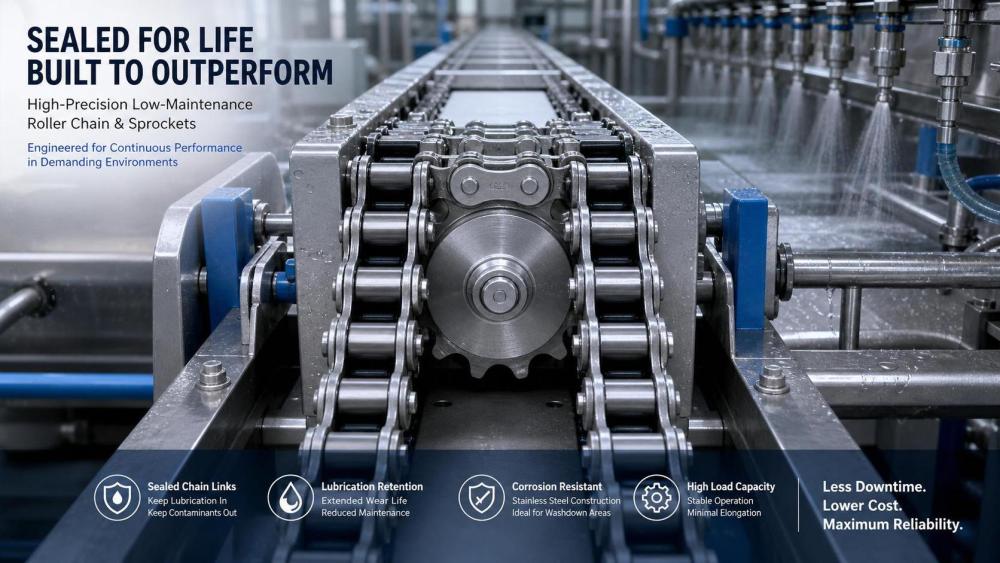
For aftermarket maintenance teams, low maintenance chains are a practical reliability decision, not a marketing label.
A chain that needs less adjustment, less lubrication, and fewer emergency replacements protects output and labor availability.
That matters even more in plants facing dust, washdown cycles, shock loads, and long operating hours.
The real question is simple: which chain designs actually reduce downtime best in service conditions that are hard on components?
The answer depends on wear points, sealing strategy, metallurgy, and how well the chain matches the duty cycle.
In practice, low maintenance chains perform best when they reduce contamination entry and slow pin-bushing wear.
This article compares the most useful chain designs for selection and shows where each one fits.
Why Chain Design Drives Maintenance Frequency
Most chain failures do not begin with a dramatic break.
They usually start with elongation, stiff joints, poor articulation, corrosion, or side wear.
Once those issues build up, tension becomes unstable and sprocket wear accelerates.
That is why low maintenance chains are designed around internal wear control, not only surface strength.
The pin and bushing interface is the main battle zone.
If lubricant stays inside and abrasive particles stay outside, service life improves quickly.
More importantly, maintenance planning becomes more predictable.
The Design Features That Matter Most
- Sealed joints that retain factory lubricant
- Hardened pins and bushings with controlled surface finish
- Corrosion-resistant materials or coatings
- Pre-stretched construction to reduce early adjustment
- Geometry that supports better load distribution
- Compatibility with existing sprockets and alignment conditions
A chain can be strong on paper and still create frequent shutdowns if these details are ignored.
Which Low Maintenance Chains Perform Best?
Not all low maintenance chains reduce downtime in the same way.
Some extend relubrication intervals. Others resist washout, dirt entry, or corrosion better.
Selection becomes easier when designs are compared by failure mode.
1. Sealed Roller Chains
Sealed roller chains are often the strongest option for reducing service interruptions.
Their seals hold lubricant around the pin and bushing while blocking contaminants.
This design directly slows chain elongation, which is a major driver of replacement and retension work.
For dusty conveyors, packaging lines, and agricultural equipment, sealed low maintenance chains usually outperform standard chains.
Their main tradeoff is higher initial cost and slightly greater drag in some setups.
2. Self-Lubricating Chains
Self-lubricating chains use sintered bushings or oil-impregnated materials to release lubricant during operation.
These low maintenance chains are useful where manual lubrication is difficult or contamination from oil must be minimized.
Food handling support systems, clean manufacturing zones, and overhead access-limited drives are common examples.
They reduce routine upkeep well, but extreme heat or heavy shock loading can shorten the benefit window.
3. Corrosion-Resistant Chains
In wet, chemical, or washdown environments, corrosion often causes downtime before wear limits are reached.
Stainless steel, nickel-plated, or specially coated low maintenance chains can hold reliability much longer in these conditions.
The key is understanding whether the problem is surface rust, chemical attack, or lubricant washout.
Coatings help in moderate exposure. Full stainless designs are better where corrosion is constant.
4. Heavy-Duty Engineered Chains
For mining, lumber, bulk material handling, and high-impact conveyors, heavy-duty engineered chains may reduce downtime best.
These are not always marketed as low maintenance chains, but robust bushings, thicker sections, and wear-resistant alloys matter.
When shock and abrasion dominate the risk profile, durability beats lubricant interval alone.
Best Chain Design by Operating Condition
From a decision standpoint, the best low maintenance chains are condition-specific.
A design that excels in dust may fail early in chemical washdown.
This is where selection mistakes usually happen.
This comparison also shows why standard roller chain upgrades often underdeliver.
If the environment is the main problem, stronger tensile ratings alone will not solve downtime.
Selection Checks Before You Specify Low Maintenance Chains
A solid selection process prevents expensive trial-and-error.
Before choosing low maintenance chains, review the application through these filters.
- Identify the real failure mode. Measure elongation, corrosion, stiff links, and sprocket wear separately.
- Check load pattern. Continuous steady torque needs a different answer than start-stop shock loading.
- Review contamination type. Fine dust, slurry, water, and chemicals affect chain choice differently.
- Confirm lubrication limits. Some sites cannot support frequent relubrication or overspray control.
- Inspect sprocket condition and alignment. Low maintenance chains cannot compensate for damaged engagement geometry.
- Compare lifecycle cost, not piece price. Fewer stoppages often justify the premium quickly.
This step matters because chain selection is really a system decision.
Chain type, sprockets, guards, lubrication method, and cleaning practice all influence maintenance burden.
Common Decision Errors
- Choosing stainless steel for wear problems when the real issue is articulation load
- Installing sealed low maintenance chains on worn sprockets
- Expecting maintenance-free service in extreme abrasive conditions
- Ignoring temperature limits of seal materials or internal lubricants
How to Reduce Downtime After Installation
Even the best low maintenance chains still need disciplined follow-up.
The good news is that upkeep becomes simpler when the design matches the environment.
A few practical habits make the downtime benefit visible much faster.
- Record installation length and track elongation at fixed intervals
- Replace sprockets when tooth wear threatens smooth engagement
- Control misalignment before blaming chain quality
- Use cleaning methods that do not strip internal lubricant or damage seals
- Standardize replacement triggers across similar assets
In actual operations, this creates two benefits.
First, emergency work orders decline. Second, spare parts planning becomes more accurate.
That is often where low maintenance chains deliver the strongest business value.
Final Decision: Which Designs Reduce Downtime Best?
If one design leads the field, it is usually the sealed roller chain.
For many industrial drives, it offers the best balance of wear control, contamination resistance, and maintenance interval extension.
But that is not a universal answer.
Self-lubricating chains are often the smarter choice where access is poor or lubrication must stay minimal.
Corrosion-resistant low maintenance chains win where moisture or chemicals drive failures.
Heavy-duty engineered chains remain the better answer when impact and abrasion dominate.
The strongest selection method is to match the chain design to the actual downtime mechanism.
When that match is right, low maintenance chains do more than reduce service tasks.
They improve uptime stability, lower total maintenance cost, and make replacement planning far less reactive.
Start with the failure mode, verify the environment, and choose the chain design that removes the root cause first.
Want to dive deeper into these market dynamics, or need data-driven support for your next business move? Drop a line below and let the analysts at PCTS provide customized insights.
We respect your privacy. Your information is strictly confidential.
Related News
- 00
0000-00
How sealing technology reduces contamination in semiconductor manufacturing - 00
0000-00
Where to install vibration sensors on rotating machinery - 00
0000-00
NTSB Probe Finds Boeing Warned of MD-11 Engine Bearing Risk Years Earlier - 00
0000-00
How to size pneumatic grippers for packaging system integration - 00
0000-00
How to size alloy steel power transmission chains for heavy loads
Weekly Insights
Stay ahead with our curated technology reports delivered every Monday.