





Why Chain Choice Matters More in Food Plants
In food production, a small chain issue rarely stays small for long.
A seized link, trapped residue, or corrosion spot can stop conveyors, disrupt washdown routines, and raise contamination concerns across an entire line.
That is why industrial chain applications food processing operations depend on deserve closer attention than a simple power transmission decision.
The right chain supports motion, product flow, and uptime, but it also affects cleanability, lubrication strategy, inspection frequency, and replacement planning.
For a sector balancing hygiene, throughput, and maintenance cost, chain selection becomes part of reliability engineering.
Seen through the broader lens used by PCTS, chains are not isolated parts.
They interact with sprockets, bearings, seals, lubricants, condition monitoring, and overall MRO strategy.
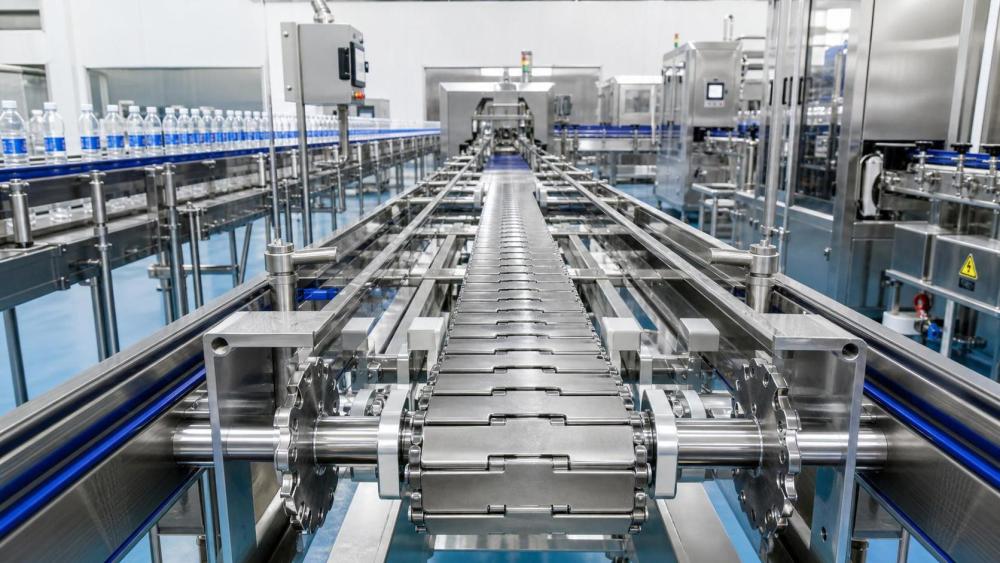
This is where hygienic choices begin to reduce downtime in practical, measurable ways.
What Food Processing Chains Are Expected to Do
Food processing chains move far more than packaged goods from one point to another.
They often carry raw ingredients, trays, bottles, cans, cartons, or prepared products through wet, sticky, abrasive, or temperature-sensitive environments.
Some lines run under constant washdown.
Others face sugar buildup, salt exposure, acids, fats, or cleaning chemicals that attack materials over time.
In this context, industrial chain applications food processing teams evaluate usually share several requirements.
- Resistance to corrosion, pitting, and surface damage
- Geometry that minimizes debris retention
- Stable performance under frequent cleaning cycles
- Low lubrication demand or food-grade lubrication compatibility
- Predictable wear behavior and easy inspection
- Compatibility with existing sprockets, guides, and line speed targets
A chain that handles load well but traps residue in hinge points may still be the wrong choice.
Likewise, a corrosion-resistant chain with poor fatigue life can create a different form of downtime.
Where Downtime Usually Starts
Food plant chain failures often develop gradually, not suddenly.
Wear elongation changes pitch and leads to poor sprocket engagement.
Corrosion roughens surfaces and accelerates friction.
Improper lubrication attracts debris or washes away too easily.
Misalignment increases side loading and shortens service life.
The result is usually one of three operational problems.
This is why industrial chain applications food processing reviews should focus on root causes, not only replacement intervals.
Materials and Designs That Support Hygiene
Material choice is usually the first technical filter.
Stainless steel chains are common where corrosion resistance and washdown durability matter most.
They are often selected for meat, dairy, beverage, bakery, and frozen food lines.
Yet not all stainless grades behave the same under chlorides, acids, or temperature cycling.
Plastic tabletop and modular chains may offer advantages in certain conveying zones.
They can reduce noise, resist some chemicals, and simplify cleaning, especially in packaging sections.
Still, they must be checked for load capacity, wear strip compatibility, and thermal stability.
Design details that often matter in practice
- Open profiles that allow better drainage after washdown
- Smooth surfaces that limit product adhesion
- Pin and joint configurations that reduce debris accumulation
- Corrosion-resistant attachments for guides or fixtures
- Food-grade lubricated or maintenance-reduced chain constructions
In other words, hygienic performance comes from both material and geometry.
Choosing one without the other usually leaves hidden failure points in the system.
Typical Industrial Chain Applications Food Processing Lines Depend On
Different zones inside the same facility often need different chain solutions.
That is one reason generic selection rules rarely hold up in actual operation.
Raw material and primary processing
These areas may involve moisture, abrasive particles, and heavy loads.
Chains here need strong wear resistance and easy washdown recovery.
Cooking, cooling, and thermal transitions
Temperature change affects lubrication, material expansion, and condensation behavior.
Chain stability becomes as important as corrosion resistance.
Filling and packaging
Speed, indexing accuracy, and low noise are often more critical here.
Plastic conveying chains or precision stainless options may be preferred.
Clean-in-place and washdown-intensive sections
These environments expose weak surface finishes and poor sealing practices very quickly.
The broader industrial chain applications food processing picture should include surrounding parts such as bearings, shafts, and seals.
A hygienic chain paired with vulnerable support components will still create downtime.
How to Evaluate a Chain Beyond the Catalog
Catalog ratings are necessary, but they rarely answer daily operating questions on their own.
A better evaluation combines mechanical fit, sanitation demands, and maintenance behavior.
The following checkpoints are usually more useful than headline specifications alone.
- Identify the exact exposure: water, caustic cleaners, acids, sugar, salt, oils, or mixed residues
- Check whether lubrication can be controlled consistently after each sanitation cycle
- Review chain and sprocket wear together, not as separate purchases
- Measure alignment and tensioning conditions during real production loads
- Inspect access points for cleaning, visual checks, and replacement work
- Compare total service life cost, not only unit price
This is where PCTS-style intelligence becomes useful.
Chain decisions improve when wear, lubrication, sealing, and condition trends are reviewed as one connected system.
Reducing Downtime Through Better MRO Decisions
The best hygienic chain still needs a disciplined maintenance approach.
In many plants, downtime comes less from dramatic breakage and more from inconsistent inspection and delayed replacement.
Useful MRO practice usually includes trend-based checks rather than reactive swaps.
- Track elongation against a defined replacement threshold
- Record corrosion patterns by line section and cleaning chemistry
- Standardize food-grade lubricant type and relubrication timing
- Replace worn sprockets with chains when wear pairing is evident
- Use condition monitoring where speed, load, or uptime demands justify it
For industrial chain applications food processing teams rely on daily, these habits often do more to prevent stoppages than changing brands alone.
A Practical Next Step for Line Reliability
Food processing lines rarely fail because one part looked wrong on paper.
They fail when the real operating environment was not fully considered.
That makes industrial chain applications food processing analysis a practical exercise in matching hygiene demands, mechanical load, and maintenance reality.
A useful next step is to review each conveyor or transfer point by exposure, cleanability, wear mode, and service history.
Then compare chain material, joint design, lubrication method, and support components as a complete transmission package.
That approach creates a clearer basis for selection, fewer sanitation-related surprises, and a more stable path to reduced downtime.
Want to dive deeper into these market dynamics, or need data-driven support for your next business move? Drop a line below and let the analysts at PCTS provide customized insights.
We respect your privacy. Your information is strictly confidential.
Related News
- 00
0000-00
How sealing technology reduces contamination in semiconductor manufacturing - 00
0000-00
Where to install vibration sensors on rotating machinery - 00
0000-00
NTSB Probe Finds Boeing Warned of MD-11 Engine Bearing Risk Years Earlier - 00
0000-00
How to size pneumatic grippers for packaging system integration - 00
0000-00
How to size alloy steel power transmission chains for heavy loads
Weekly Insights
Stay ahead with our curated technology reports delivered every Monday.