





For technical evaluators comparing motion-control options, timing belt drives for robotics can make more sense than gear drives when speed, low noise, long center distance, and cost efficiency matter.
In many automation systems, they provide clean power transmission, lower moving mass, simpler maintenance, and accurate synchronization without the packaging and backlash challenges of fully geared layouts.
That does not mean belts are universally better. The right choice depends on torque density, positional accuracy, environmental exposure, service expectations, and the economics of the full machine architecture.
For readers searching timing belt drives for robotics, the real question is usually practical: when does a belt-driven design outperform a gear-driven one in a way that matters to system performance and ownership cost?
This article answers that question from a technical evaluation perspective, with emphasis on application fit, design tradeoffs, and the decision criteria most useful during concept selection or supplier review.
What technical evaluators are actually trying to determine
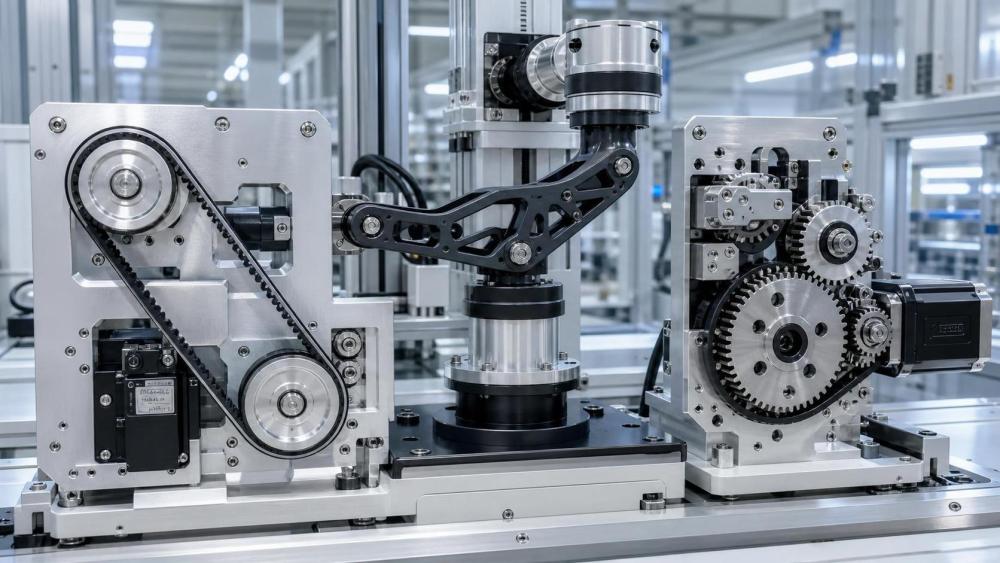
Most evaluators are not looking for a generic definition of belts or gears. They want to know whether timing belt drives for robotics will improve machine behavior in a measurable, defensible way.
That usually means comparing motion quality, repeatability, acoustic performance, maintenance burden, packaging flexibility, and the total cost impact across the robot, subsystem, or end-effector design.
In early-stage selection, the central issue is not only torque transmission. It is whether the drive choice supports the intended duty cycle, control strategy, installation layout, and commercial targets.
For a robot designer, a belt may create space, reduce weight, and simplify architecture. For a procurement or validation team, it may also reduce machining complexity and supplier dependency.
So the useful comparison is application-specific. Timing belt drives for robotics make sense when they solve system-level problems more effectively than gears, not merely when component prices look lower.
When timing belt drives for robotics make more sense than gear drives
The strongest case for belts appears when power must be transmitted across a longer center distance. Gears are efficient at short, direct meshing interfaces, but they do not bridge distance without added shafts or stages.
Timing belts allow the motor to be placed away from the driven axis while maintaining synchronous motion. That flexibility is valuable in robotic arms, gantries, packaging cells, and collaborative automation layouts.
Belts also make sense when reducing moving inertia is important. Relocating a motor away from a wrist, slide, or upper axis can lower carried mass and improve acceleration, energy use, and control responsiveness.
Noise is another common reason. Compared with many gear sets, properly tensioned timing belts often run more quietly, which matters in laboratory automation, medical devices, electronics assembly, and human-facing workspaces.
Cost efficiency can be decisive as well. A belt-and-pulley system often requires fewer precision-machined transmission elements than a multi-stage gear arrangement, especially where ratios are moderate and layout freedom matters.
Belts can also offer cleaner operation because they require no oil bath and typically less lubrication management. In controlled environments, that simplifies contamination control and day-to-day maintenance planning.
Finally, belts are attractive when synchronization between parallel axes is needed. One belt can coordinate motion across multiple shafts or stations in ways that would require more complex geared architecture.
Where gear drives still hold the advantage
A balanced evaluation also needs to identify where belts are not the best answer. Gear drives generally remain stronger where very high torque density is required within a compact envelope.
If the robotic axis must hold high loads with minimal elastic compliance, a gearbox often provides a stiffer mechanical path. That stiffness can matter in heavy payload handling, cutting, or force-intensive operations.
Gears are also preferable when very high reduction ratios are needed in a small package. Achieving the same ratio with belts may require larger pulley differences or additional stages.
Some applications demand extremely tight torsional behavior under rapidly reversing loads. While modern belts are highly capable, they still introduce different compliance characteristics than rigid gear meshes.
Environmental conditions also matter. Abrasive debris, high heat, chemical exposure, or severe shock can shorten belt life unless materials, covers, and guarding are selected very carefully.
For evaluators, the takeaway is simple: timing belt drives for robotics are compelling in many automation scenarios, but gear drives still win where compact torque concentration and structural stiffness dominate.
How belts affect robotic performance in real applications
In robotics, performance is judged by more than top speed. Engineers care about settling time, repeatability, vibration, payload behavior, and how the transmission interacts with the servo control loop.
A timing belt system can improve dynamic response by shifting motor mass off the moving structure. In pick-and-place robots or Cartesian systems, that can translate into faster cycles and lower actuator demand.
Belts can also damp some mechanical noise and transmission harshness. That does not replace good control tuning, but it can improve perceived smoothness and reduce acoustic penalties in production settings.
In long-travel axes such as gantries, transfer robots, or linear modules, a belt often provides a cleaner and more practical architecture than trying to distribute motion through multiple gear elements.
For indexing, tracking, or synchronized handling functions, belts can deliver reliable phase relationship between shafts. This is useful in labeling, packaging, inspection, and coordinated material handling applications.
However, evaluators should separate repeatability from absolute rigidity. A well-designed belt system can be very repeatable, but its behavior under varying load and tension differs from a rigid gear train.
That distinction is critical when the robot must both move quickly and maintain process force. The transmission should be assessed against the actual task, not generic assumptions about precision.
What design questions should be asked before choosing a belt drive
Good selection starts with the load case. Evaluators should define peak torque, continuous torque, acceleration profile, shock events, duty cycle, and whether the axis primarily moves, holds, or synchronizes.
Next comes the layout question. If the motor location creates mass or access problems, a timing belt may solve more than transmission alone by improving packaging and serviceability.
Center distance and ratio range should be reviewed early. Belts excel at spanning distance, but pulley size, wrap angle, and tooth engagement still need to support torque transfer reliably.
Accuracy requirements should be translated into real metrics. Ask whether the application needs absolute positioning stiffness, cycle-to-cycle repeatability, low backlash, or simple speed synchronization, because these are not identical requirements.
Environmental conditions deserve direct scrutiny. Dust, cutting fluids, cleaning agents, temperature swings, and washdown demands all influence belt material, cover, cord selection, and expected service life.
Maintenance philosophy matters too. If the end user wants easy replacement and low lubrication management, timing belt drives for robotics can align well with practical MRO expectations.
Finally, consider supplier capability. Consistent pulley quality, tooth profile control, belt material selection, and support for tensioning guidelines all affect whether the theoretical benefits are realized in production.
Total cost of ownership often favors belts in the right system
Technical evaluators are frequently asked to support a commercial decision, not just a mechanical one. That is where total cost of ownership becomes more useful than simple component price comparison.
A belt-driven layout may reduce the number of shafts, bearings, housings, and precision-machined gear elements needed in the assembly. That can lower manufacturing complexity and simplify sourcing.
Installation and replacement can also be easier. In many machines, changing a belt is faster and less specialized than rebuilding a compact geared transmission or replacing a sealed gearbox assembly.
Lower noise and cleaner operation may not appear on a component datasheet, but they can matter commercially in electronics, medical, light assembly, and collaborative robotic environments.
Energy effects should also be reviewed at the system level. Reduced moving mass and simpler layouts can cut servo demand, although exact savings depend heavily on duty profile and control strategy.
There are still cost risks if the system is underdesigned. Poor tension control, misalignment, inadequate guarding, or wrong belt material can erase expected savings through premature wear or unstable performance.
So the cost advantage is real, but only when the belt system is engineered around the application rather than treated as a low-cost substitute by default.
Typical robotics applications where timing belt drives are a strong fit
Timing belt drives for robotics are often a strong fit in Cartesian robots, gantry systems, transfer units, and long-axis automation where distance, speed, and moderate load handling define performance.
They are also common in packaging robots, labeling equipment, inspection stations, and assembly cells where synchronized motion, low noise, and straightforward maintenance create operational value.
In end-of-arm tooling, belts can help move actuators away from the tool head, reducing wrist mass and improving dynamic efficiency. That can be useful in sorting, dispensing, and lightweight handling tasks.
Laboratory automation and medical devices often benefit from belts because they support compact, quiet, clean motion transmission without the lubrication management associated with some geared solutions.
Electronics manufacturing is another good example. Fast, repetitive motion with low contamination risk and controlled loads often aligns well with the strengths of synchronous belt systems.
These examples do not replace engineering validation, but they show the pattern: belts work best where the robotic task values speed, distance, synchronization, quiet operation, and manageable loads.
A practical decision framework for evaluators
If the application needs long center distance, flexible motor placement, lower moving mass, quiet operation, and moderate torque transmission, a timing belt design should be considered early, not as a fallback.
If the axis must deliver very high torque in a compact space, maintain high structural stiffness, or support aggressive load holding under reversal, gear drives usually deserve priority consideration.
Where both options appear viable, evaluators should request comparative data on backlash behavior, stiffness, acoustic performance, maintenance interval, replacement complexity, and expected lifecycle cost.
It is also wise to review failure modes. Belts tend to show wear, tension drift, or tooth damage differently than gears, and those patterns influence predictive maintenance planning.
Control integration should be part of the decision as well. Mechanical transmission choices affect servo tuning, resonance behavior, and positional performance in ways that can materially change commissioning effort.
The best evaluation process therefore combines mechanical, controls, maintenance, and procurement perspectives. Looking at only torque or only unit price usually leads to a weak decision.
Conclusion
Timing belt drives for robotics make sense over gear drives when the system benefits most from layout flexibility, lower moving mass, quieter operation, simpler maintenance, synchronized motion, and cost-efficient architecture.
They are especially valuable in automation systems where speed, center distance, cleanliness, and practical serviceability matter more than maximum torque density in the smallest possible package.
Gear drives still have a clear place in compact, high-load, high-stiffness applications. The right answer depends on what the robotic axis must actually do, how it will be maintained, and what the full machine must cost.
For technical evaluators, the most reliable conclusion is this: choose belts when they improve the behavior of the complete robotic system, not just the appearance of the bill of materials.
Want to dive deeper into these market dynamics, or need data-driven support for your next business move? Drop a line below and let the analysts at PCTS provide customized insights.
We respect your privacy. Your information is strictly confidential.
Related News
- 00
0000-00
How sealing technology reduces contamination in semiconductor manufacturing - 00
0000-00
Where to install vibration sensors on rotating machinery - 00
0000-00
NTSB Probe Finds Boeing Warned of MD-11 Engine Bearing Risk Years Earlier - 00
0000-00
How to size pneumatic grippers for packaging system integration - 00
0000-00
How to size alloy steel power transmission chains for heavy loads
Weekly Insights
Stay ahead with our curated technology reports delivered every Monday.