





Comparing a timing belt drives supplier is rarely a simple price exercise. Belt speed stability, tooth wear, tracking accuracy, and replenishment timing all influence uptime, maintenance cost, and delivery confidence across packaging, automation, conveyors, machine tools, and light power transmission systems.
That is why supplier selection now sits closer to reliability planning than routine purchasing. A capable source supports not only part availability, but also repeatable performance, documentation quality, and better control of total ownership cost.
Why supplier comparison matters in real transmission systems
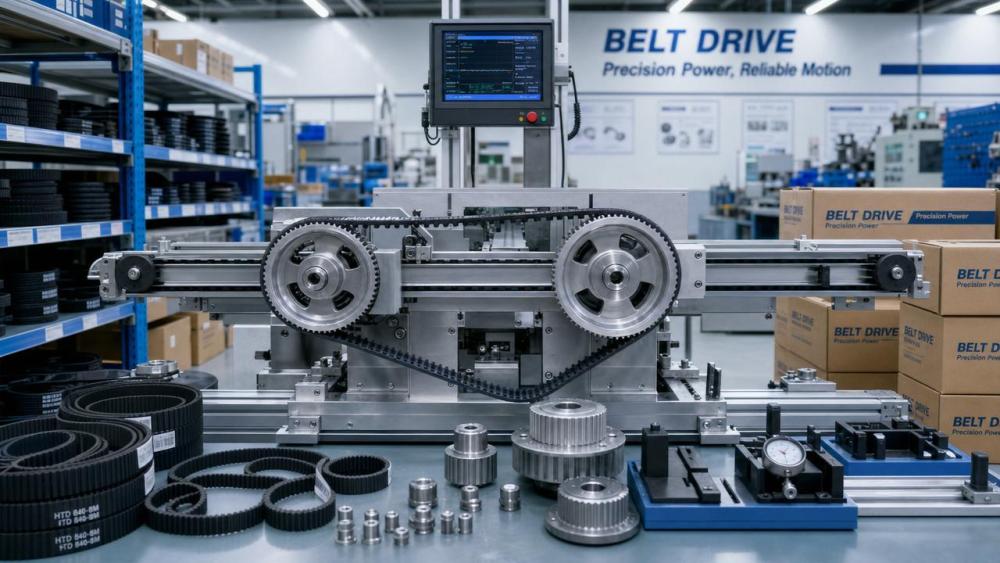
Timing belt drives work in systems where motion quality matters. In indexing equipment, robotic axes, printing units, and synchronized conveyors, a small change in belt quality can affect accuracy, noise, and service life.
A strong timing belt drives supplier does more than ship belts. It should understand pulley fit, tensile cord behavior, compound selection, wear patterns, and the operating conditions that shorten life.
This is especially relevant in the wider precision component market covered by PCTS, where belts, chains, bearings, couplings, seals, and monitoring practices are linked. Poor belt sourcing often creates secondary problems in bearings, shafts, alignment, and maintenance scheduling.
Start with the performance question, not the catalog
Before comparing suppliers, define what the drive must actually do. A fast linear actuator, a clean-room conveyor, and a heavy start-stop packaging line do not place the same demands on the belt body or tooth profile.
The useful starting point is application behavior:
- Required speed and acceleration
- Shock loading and duty cycle
- Ambient temperature and contamination
- Allowable elongation and positional error
- Maintenance access and replacement window
Once those conditions are clear, a timing belt drives supplier can be judged on fit, not on broad marketing claims. This usually leads to better comparisons between standard inventory, custom production, and engineered alternatives.
How to evaluate speed capability without oversimplifying
Speed is often discussed as a headline number, yet real speed capability depends on material stability and system matching. A supplier that quotes maximum speed without discussing pulley diameter, tooth engagement, and tensioning is leaving out critical context.
In practical terms, compare these areas carefully.
Belt construction and tensile member choice
Neoprene, polyurethane, fiberglass, aramid, and steel cord combinations behave differently at high cycle rates. Faster applications often need stronger dimensional stability, but also flexibility around smaller pulleys.
Tooth profile consistency
Uniform tooth geometry reduces vibration and meshing variation. An experienced timing belt drives supplier should provide tolerance data, profile compatibility, and evidence of repeatable mold or machining quality.
Dynamic application support
Some suppliers only sell parts. Others review acceleration curves, transmitted torque, start-stop frequency, and shaft loads. The second group usually delivers more reliable speed performance over time.
Wear resistance is a material and process issue
Wear is not caused by one factor alone. It reflects compound quality, cord adhesion, pulley finish, alignment, contamination, and installation accuracy. That is why the lowest-cost belt may become the highest-cost sourcing choice.
A timing belt drives supplier with real process control should explain:
- Cover material resistance to abrasion, oil, or chemicals
- Tooth fabric design for low-friction meshing
- Bonding quality between body and tensile member
- Batch consistency and traceability records
- Recommended installation and re-tension practices
In broader MRO terms, wear data is valuable because it helps forecast replacement cycles. This aligns with how PCTS frames industrial components: not as isolated parts, but as contributors to uptime, friction control, and maintenance economics.
Lead time is more than shipping speed
Many sourcing problems appear after technical approval. The sample is acceptable, but replenishment is inconsistent, custom lengths take too long, or export paperwork delays urgent orders. Lead time should therefore be compared in layers.
Production lead time
Ask how long standard and non-standard belts take in normal conditions. Distinguish between factory schedule, finishing time, and dispatch readiness.
Inventory depth
A reliable timing belt drives supplier often keeps fast-moving profiles and popular pitches in stock. Inventory strategy matters more than promises during peak demand.
Supply chain resilience
Raw material dependence, single-plant manufacturing, and outsourced finishing can all create risk. Stronger suppliers usually disclose contingency options and communication procedures.
A practical comparison should cover the full timeline, from order confirmation to usable arrival at site. That includes packaging quality, labeling clarity, customs readiness, and document accuracy.
Signals that separate a dependable supplier from a basic trader
Not every timing belt drives supplier operates at the same level. Some are efficient distribution partners. Others add technical review, drawing support, quality control, and lifecycle insight.
The difference usually appears in the depth of information they can provide before an order is placed.
- Clear material specifications rather than generic labels
- Application-based recommendations instead of one-size-fits-all quotes
- Tolerance, testing, and inspection documentation
- Traceability for batches and production dates
- Stable communication on lead time changes and substitutions
- Ability to discuss paired components such as pulleys, bearings, shafts, and seals
That last point matters. In many industrial systems, belt performance is tied to surrounding transmission elements. PCTS consistently highlights this system view across bearings, chains, couplings, sealing, and condition monitoring topics.
A practical comparison framework for sourcing decisions
When several offers look similar, scoring them against the same factors helps reduce bias. The goal is not to find a perfect supplier, but to find the best fit for the operating profile.
This type of framework makes supplier comparison easier to defend internally. It also supports more useful discussions with operations, maintenance, and design teams when part standardization is under review.
What to do before making the final choice
A final decision is stronger when it combines technical fit, sourcing confidence, and replacement planning. Shortlist suppliers only after checking samples, documents, and replenishment realism against the actual duty cycle.
It often helps to compare a timing belt drives supplier using one pilot application first. Review wear after early service hours, confirm order repeatability, and test how quickly questions are answered when conditions change.
From there, the next step is straightforward: build a comparison sheet around speed, wear, and lead time, then refine it with site-specific risks such as contamination, temperature, stocking strategy, and equipment criticality.
That approach turns sourcing into a more reliable transmission decision, which is exactly where long-term value usually appears.
Want to dive deeper into these market dynamics, or need data-driven support for your next business move? Drop a line below and let the analysts at PCTS provide customized insights.
We respect your privacy. Your information is strictly confidential.
Related News
- 00
0000-00
How sealing technology reduces contamination in semiconductor manufacturing - 00
0000-00
Where to install vibration sensors on rotating machinery - 00
0000-00
NTSB Probe Finds Boeing Warned of MD-11 Engine Bearing Risk Years Earlier - 00
0000-00
How to size pneumatic grippers for packaging system integration - 00
0000-00
How to size alloy steel power transmission chains for heavy loads
Weekly Insights
Stay ahead with our curated technology reports delivered every Monday.