





Choosing Belt Drive Systems Starts With the Failure Mode, Not the Catalog
Most belt drive selection mistakes happen before anyone compares belt profiles or pulley diameters. The real error is treating all belt drive systems as interchangeable power transmission options and then sizing around nominal horsepower alone. In practice, the right choice depends on what the drive is most likely to struggle with: high starting torque, sustained high speed, shock loading, contamination, limited tensioning space, or maintenance access. Once that is clear, the belt family usually narrows quickly.
For technical evaluators, belt drives sit in an awkward but useful middle ground. They are quieter and often simpler than chain drives, more forgiving of minor misalignment than gear trains, and easier to service than many enclosed transmission systems. But they are not automatically the low-cost answer. A poorly selected belt can create slip, heat build-up, bearing overload from excessive pre-tension, and frequent stoppages that wipe out any initial savings.
That is why load, speed, and maintenance should be assessed together. Looking at only one of them almost always leads to a distorted decision.
Load Is More Than Rated Power
When engineers talk about load in belt drive systems, they do not just mean motor power. They mean the character of the load. A conveyor with steady resistance, a compressor with pulsating torque, and a crusher feed system may all fall into a similar power band on paper, yet they place very different demands on the belt.
This is where service factors matter. Manufacturers typically provide correction factors for shock, duty cycle, and start-stop severity. Those factors are not a bureaucratic extra. They are the bridge between nameplate conditions and real operating stress. If the drive sees frequent starts, reversals, or intermittent jamming, the selection should reflect peak transmitted torque and dynamic loading, not only average output.
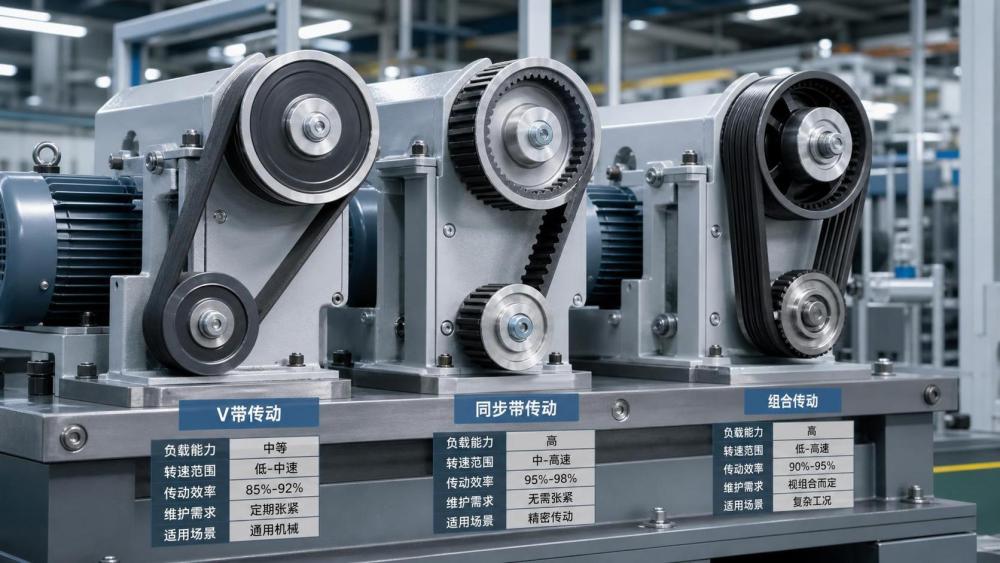
Different belt types react to load in different ways:
A common misunderstanding is that a heavier belt automatically improves reliability. Sometimes it does the opposite. Oversizing can increase bending stress on small pulleys, raise bearing loads because of higher required tension, and reduce efficiency. Belt capacity has to be matched to the pulley geometry and shaft support, not just to the desire for extra margin.
Speed Changes the Selection Logic
At higher speeds, belt behavior becomes less intuitive. Centrifugal effects, heat generation, bending frequency, and vibration all start to shape performance. A drive that works well at moderate speed may become noisy, unstable, or short-lived when rotational speed increases, even if transmitted power does not.
This is why pulley diameter and belt flex life deserve close attention. Small pulleys improve compactness, but they also force tighter bending cycles. For some belt constructions, especially where reinforcement cords and compound fatigue are limiting factors, that can shorten service life significantly. In high-speed drives, poly-V belts often gain an advantage because they combine flexibility with good contact area, while timing belts are preferred when exact synchronization is non-negotiable.
Speed ratio accuracy also needs to be interpreted correctly. Friction-based drives such as V-belts can experience a small amount of slip and creep under load, so they are not ideal for applications where positional accuracy or exact phase timing matters. On fans, pumps, and many process auxiliaries, that may be acceptable. On packaging machinery, servo-linked axes, or transfer systems that rely on registration, it usually is not. In those cases, synchronous belt systems are selected less for raw torque capacity than for predictable motion control.
High speed also amplifies balance and alignment errors. Technical reviews often focus on the belt and underweight the pulley set. Yet pulley runout, groove accuracy, surface finish, and shaft parallelism can decide whether a drive runs smoothly or consumes belts at an abnormal rate. If one side of the system is built to precision tolerances and the other is treated as commodity hardware, the belt becomes the visible victim of a deeper assembly problem.
Maintenance Requirements Should Influence the Design Up Front
Maintenance is often discussed too late, after the transmission architecture has already been fixed. That is backwards. Belt drive systems are frequently chosen because they are easier to inspect and replace than enclosed gears or some chain arrangements. But this advantage only exists if the installation leaves room for tension adjustment, pulley inspection, and safe replacement procedures.
In plants where maintenance windows are short, the practical questions matter as much as the mechanical ones. Can the team check tension without dismantling guarding? Is the center distance adjustable? Does the design require matched sets for multi-belt drives? Are spare pulleys stocked, or only belts? These details affect total downtime more than the purchase price difference between two belt options.
For low-maintenance targets, timing belts are often attractive because they do not rely on friction in the same way as V-belts and therefore avoid slip-related wear during normal operation. That said, “low maintenance” does not mean “maintenance free.” Tooth wear, cord fatigue, contamination, and tension decay still need monitoring. V-belt drives, on the other hand, may demand more periodic retensioning, but in dirty or shock-prone environments they can offer a degree of forgiveness that keeps the machine running when a more exacting system would fail abruptly.
This is one of the more useful distinctions in selection work: some belt drives degrade gradually and give warning through noise, dust, slip, or visible wear; others hold accuracy well until a more sudden end-of-life point. Neither behavior is universally better. The decision depends on whether the equipment benefits more from precision or from fault tolerance.
Environment Usually Decides the Borderline Cases
When two drive options both satisfy load and speed requirements, the operating environment often breaks the tie. Temperature, dust, oil mist, humidity, washdown conditions, and chemical exposure all influence belt material life and traction behavior. A belt that performs well in a clean automation enclosure may behave very differently in a quarry, food line, or outdoor agricultural installation.
Dust and abrasive particles can accelerate pulley wear and interfere with tooth engagement. Oil contamination may reduce friction in V-belt systems. Elevated temperature can harden or soften compounds depending on the material and construction. Where hygiene or static control is relevant, material compliance and specialized belt properties may enter the specification. Those requirements vary by sector and should be checked against the supplier’s documented product data rather than assumed from generic belt terminology.
This is also where belt drive systems should be compared against alternatives honestly. If the environment is extremely abrasive, constantly wet, or exposed to aggressive chemicals, the discussion may need to include chain, direct drive, or sealed geared solutions instead of forcing a belt into an unsuitable role.
What Technical Evaluators Should Ask Before Approving a Selection
A good review process is less about finding the “best” belt and more about exposing hidden assumptions. The following questions usually reveal whether the proposed belt drive systems have been engineered or merely chosen from habit:
- Is the drive sized from actual duty conditions, including start-up and shock load, or only from motor nameplate power?
- Does the application require accurate speed ratio or positional synchronization?
- Are pulley diameters and center distance compatible with the belt’s flex limits and expected life?
- What is the expected maintenance practice: periodic tension checks, condition-based inspection, or run-to-replacement?
- How sensitive is the system to slip, vibration, and noise?
- What environmental exposures could change friction, compound life, or tooth engagement?
- Can local maintenance teams source matching replacement components without long lead times?
These are not abstract procurement questions. They connect directly to cost of ownership. A belt that is slightly more expensive but reduces alignment sensitivity, inventory complexity, or shutdown frequency may be the better industrial choice. Conversely, a premium design specified for a non-critical auxiliary drive can be unnecessary overengineering.
A Practical Reading of “Right-Sized”
In real projects, the most reliable belt drive systems are rarely the most aggressive on paper. They are the ones selected with a realistic view of operating variance. Right-sized does not mean minimal. It means the drive has enough reserve for the real duty cycle, uses pulley geometry that the belt can live with, and fits the maintenance discipline of the site.
If load is uncertain, collect operating data before finalizing. If speed is high, scrutinize pulley quality and dynamic behavior. If maintenance access is poor, account for that as a design constraint rather than an afterthought. Belt selection becomes much clearer once the drive is treated as part of a working machine system instead of an isolated catalog item.
That is the useful way to approach a selection decision: not “Which belt is strongest?” but “Which belt system remains predictable under this machine’s real load, speed, and service conditions?” That question usually leads to better answers, and to fewer surprises after commissioning.
Want to dive deeper into these market dynamics, or need data-driven support for your next business move? Drop a line below and let the analysts at PCTS provide customized insights.
We respect your privacy. Your information is strictly confidential.
Related News
- 00
0000-00
IndexBox Forecasts 3.8% Annual Growth for Global Radial Seals Market Through 2035 - 00
0000-00
How to assess the chemical compatibility of FFKM sealing sheets - 00
0000-00
IndexBox Forecasts 3.6% Annual Growth for Construction Bearings Market - 00
0000-00
When do hydraulic components require an export license? - 00
0000-00
How to size modular pneumatic valve systems for adequate airflow
Weekly Insights
Stay ahead with our curated technology reports delivered every Monday.