





The timing of the underlying event is not clearly specified in the source input, but a customs briefing dated May 27, 2026 indicates a notable trade-development signal for bearing-related exports from Shangrao, Jiangxi. The key change worth tracking is not only the reported export growth, but also the introduction of a green-channel mechanism combining pre-classification for bearing product categories with intelligent ASEAN origin verification. For exporters, distributors, procurement teams, and supply-chain service providers linked to Southeast Asia, this matters because customs handling, origin documentation, and delivery timing are becoming more operationally important in cross-border execution.
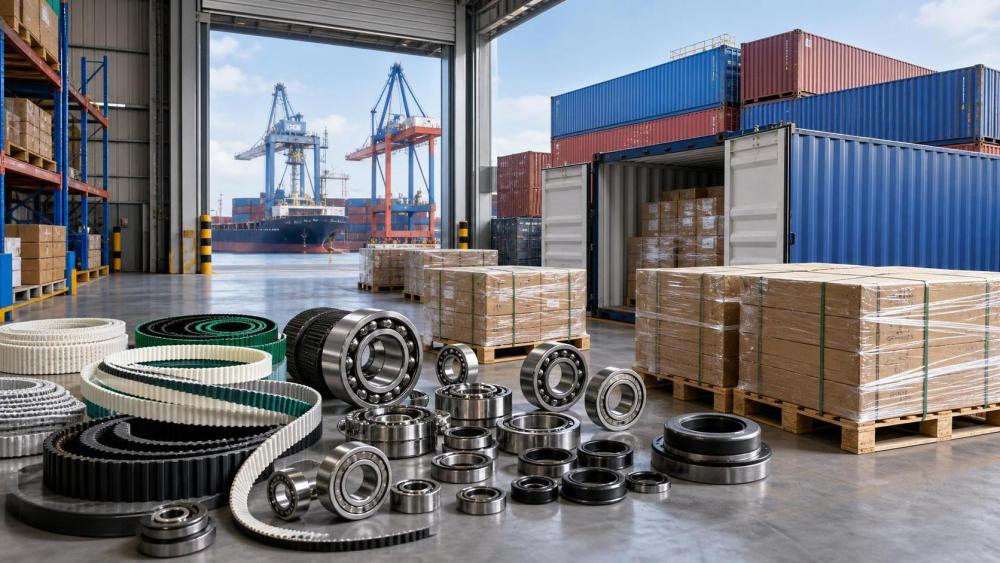
A documented shift in customs handling for bearing-related exports
According to the customs update provided in the input, bearing exports from Shangrao in the first four months rose 56.3% year on year. The main increase came from RCEP member markets including Vietnam, Thailand, and Malaysia.
The same update states that local customs, together with the commerce bureau, launched a green channel built around two elements: pre-classification for bearing-related product categories and intelligent verification of ASEAN origin.
The mechanism reportedly reduced average customs clearance time by 3.2 days. The scope mentioned in the input extends beyond bearings in a narrow sense and includes composite product lines such as PU Timing Belts, Self-lubricating Chains, and Mechanical Seals.
The source summary also notes that this arrangement provides more certainty for Southeast Asian distributors managing inventory turnover and preparing for peak-season stocking.
Why this matters across the trade chain
Export sellers face a higher premium on classification accuracy
From an industry perspective, exporters are likely to be affected first because the green channel is tied directly to product-category pre-classification and origin verification. In practice, that means classification consistency, product descriptions, and supporting trade documents may become more important in securing faster customs handling. Companies shipping mixed or composite industrial product lines should pay close attention to whether their internal documentation aligns with the category treatment used in customs filing.
Distributors gain from predictability, not only speed
For channel and distribution businesses serving Southeast Asian buyers, the more relevant impact may be improved predictability rather than a simple reduction in transit delay. If customs handling becomes more standardized for eligible goods, inventory planning, replenishment timing, and peak-season purchase scheduling can be adjusted with greater confidence. What deserves closer attention is whether this predictability depends on complete origin materials and properly prepared shipment files.
Supply-chain and customs service providers may need tighter document workflows
Customs brokers, logistics coordinators, and related service providers are also likely to feel the effect because the mechanism links clearance efficiency to document readiness. Analysis shows that origin review, classification support, and shipment file completeness may become a more visible part of service quality, especially for shipments covering bearings together with adjacent mechanical transmission or sealing products.
Procurement teams should watch delivery assumptions in contracts and stocking plans
Buyers and procurement teams may also be affected where sourcing plans rely on Southeast Asian distribution channels. If faster or more reliable clearance becomes part of commercial expectations, purchase scheduling, replenishment cycles, and buffer-stock assumptions may need to be reviewed. This is particularly relevant where delivery timing influences seasonal stocking or downstream production continuity.
What companies should watch next in daily execution
Check whether product files support pre-classification treatment
Analysis shows that companies should review whether product descriptions, specifications, and customs-facing materials are sufficiently clear for pre-classification handling, especially for goods that sit across multiple mechanical categories or are sold as part of broader industrial product portfolios.
Keep origin documentation aligned with shipment practice
Because the mechanism includes intelligent ASEAN origin verification, firms should pay close attention to the consistency of origin-related documents used in actual export transactions. The input does not provide the detailed execution standard, so this should be treated as an area requiring continued monitoring rather than as a fully defined compliance framework.
Focus on mixed-category shipments to Southeast Asia
The inclusion of PU Timing Belts, Self-lubricating Chains, and Mechanical Seals suggests that the operational effect may reach composite or adjacent product categories. Export and sourcing teams should therefore watch whether mixed-category shipments require more disciplined document preparation, technical product matching, or supporting materials during customs processing.
Reassess delivery and stocking assumptions cautiously
Observably, the reported reduction in average clearance time can influence lead-time planning, but companies should avoid treating it as a guaranteed outcome in every shipment scenario. It is more appropriate to use the update as a signal to revisit delivery planning and distributor stocking assumptions while continuing to verify how the mechanism is applied in practice.
How this signal should be interpreted for now
Analysis shows that this update is best read as an execution-level trade facilitation signal rather than as a broad rewrite of market rules. The practical importance lies in how customs service coordination, category treatment, and origin review are being translated into shorter handling time for relevant exports.
At the same time, it is more appropriate to understand this as a partially observed rule-implementation development, not as a finished or universal standard across all products and ports. The input confirms the mechanism and the reported time effect, but it does not provide full procedural details, broader enforcement scope, or long-term market feedback.
A practical reading of the current development
For the industry, the main takeaway is that customs process design is becoming a material factor in export competitiveness for bearing-related and adjacent mechanical product lines moving into Southeast Asia. The reported export growth matters, but the more durable signal may be the attempt to reduce friction around classification and origin checks.
In neutral terms, this development is better understood as a concrete implementation signal with real operational relevance, while still requiring continued observation on detailed execution, market consistency, and enterprise-level adaptation.
Source basis and points that still need verification
This article is generated from the user-provided news title, event timing field, and event summary. The specific official source link was not provided in the input, so the exact original release path still needs to be verified on an ongoing basis.
For events of this type, relevant source categories commonly include official notices, releases from regulatory authorities, customs or trade-administration information, industry association updates, standard-setting documents, and reporting by authoritative media. Further observation should focus on detailed implementation language, origin-verification practice, customs execution consistency, changes in tender or procurement documents, market feedback, and how enterprises apply the mechanism in real shipments.
Want to dive deeper into these market dynamics, or need data-driven support for your next business move? Drop a line below and let the analysts at PCTS provide customized insights.
We respect your privacy. Your information is strictly confidential.
Related News
- 00
0000-00
How sealing technology reduces contamination in semiconductor manufacturing - 00
0000-00
Where to install vibration sensors on rotating machinery - 00
0000-00
NTSB Probe Finds Boeing Warned of MD-11 Engine Bearing Risk Years Earlier - 00
0000-00
How to size pneumatic grippers for packaging system integration - 00
0000-00
How to size alloy steel power transmission chains for heavy loads
Weekly Insights
Stay ahead with our curated technology reports delivered every Monday.