





Effective from March 1, 2026, China Customs began using a new export tariff line, HS code 84798970, for intelligent bionic robots. This is worth industry attention not only because it gives humanoid robot exports a clearer customs classification path, but also because the change is already showing effects across supporting components, export execution, procurement planning, and delivery schedules, especially for suppliers of PU Timing Belts and Pneumatic Grippers.
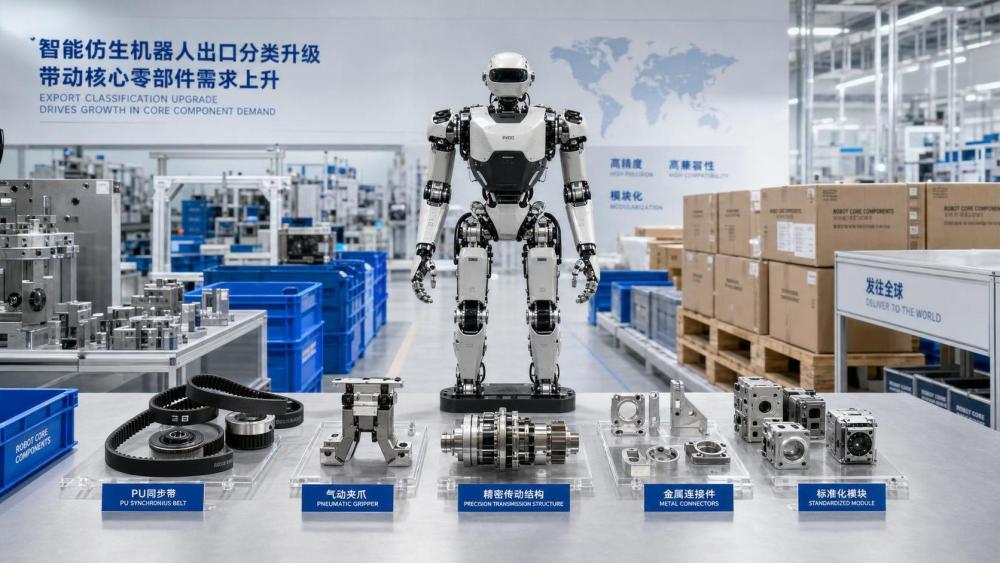
A new customs category is now in use
From March 2026, China formally activated HS code 84798970 for intelligent bionic robots. The change supports the formalization of humanoid robot exports under a dedicated customs item.
In May, exports under this category reached RMB 139 million for the month. The United States, Germany, and Japan ranked among the leading buyers.
The products involved rely heavily on high-precision PU Timing Belts for synchronized joint transmission and high-response Pneumatic Grippers for end-effector operations. Domestic supporting suppliers reported that in Q2, orders for related components increased by more than 65% year on year, while lead times generally extended to 8–10 weeks.
Where the impact is appearing first
Export execution is becoming more structured
For exporters of humanoid robots and related systems, the addition of a dedicated customs item may affect how goods are classified, declared, and described in trade documentation. From an industry perspective, what deserves closer attention is whether internal product descriptions, customs filings, and technical documentation are aligned with the new classification in actual export workflows.
Component suppliers are facing delivery pressure
Suppliers of PU Timing Belts and Pneumatic Grippers may be affected because these parts are directly tied to key robot functions such as joint synchronization and terminal handling. The immediate business impact appears in order scheduling, production planning, and delivery commitments, especially as reported order growth has already been accompanied by lead-time extension.
Procurement teams may need earlier planning cycles
For buyers and sourcing teams, the main issue is not only stronger demand, but also the risk that longer lead times will affect shipment readiness and project timing. Analysis shows that procurement attention is likely to shift toward supplier capacity, delivery visibility, technical consistency of parts, and documentation readiness for cross-border transactions.
Supply chain service providers may see tighter coordination requirements
Logistics, trade support, and related service providers may need to watch for changes in product categorization, supporting paperwork, and delivery timing. Observably, when a new customs line begins to be used in practice, coordination between exporter, supplier, and shipment service parties often becomes more documentation-sensitive, even when the core products themselves are unchanged.
What companies should monitor now
Check whether product documents match the declared category
Companies involved in exporting complete robots should closely review whether commercial descriptions, technical materials, and customs-facing documentation are consistent with the new HS code usage. The input does not provide detailed execution rules, so this should be treated as a monitoring point rather than a confirmed procedural requirement.
Reassess lead times for critical motion and gripping parts
For manufacturers and procurement teams, the reported 8–10 week lead time for relevant PU Timing Belts and Pneumatic Grippers means delivery planning may need to start earlier than before. What deserves closer attention is whether current production and shipment schedules still reflect actual component availability.
Track market-facing requirements in major destination markets
With the United States, Germany, and Japan listed among the leading buyers, exporters should pay close attention to how customer documentation requests, technical file expectations, and after-sales traceability needs evolve in these markets. The provided information does not confirm any new destination-market rule, so this remains an area for continued observation rather than a concluded compliance shift.
Prepare for possible adjustments in bidding and specification language
For companies participating in project procurement or technical tenders, it is worth watching whether bid documents, specification sheets, or sourcing requirements begin to reflect more explicit references to humanoid robot classification, key transmission parts, or end-effector performance. Analysis shows this may become an execution issue before it appears as a formal rule change in every transaction.
Why this matters beyond one month of export data
Observably, this development is better understood as an execution signal rather than a simple export data point. The new customs item indicates that humanoid robot exports are entering a more defined reporting and trade-handling framework, while the sharp rise in demand for PU Timing Belts and Pneumatic Grippers suggests that upstream supporting capacity is already being tested.
At the same time, it is more appropriate to understand this as a rule change that has started to land, but whose practical interpretation still needs continued observation. Analysis shows that the most important next signals will likely come from how documentation is handled in practice, how procurement cycles adjust, and how quickly the supporting supply chain responds to longer delivery expectations.
A clearer trade signal, but not the final picture
This event points to a concrete change already in effect: a newly activated customs classification for intelligent bionic robots is shaping how exports are organized and observed. It also highlights that the impact is not limited to finished robots, but is extending into key component sourcing and delivery management.
From an industry perspective, the most balanced reading is that this is a landed rule change with broader downstream implications still unfolding. Companies do not yet need to assume every execution detail is settled, but they do need to pay closer attention to classification consistency, component lead times, and market feedback from active destination countries.
Basis of this article and what still needs verification
This article is generated based on the user-provided news title, event date, and event summary. The specific official source link was not provided in the input, so the underlying policy wording, customs implementation details, and any related official explanatory documents still require ongoing verification.
For this type of development, commonly relevant source categories include official notices, information released by customs or trade authorities, industry association updates, standards-related documents, and reporting by authoritative media. Further observation is still needed on detailed implementation language, compliance interpretation, bidding document changes, supply chain feedback, and how companies are executing against the new classification in practice.
Want to dive deeper into these market dynamics, or need data-driven support for your next business move? Drop a line below and let the analysts at PCTS provide customized insights.
We respect your privacy. Your information is strictly confidential.
Related News
- 00
0000-00
Where to install vibration sensors on rotating machinery - 00
0000-00
NTSB Probe Finds Boeing Warned of MD-11 Engine Bearing Risk Years Earlier - 00
0000-00
How to size pneumatic grippers for packaging system integration - 00
0000-00
How to size alloy steel power transmission chains for heavy loads - 00
0000-00
Where are axial piston pumps used in mining equipment?
Weekly Insights
Stay ahead with our curated technology reports delivered every Monday.