





Predictive Maintenance Starts With Dust Behavior, Not Sensor Selection
A conveyor belt predictive maintenance plan is worth building in a dusty facility when an unplanned conveyor stop can interrupt a production line, block material flow, create a cleanup burden, or expose personnel to unsafe intervention. The plan should not begin with a list of sensors. It should begin with the way dust enters, settles on, and moves through the conveyor system.
Dust changes failure patterns. Fine material can pack into pulley lagging, collect around idlers, obscure belt edges, contaminate bearing seals, interfere with optical devices, and make a minor tracking problem develop into belt-edge damage. In dry bulk handling, cement, mining, recycling, grain processing, wood products, and similar operations, a belt can appear serviceable during a routine walkdown while its drive train, rollers, or cleaning system are already operating outside normal conditions.
For a project leader, the practical objective is not to monitor every conveyor component continuously. It is to identify the faults that are likely to stop the process or create a safety event, establish measurable warning signs, and ensure that a warning leads to a timely maintenance action. A dashboard without access planning, cleaning discipline, spare parts, and clear ownership will detect problems without preventing downtime.
Define the Conveyor's Failure Consequences Before Defining Its Monitoring Scope
Dusty facilities often contain dozens or hundreds of conveyors, but their operational importance is rarely equal. A short transfer conveyor with an available bypass does not deserve the same predictive maintenance investment as a main feed belt serving a kiln, crusher, packaging line, ship loader, or production bottleneck.
Start by grouping conveyors according to consequence rather than equipment age alone. Consider the effect of a belt failure on throughput, downstream accumulation, restart time, safety exposure, environmental housekeeping, product contamination, and the availability of an alternate route. Then assess whether the conveyor has a history of repeated faults, difficult access, long lead-time parts, or frequent operation near maximum load.
This ranking determines the appropriate maintenance approach:
- Low-consequence conveyors may need disciplined visual inspections, basic cleaning, and planned component replacement.
- Process-critical conveyors often justify condition monitoring on drives, pulleys, and selected idlers, together with documented response thresholds.
- Conveyors handling abrasive or sticky dust may require intensified cleaning and mechanical inspection even when their operating hours are moderate.
- Conveyors with difficult access, such as elevated galleries or enclosed transfer routes, benefit from remote indicators because discovering a fault late can be more costly than the fault itself.
A criticality review also prevents a common mistake: treating the belt as the only asset that matters. In many stoppages, the belt is the visible casualty while the initiating problem lies in a seized idler, worn bearing, loaded pulley, failed scraper, misaligned structure, or abnormal drive condition.
Map Dust-Driven Failure Modes Along the Material Path
The most useful inspection and monitoring points follow the path of material and dust, from loading zone to discharge. Each location produces different evidence of degradation.
At the loading point, inspect whether the material stream is centered and stable. Off-center loading creates uneven belt loading and can pull the belt toward one side. Dust accumulation within skirting can trap material against the belt, accelerate cover wear, and increase friction. If skirts are adjusted too tightly in an attempt to control dust, they may create a persistent drag condition that increases power demand and damages the belt surface.
Along the carrying run, examine idler rotation, roller contamination, frame alignment, belt edge condition, and material buildup. A roller may continue turning intermittently even as its bearing begins to degrade. Heat, noise, vibration, and a growing dust ring around the roller can be earlier evidence than complete seizure. In highly abrasive service, worn idler shells and damaged rollers can also create localized belt damage before a maintenance round identifies the defect.
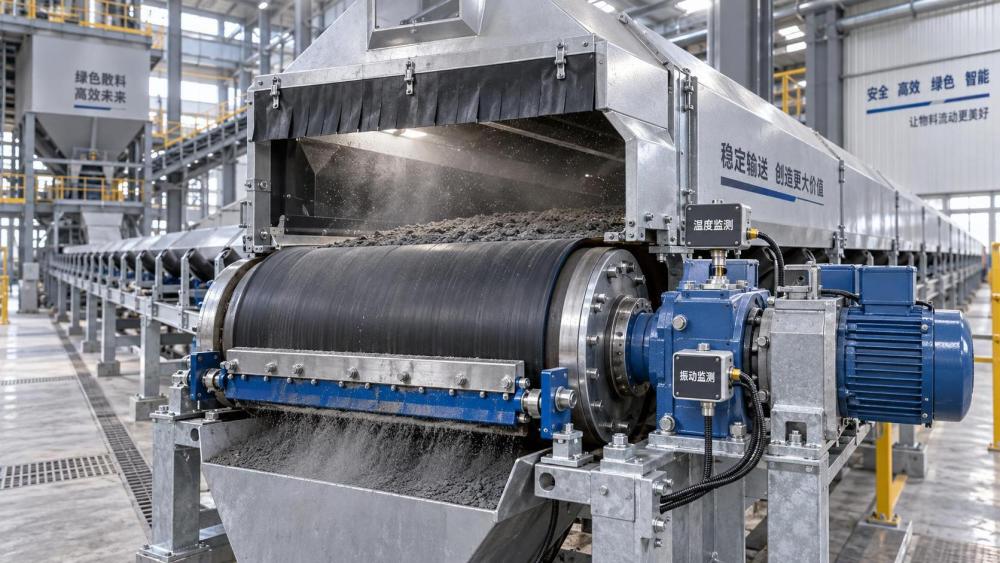
At head, tail, bend, and take-up pulleys, buildup deserves special attention. Material packed on a pulley changes its effective diameter and surface profile. That can alter belt tracking, reduce traction, introduce cyclic vibration, and impose uneven loading on pulley bearings. The fault is sometimes misdiagnosed as a tracking issue, leading teams to adjust training devices repeatedly while the underlying buildup remains in place.
Discharge zones require a separate check. Poor belt cleaning allows carryback to drop throughout the return run. The result is more than housekeeping: carryback can coat return rollers, promote mistracking, overload cleaners, contaminate bearings, and increase the frequency of manual cleanup. A maintenance plan should treat primary and secondary cleaners, tensioning systems, and plow arrangements as reliability components rather than ancillary accessories.
Use Condition Indicators That Can Survive the Environment
Predictive maintenance depends on useful signals, not on collecting the largest possible volume of data. Dust, vibration, moisture, temperature swings, and cleaning activity can degrade sensor reliability. Monitoring choices should therefore be matched to the failure mode and the local environment.
For drive systems, motor current, power trend, gearbox vibration, bearing temperature, and lubricant condition can reveal developing mechanical issues. A rising power requirement may indicate increased material load, belt drag, buildup, or a deteriorating rotating component. It should be interpreted alongside throughput and operating conditions. A high current reading during a heavy production period has a different meaning from the same reading at normal loading.
For pulley and idler bearings, temperature and vibration are useful where sensors can be installed, protected, and serviced. Thermal monitoring is particularly valuable for identifying abnormal friction and potential hot-running components, but it should not be used as the only indicator. A bearing may be damaged without presenting a clear temperature rise under every duty cycle, while direct sunlight, nearby process heat, or dust accumulation can affect surface readings.
For belt condition, visual evidence remains important. Belt-edge fraying, cover cuts, splice deterioration, abnormal wear patterns, and recurring mistracking are not always captured effectively by a single sensor. Fixed cameras can assist in accessible, repeatable viewing locations, provided lenses and housings are included in the cleaning schedule. In severe dust, a camera that cannot see clearly becomes another unmaintained asset.
Belt speed and slip detection are especially relevant at critical drives. A mismatch between commanded drive speed and actual belt movement can indicate slip, reduced traction, mechanical binding, or a developing drive fault. These signals become more valuable when they are linked to alarm rules that account for startup, loading changes, and planned operating states.
The point is not to declare one technology superior across all conveyors. A practical plan usually combines a limited number of instrumented indicators with repeatable field observations. The field route confirms conditions that sensors cannot fully explain, while trends help teams see gradual change that an individual inspection may miss.
Build Baselines Before Setting Alarm Limits
Many monitoring programs lose credibility because alarm thresholds are copied from generic guidance or set before normal operating behavior is understood. A conveyor carrying dry material at fluctuating rates will naturally show changing vibration, current, and temperature patterns. Dusty sites add another variable: cleaning condition can materially affect readings.
Establish baseline data after confirming that the conveyor is mechanically sound, reasonably clean, correctly tracked, and operating under known conditions. Record the operating load, belt speed, ambient conditions where relevant, drive settings, and maintenance state. For rotating equipment, collect multiple readings across typical production conditions rather than relying on one commissioning value.
Trend direction is often more actionable than an isolated value. A stable gearbox vibration signature that begins to rise after repeated cleaning-system failures deserves investigation even when it has not reached an arbitrary alarm level. Similarly, a growing difference between comparable drive temperatures may point to a developing issue before either individual temperature appears extreme.
Alarm design should distinguish between alerts requiring observation and alarms requiring intervention. If every notification produces an urgent work order, maintenance teams will eventually ignore the system. If alarms are too permissive, the program merely documents failures after they become disruptive. A useful escalation process might define three decisions: inspect during the next available route, schedule corrective work during a planned window, or stop and assess immediately because the risk of continued operation is unacceptable.
Connect Inspection Routes to Specific Maintenance Decisions
Routine inspections are still essential in dusty service, but a checklist should be designed to produce decisions rather than a record of completed rounds. “Check conveyor condition” is too vague. A technician needs to know what condition is being checked, what abnormal evidence looks like, how it should be documented, and when it changes the maintenance priority.
For example, an inspection route can require observation of belt tracking at designated reference points, material buildup at head and tail pulleys, cleaner contact condition, idler noise or heat, structural looseness, dust accumulation near bearing seals, and evidence of carryback on the return side. Recording a repeatable condition category, photo, temperature comparison, or vibration trend is more useful than a simple pass/fail mark.
Some checks should be linked directly to corrective actions:
- Repeated belt drift toward the same side calls for inspection of loading alignment, pulley buildup, structure squareness, and roller condition before trainer adjustments are made.
- Increasing carryback should trigger review of cleaner blade wear, cleaner tension, belt surface condition, discharge geometry, and material moisture behavior.
- A hot or noisy idler requires evaluation for replacement and inspection of the surrounding belt area for heat damage or abnormal wear.
- Rising drive load requires confirmation of actual throughput, buildup, skirting drag, belt tension, pulley traction, and drivetrain condition.
- Recurring dust deposits around a component should lead to examination of sealing, guarding, extraction, and access arrangements, not only repeated cleaning.
This relationship between observation and action is where a predictive program becomes operational. It converts a condition signal into planned work before an emergency repair crew is required.
Cleaning Is a Reliability Control, Not a Separate Housekeeping Activity
In dusty facilities, maintenance planning often separates cleaning from mechanical reliability. That division creates blind spots. A conveyor can be inspected and lubricated on schedule while buildup continues to alter tracking, load distribution, heat transfer, and sensor visibility.
Cleaning tasks should be assigned according to failure consequence and dust generation points. The aim is not to create an unrealistic requirement for spotless equipment. It is to prevent deposits that interfere with rotation, tracking, sensing, guarding, or safe access. Define who cleans each area, when the task is performed, what conditions trigger extra cleaning, and how the result is verified.
The plan should also address the cleaning method. Compressed air may disperse fine dust into bearings, electrical enclosures, or adjacent equipment if used without control. Aggressive scraping can damage seals, lagging, cable protection, or sensor mounts. Water-based cleaning can introduce corrosion or material handling issues in some facilities. The best method depends on dust characteristics, enclosure design, and the equipment materials, but the decision belongs in the maintenance strategy rather than being left to improvisation.
Plan Spares Around Recovery Time and Failure Evidence
Predictive maintenance reduces surprise, but it does not eliminate component failures. Critical spares planning must account for the time needed to diagnose, access, isolate, replace, align, test, and restart the conveyor. Keeping a spare bearing is of limited value if the required pulley assembly, lift arrangement, or belt repair materials are unavailable.
For high-consequence conveyors, review the availability and condition of idlers, pulley bearings, lagging repair materials, belt repair kits, cleaners, scraper blades, tracking components, gearbox or coupling items, and sensor hardware. Storage conditions matter in dusty or humid environments; unprotected spares can degrade before they are installed.
Spare selection should follow the failure modes identified during the criticality review. A facility that repeatedly experiences carryback and roller contamination may gain more reliability from readily available cleaners and sealed idlers than from a broad stock of low-probability electrical parts. Conversely, a long-lead gearbox on a bottleneck conveyor may justify a different level of contingency.
Make the Plan Usable During Production Pressure
The test of a conveyor belt predictive maintenance plan is whether it still functions when production is under pressure. Maintenance teams need authority to act on defined warning conditions, while project and operations leaders need a clear view of the operational consequence of deferring work.
Use a short review cycle to examine recurring alarms, emergency repairs, belt damage, carryback levels, missed inspections, and repeat work orders. Look for patterns across mechanical condition, cleaning performance, operating practice, and access constraints. A repeated problem is often evidence that the maintenance task is treating the symptom rather than the cause.
A well-built program gives project leaders a defensible basis for scheduling interventions: evidence of deterioration, the likely failure path, the available repair window, and the parts required to complete the work. In dusty conveyor service, that discipline is more valuable than a larger sensor count. It keeps the belt, drive, pulleys, idlers, and cleaning system managed as one connected reliability problem.
Want to dive deeper into these market dynamics, or need data-driven support for your next business move? Drop a line below and let the analysts at PCTS provide customized insights.
We respect your privacy. Your information is strictly confidential.
Related News
- 00
0000-00
How to check vibration analysis software for sensor compatibility - 00
0000-00
IndexBox Forecasts 3.8% Annual Growth for Global Radial Seals Market Through 2035 - 00
0000-00
How to assess the chemical compatibility of FFKM sealing sheets - 00
0000-00
IndexBox Forecasts 3.6% Annual Growth for Construction Bearings Market - 00
0000-00
When do hydraulic components require an export license?
Weekly Insights
Stay ahead with our curated technology reports delivered every Monday.