





On July 1, 2026, Shanghai Yangshan Port began a pilot export verification process for Heavy Roller Chains shipped to the EU, bringing carbon-footprint documentation into the pre-shipment stage for this product category. For exporters, manufacturers, customs-facing logistics teams, and EU-focused buyers, the immediate issue is not only compliance paperwork but also delivery timing, because missing documents can now translate directly into delayed release and a longer order cycle.
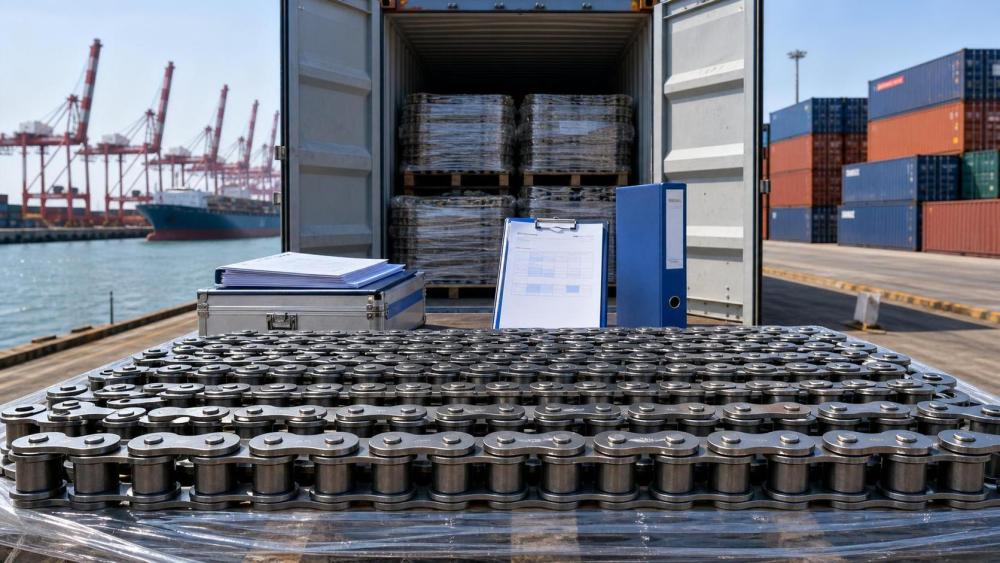
A new pre-shipment requirement at Yangshan Port
According to the provided event information, Shanghai Yangshan Port, together with the General Administration of Customs of China and SGS, launched a pilot program described as a green channel for exports of high-load transmission components starting on July 1, 2026.
The first covered category is Heavy Roller Chains. Under the pilot, all products in this category destined for the EU must submit a carbon footprint declaration (CFP) compliant with EN 15804+A2:2023, along with a third-party verification report, before shipment.
The provided information also states that shipments without these documents will face delayed clearance, with the average delivery cycle extended by 5 to 7 working days.
Where the pressure is likely to appear first
Export-facing manufacturers will feel it at the shipment gate
From an industry perspective, manufacturers and direct exporters of Heavy Roller Chains are the most immediately affected because the requirement applies before cargo release. The operational impact is likely to concentrate in document preparation, verification readiness, and shipment scheduling for EU-bound orders.
What deserves closer attention is whether the carbon-footprint declaration and the third-party verification report can be prepared in time for each shipment, since the stated penalty for missing documentation is a release delay rather than a later-stage correction.
Supply chain and customs teams will have to absorb timing risk
For logistics providers, freight coordinators, and customs-handling teams, the main issue is workflow disruption. Analysis shows that even where production is complete, incomplete compliance files may hold cargo at the port stage, which can affect booking plans, departure timing, and customer delivery commitments.
The practical concern here is not a change in product demand stated by the event, but a change in how shipment readiness is judged for this route and product scope.
EU buyers and procurement teams may focus more on document readiness
Buyers and procurement teams sourcing Heavy Roller Chains into the EU may also be affected because delivery timing now depends in part on carbon-footprint documentation being accepted before shipment. Observably, the risk is concentrated in order confirmation, supplier coordination, and expected lead times rather than in any confirmed change to product specifications beyond the stated documentation requirement.
What companies should monitor now
The exact execution of the pilot at shipment stage
Companies should track how the pilot is implemented in day-to-day export handling, especially for EU orders within the Heavy Roller Chains category. The event confirms the filing requirement and the consequence of delay, but businesses still need to watch closely for any further official wording that clarifies submission timing, review steps, or practical acceptance criteria.
Document ownership and verification sequencing
A key operational issue is who inside the supply chain is responsible for preparing the CFP and arranging the third-party verification report before shipment. Analysis shows that responsibility gaps between factory, exporter, and service provider could turn a compliance requirement into a scheduling problem.
Customer communication around lead time exposure
For companies serving EU customers, it is worth reviewing how delivery windows are communicated. The provided information already indicates that non-submission can extend the average delivery cycle by 5 to 7 working days, so contract timing, booking buffers, and shipment notices may require closer coordination.
Whether the pilot remains category-specific or becomes a broader signal
What deserves closer attention is that the pilot starts with Heavy Roller Chains as the first covered category. Companies operating in adjacent export lines may need to monitor whether this remains a narrow product-specific control or becomes a reference point for wider document checks in similar export segments.
Why this looks bigger than a single paperwork update
Analysis shows that this development is more than a routine filing adjustment because it ties carbon-footprint disclosure and third-party verification directly to cargo release for EU-bound shipments in a defined product category. That gives the requirement immediate commercial relevance through lead-time risk.
At the same time, it is more appropriate to understand this as an active industry signal rather than a fully settled long-term outcome. The event clearly confirms the pilot, the covered product category, the required documents, and the delay consequence for non-submission. What remains to be observed is how consistently the process is applied over time and whether similar mechanisms appear in other categories or ports.
How the market may read this for now
For the industry, the most balanced reading is that this is a short-term operational change with potential long-term significance. In the near term, its effect is practical and shipment-related: EU orders for Heavy Roller Chains now face an added pre-shipment compliance checkpoint at Yangshan Port. In the longer view, the more important question is whether this pilot signals a broader normalization of carbon-footprint verification in export execution.
For now, it is more appropriate to treat the event as a concrete compliance development that warrants close monitoring, not as proof of a wider market outcome that has already been established.
Basis of this article and what still needs verification
This article is based on the user-provided news title, event date, and event summary. The analysis is limited to those confirmed inputs and does not rely on additional unverified market data, company statements, or external policy interpretation.
For this type of development, relevant source categories would usually include official notices, customs-related announcements, company disclosures, industry association updates, authoritative media coverage, and standard-setting documents. A specific official source link was not provided in the input, so further verification remains necessary. Continued attention should focus on any later official clarification of execution details, category scope, and follow-up changes to document review practice.
Related News
- 00
0000-00
Where are axial piston pumps used in mining equipment? - 00
0000-00
Embodied AI Robotics and Drive Control Forum Held in Shanghai - 00
0000-00
How does seal service life affect the total cost of ownership? - 00
0000-00
Schaeffler to Cut 3,460 Jobs and Close Five European Plants - 00
0000-00
How does system size affect the price of a belt drive system?
Weekly Insights
Stay ahead with our curated technology reports delivered every Monday.