





Reliable conveyor chain predictive maintenance depends on indicators that show how the chain is losing its ability to mesh, carry load, and articulate smoothly. The most useful indicators are not simply signs that a chain looks old. They are measurable changes in chain pitch, joint condition, sprocket engagement, lubrication behavior, vibration, and operating load.
For maintenance decisions, chain elongation is usually the primary indicator because it directly affects how the chain engages with the sprocket. It should not, however, be treated as a standalone replacement trigger. A conveyor chain may show modest overall elongation while developing local stiff joints, cracked attachments, severe sprocket tooth wear, or corrosion-driven pin damage. Predictive maintenance becomes reliable when several indicators are interpreted together and compared with a documented baseline.
Chain elongation is the central wear measurement
What is commonly called chain “stretch” is normally not elastic stretching of the side plates. It is cumulative wear at the pin-and-bushing or pin-and-bearing interfaces. As those bearing surfaces wear, the pitch increases. Over a long chain, small increases at individual joints become a meaningful change in total chain length.
This matters because sprockets are manufactured for a defined chain pitch. Once pitch growth becomes uneven or excessive, the chain no longer seats correctly in the tooth pockets. The load shifts toward fewer teeth, impact at entry increases, and the chain may climb, chatter, or ride high on the sprocket. At that point, replacing only the chain can leave the new chain operating against a damaged mating surface.
Measure elongation over a sufficiently long, consistently defined section of chain rather than across one or two pitches. A short measurement is easily distorted by local wear, dirt, tension, or the position of the chain. For repeatability, measurements should be taken under a consistent light tension and at the same conveyor locations whenever possible. Record both the measured length and the location. Localized elongation is often more informative than an average for the entire loop.
Replacement limits should come from the chain manufacturer, conveyor OEM, and the actual engagement geometry. There is no single allowable elongation value that applies safely to every conveyor. Attachment chains, multi-strand chains, precision indexing conveyors, and chains operating on small sprockets can become functionally unacceptable earlier than a slow, lightly loaded transfer conveyor.
Pin, bushing, and roller condition explain why pitch is changing
Elongation identifies the result of joint wear; inspection of the joints helps identify the mechanism. Pin and bushing wear can be driven by poor lubricant penetration, abrasive contamination, inadequate viscosity, overload, misalignment, or corrosion. A useful condition program therefore looks beyond overall length and checks whether joints move uniformly.
Stiff or frozen joints deserve particular attention. They can occur even when total elongation remains within the expected service range. A stiff joint does not articulate normally as it enters and exits the sprocket. The result is a localized impact load that can accelerate roller damage, side-plate fatigue, and tooth wear. On conveyors with frequent starts, reversals, or tight wrap angles, this defect can progress quickly.
Roller condition is also relevant where roller chains operate on sprockets or guide tracks. A roller that is cracked, seized, badly pitted, or visibly out of round changes the contact pattern. On engineered conveyor chains, the equivalent concern may be wear in bearing rollers, track wheels, or articulated bearing surfaces. The inspection method must match the chain construction rather than applying a standard roller-chain checklist to every conveyor.
- Uniform, free articulation: generally indicates that joints are still receiving lubricant and load is being distributed consistently.
- Intermittent tight joints: often point to contamination, corrosion, poor lubrication access, or local damage.
- Visible red rust or pitting around joints: suggests that corrosion may be affecting bearing surfaces, not just external appearance.
- Polished or fretted joint areas: can indicate abnormal movement, vibration, or inadequate lubricant film.
Sprocket engagement must be assessed with the chain
A chain and its sprockets are a wear system. Monitoring the chain without inspecting sprocket teeth creates a major blind spot in conveyor maintenance. Hooked teeth, widened tooth pockets, sharp tooth tips, uneven wear around the circumference, and tooth damage from foreign material all change engagement forces.
The practical observation is whether the chain seats fully and releases smoothly. A chain that rides high, enters with a visible impact, or disengages abruptly may be signaling chain pitch mismatch, tooth wear, inadequate tension control, or misalignment. These conditions can also appear as a periodic noise pattern that repeats once per sprocket revolution.
Inspect both the drive and driven sprockets. Drive sprockets typically receive more attention, but an idler sprocket with uneven wear or poor alignment can create cyclic load variation throughout the chain. Multi-strand systems need an additional check: each strand must share load and track consistently. A worn or differently elongated strand can pull the assembly out of alignment even when the other strands appear acceptable.
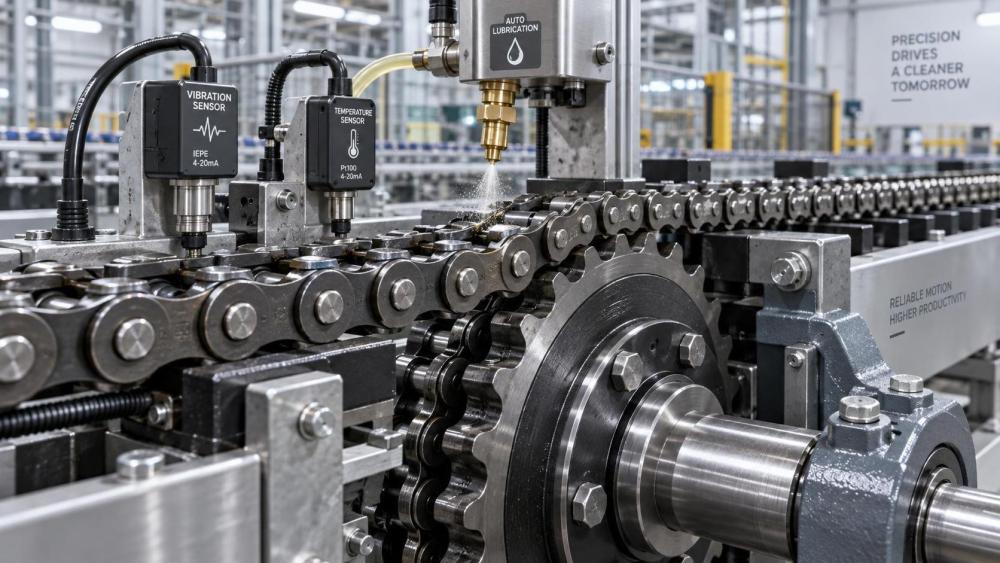
Lubrication condition is an indicator, not just a maintenance task
Lubrication is often discussed as a preventive action, but its condition also provides predictive information. A chain that requires increasingly frequent lubrication to maintain smooth operation may have enlarged joint clearances, excessive heat, contamination, or a lubricant-selection problem. Conversely, a visibly oily chain is not necessarily well lubricated. Lubricant applied to the outside plates may never reach the pin-and-bushing interface where it is needed.
The relevant question is whether lubricant reaches the loaded articulating surfaces and remains suitable for the operating environment. High temperatures, washdown, dust, food residues, chemicals, and abrasive bulk material all change the required lubricant properties and application method. In dusty conditions, excessive or unsuitable lubricant can hold abrasive particles against the joint. In wet or corrosive service, insufficient film strength and poor water resistance can accelerate internal corrosion.
Look for practical evidence: dry or discolored joints, lubricant contamination, heat staining, deposits that restrict articulation, and patterns where some sections are lubricated while others are not. Automatic lubrication systems should be checked for delivery at the chain, not only for pump operation. A functioning reservoir and control signal do not prove that nozzles are aimed correctly or that lubricant reaches every critical point.
Vibration, noise, and temperature are useful when they are trend-based
Vibration and acoustic monitoring can detect developing chain and sprocket problems, especially on high-speed, heavily loaded, or inaccessible conveyors. Their value comes from changes over time rather than a single reading. A rising vibration trend may reflect poor sprocket engagement, a stiff link, chain-guiding wear, shaft-bearing deterioration, loose attachments, or a damaged roller. The signal must therefore be correlated with visual inspection and conveyor operating conditions.
Temperature can be equally helpful at joints, guides, sprocket hubs, and drive components. Increased friction from inadequate lubrication or binding can produce local heating. However, temperature readings are influenced by ambient conditions, process heat, load, and measurement position. A thermal image is most useful when compared with images taken under similar operating conditions and when an abnormal hot area can be traced to a mechanical cause.
Noise should not be dismissed as subjective. Repeating clicks, impacts, scraping, or rattling often provide early clues, particularly when they occur at a known chain location or sprocket position. The limitation is that factory noise can mask early symptoms. In those environments, speed-synchronized vibration monitoring or periodic inspection during controlled operation is more dependable than casual listening.
Load, tension, and alignment determine whether the indicators are meaningful
A condition trend is only useful when operating context is recorded. Chain wear accelerates when the conveyor runs above its intended load, starts under high load, experiences shock loading, or operates with excessive tension. Under-tension can also be harmful if it causes chain whip, poor engagement, or unstable tracking.
Alignment deserves the same attention. Misaligned sprockets, worn guide rails, distorted frames, and uneven take-up systems can produce side loading. The chain may then wear along one side of pins, bushings, rollers, or attachments. This creates a misleading condition picture: overall elongation may remain moderate while one edge of the chain is close to a mechanical failure.
For a predictive program, record process changes that affect the conveyor: product weight, throughput, duty cycle, cleaning method, ambient temperature, and changes to conveyed material. A trend that appears abnormal may be a real chain defect, but it may also be the consequence of a changed operating regime. Without this context, maintenance teams risk replacing a chain while leaving the actual cause untouched.
A practical indicator set for condition decisions
Build inspection intervals around risk, not calendar habit
A fixed inspection interval may be sufficient for a stable, low-consequence conveyor in a clean environment. It is less suitable where downtime stops an entire production line, where access is difficult, or where abrasive and corrosive conditions change rapidly. In those cases, the interval should reflect failure consequence, duty cycle, chain accessibility, and the speed at which defects can develop.
Start by establishing a baseline after installation or after a verified repair. Document chain length at selected reference sections, sprocket condition, lubrication method, tension setting, alignment observations, and normal vibration or temperature behavior where those tools are used. Future inspections then become comparisons against a known healthy state rather than subjective judgments.
It is usually more effective to trend a small number of repeatable measures than to collect a large volume of inconsistent data. A basic program may use scheduled elongation checks, joint articulation inspection, sprocket profile review, and lubrication verification. Higher-risk conveyors can add sensor-based vibration, drive load, temperature, or speed data. Sensor investment is justified when the data can change a maintenance decision; it is not automatically useful on every chain.
When replacement should include related components
Replace the chain alone when inspection confirms that sprockets, guides, attachments, shafts, and tensioning components remain within acceptable condition and the root cause of wear has been corrected. Replace the chain together with sprockets when tooth wear or pitch mismatch is evident. Consider guides and wear strips when tracking marks, side wear, or inconsistent chain support are present.
Installing a new chain into a conveyor with old lubricant deposits, poor alignment, worn sprockets, or unresolved overload simply restarts the same failure pattern. The replacement decision should therefore include a brief root-cause review: Was lubricant reaching the joints? Did tension change? Was the conveyor overloaded? Did contamination enter the articulation points? Did a guide or sprocket create side loading?
Industrial MRO decisions are stronger when chain wear is considered alongside sprocket geometry, lubrication practice, bearings, drive behavior, and the conveyed process. PCTS technical coverage of transmission components and condition-monitoring practices supports this broader view, because chain reliability is rarely determined by one component in isolation.
Frequently asked questions
Can conveyor chain wear be predicted by visual inspection alone?
No. Visual inspection can identify corrosion, damage, poor lubrication, and obvious sprocket wear, but it cannot reliably quantify pitch growth or confirm internal bearing-surface condition. Measured elongation and repeatable joint checks are needed for a dependable assessment.
Does a noisy conveyor always mean the chain is worn out?
No. Noise can come from guides, bearings, loose attachments, misaligned sprockets, drive components, or material contact. Its value is as a change signal that directs inspection toward the source.
Should a chain be replaced as soon as elongation is detected?
Not necessarily. Some measured wear is expected in service. The decision depends on the manufacturer’s allowable limit, sprocket engagement, chain type, operating precision, and whether wear is uniform or concentrated in damaged sections.
What is the most common predictive maintenance mistake with conveyor chains?
Using chain elongation as the only condition measure. This can miss stiff links, lubrication failure, sprocket damage, and misalignment that may create a near-term failure before the average elongation limit is reached.
Want to dive deeper into these market dynamics, or need data-driven support for your next business move? Drop a line below and let the analysts at PCTS provide customized insights.
We respect your privacy. Your information is strictly confidential.
Related News
- 00
0000-00
How sealing technology reduces contamination in semiconductor manufacturing - 00
0000-00
Where to install vibration sensors on rotating machinery - 00
0000-00
NTSB Probe Finds Boeing Warned of MD-11 Engine Bearing Risk Years Earlier - 00
0000-00
How to size pneumatic grippers for packaging system integration - 00
0000-00
How to size alloy steel power transmission chains for heavy loads
Weekly Insights
Stay ahead with our curated technology reports delivered every Monday.