





Choosing heavy-duty chains for high-load conveyors is rarely a simple catalog decision. Chain selection affects load security, wear rate, downtime exposure, lubrication intervals, and the real cost of keeping material flow stable in demanding operations.
That is why the topic matters across bulk handling, mining, steel processing, cement plants, ports, forestry, and large manufacturing lines. In these environments, a chain is not just a component. It is part of the system that carries production risk.
Within the broader transmission landscape covered by PCTS, heavy-duty chains sit alongside sprockets, bearings, seals, lubrication practices, and condition monitoring. Evaluating them correctly means looking beyond rated strength and understanding how the whole conveyor behaves under real load.
What high-load conveyor chain selection really involves
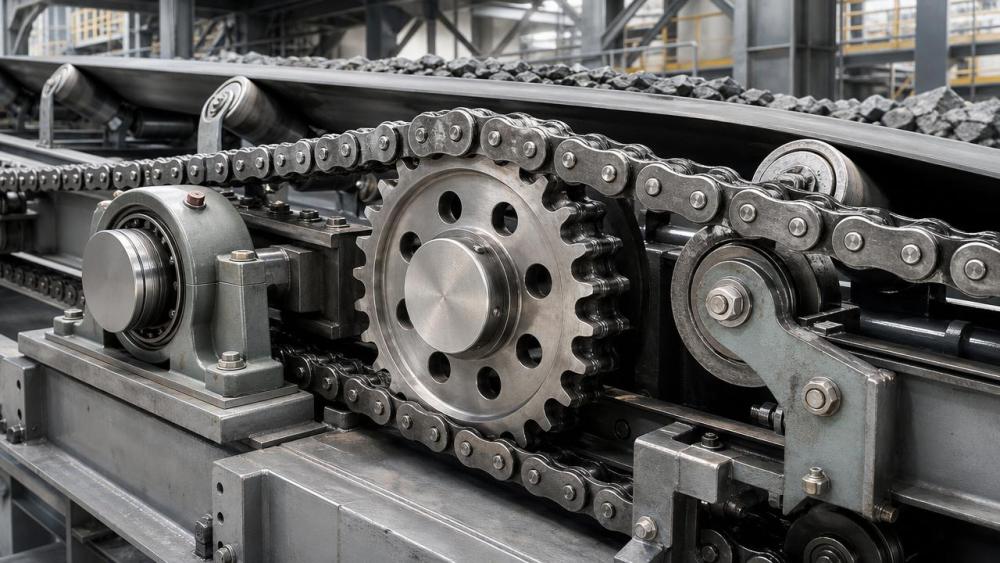
A heavy-duty chain is designed to transmit force and move materials where shock, abrasion, contamination, or sustained tension would quickly damage lighter chain types. The challenge is that “heavy-duty” does not describe one universal design.
Some conveyors need welded steel chains for impact and debris tolerance. Others depend on engineered steel chains, drop-forged chains, roller chains, or scraper conveyor chains with specific pin and bushing configurations.
In practical terms, selection starts with a load path. Static load, dynamic peaks, start-stop cycles, conveyor speed, center distance, and attachment geometry all influence whether a chain survives smoothly or wears out early.
A chain that looks oversized on paper can still fail if articulation is poor, lubrication is wrong, or the sprocket profile does not match the chain design. That is often where evaluation mistakes begin.
Why the industry pays closer attention now
High-load conveyors are being pushed harder. Throughput targets are rising, maintenance windows are tighter, and unplanned stoppages now carry larger commercial penalties than in the past.
At the same time, many operations face harsher conditions. Fine dust, corrosive washdown, temperature swings, abrasive product flow, and longer duty cycles create combined stresses that basic chain ratings do not fully explain.
There is also greater interest in total cost of ownership. PCTS often frames component decisions this way: the chain, sprocket, bearing support, sealing condition, and lubrication method should be judged together, not as isolated line items.
That wider view matters because the cheapest chain can become the most expensive option once wear elongation, sprocket damage, product loss, and labor-intensive replacement are included.
Key parameters that decide whether heavy-duty chains fit the job
A strong evaluation process usually compares several technical factors at once. Focusing on only tensile strength gives an incomplete picture.
Working load and safety margin
Breaking load is not the operating target. The useful question is the expected working load, including overload events, impact peaks, uneven feeding, and jam conditions. From there, a realistic service factor can be applied.
Pitch and articulation behavior
Pitch affects load distribution, engagement smoothness, and bending behavior around sprockets. Large pitch may suit rugged duty, but it can also increase polygonal action and vibration if conveyor speed or geometry is unfavorable.
Material and heat treatment
Pins, bushings, rollers, sidebars, and weld areas should be reviewed individually. Surface hardness, core toughness, and heat-treatment consistency often decide chain life more than nominal material grade alone.
Wear resistance at the joint
Most chain life is lost at the bearing areas between pins and bushings. Elongation from joint wear changes pitch accuracy, accelerates sprocket damage, and reduces tracking stability long before ultimate failure occurs.
Lubrication compatibility
Heavy-duty chains in dusty or hot conveyors need a lubrication strategy that suits the environment. Too little lubricant increases wear. The wrong lubricant can attract fines, harden deposits, or wash away under cleaning cycles.
Environmental conditions often decide the better option
When evaluating heavy-duty chains, environmental exposure should be treated as a primary design input, not an afterthought. The same conveyor load can require very different chain solutions depending on contamination and temperature.
In abrasive bulk handling, hardened wear surfaces and robust clearances may matter more than polished precision. In corrosive areas, alloy choice, coatings, or stainless designs may be worth the cost if replacement access is difficult.
Temperature deserves special attention. Elevated heat changes lubricant behavior, reduces film strength, and can affect material properties. Low temperatures may increase brittleness and change impact resistance during startup.
Moisture and washdown bring another layer of risk. Water displaces lubricant, promotes corrosion, and may carry particles into chain joints. That is why chain choice often needs coordination with sealing, drainage, and relubrication planning.
Looking beyond the chain itself
A chain rarely fails alone. Conveyor reliability depends on how heavy-duty chains interact with sprockets, shafts, bearings, alignment, take-up systems, and attachment points.
Sprocket tooth form must match chain pitch and seating geometry. Worn or poorly machined sprockets create impact loading, misengagement, and accelerated pitch growth. Replacing only the chain can leave the root problem untouched.
Bearing condition also matters. If shaft support is unstable, chain tension becomes inconsistent. That produces side loading, tracking problems, and uneven articulation. In many conveyor audits, the visible chain issue starts elsewhere in the drive line.
This systems perspective is one reason PCTS links transmission parts with lubrication, monitoring, and maintenance economics. Chain performance becomes more predictable when supporting components are reviewed together.
Typical application differences worth separating
Not every high-load conveyor asks the same thing from heavy-duty chains. Separating the application type helps narrow the right specification faster.
- Bulk material conveyors usually prioritize shock resistance, abrasion tolerance, and maintainability in dirty environments.
- Assembly or transfer conveyors may need smoother motion, tighter pitch control, and lower vibration near automated processes.
- Scraper and drag conveyors often require strong joint wear resistance because fines remain in constant contact with moving parts.
- Elevating conveyors need careful review of chain pull, safety margin, attachment security, and consequences of reverse loading.
- High-temperature lines call for compatible metallurgy and lubricants that retain film performance under heat.
Once the application category is clear, comparing chain families becomes more realistic. It also helps avoid copying a specification from another plant with very different duty conditions.
A practical evaluation checklist
A useful review process combines mechanical data with operating history. That approach tends to reveal risks before a chain is purchased or replaced.
- Confirm actual conveyed load, surge load, and startup torque rather than relying only on design nameplate values.
- Check chain speed, sprocket size, articulation angle, and conveyor path for conditions that raise joint stress.
- Review contamination sources such as dust, slurry, chips, moisture, or chemicals that may change wear behavior.
- Compare maintenance access with lubrication needs, because a suitable chain on paper may be unrealistic in service.
- Inspect wear patterns on removed chains and sprockets to identify misalignment, poor lubrication, or overload signatures.
- Request dimensional consistency, heat-treatment data, and service-life references for similar operating conditions.
This is also where condition monitoring becomes useful. Wear elongation tracking, vibration patterns, and lubrication trend data can support a more evidence-based chain decision instead of a purely reactive replacement cycle.
Choosing with lifecycle value in mind
The best heavy-duty chains are not always the heaviest or the most expensive. The better choice is usually the one that matches duty, environment, sprocket condition, and maintenance capability with the least operational compromise.
For many conveyor systems, the most reliable result comes from treating chain selection as part of a broader transmission review. That means comparing chain design, wear points, lubrication practice, and adjacent components as one operating package.
A sensible next step is to map actual conveyor loads, document failure patterns, and compare candidate heavy-duty chains against the environment they must survive. That creates a clearer basis for specification, supplier discussion, and long-term maintenance planning.
Want to dive deeper into these market dynamics, or need data-driven support for your next business move? Drop a line below and let the analysts at PCTS provide customized insights.
We respect your privacy. Your information is strictly confidential.
Related News
- 00
0000-00
How sealing technology reduces contamination in semiconductor manufacturing - 00
0000-00
Where to install vibration sensors on rotating machinery - 00
0000-00
NTSB Probe Finds Boeing Warned of MD-11 Engine Bearing Risk Years Earlier - 00
0000-00
How to size pneumatic grippers for packaging system integration - 00
0000-00
How to size alloy steel power transmission chains for heavy loads
Weekly Insights
Stay ahead with our curated technology reports delivered every Monday.