





How Industrial Chain Applications Improve Reliability in Forestry Equipment
In forestry equipment, reliability is usually decided long before a machine reaches the landing or the cut block. It is decided in the transmission details that keep feed rollers pulling evenly, conveyors clearing debris, heads indexing predictably, and auxiliary drives surviving water, bark dust, vibration, and repeated shock. That is why industrial chain applications forestry engineers evaluate are rarely just about transmitting motion. They are about maintaining control when loading is uneven, contamination is unavoidable, and access for service is limited by terrain, weather, and machine utilization targets.
On paper, a chain drive can look straightforward: torque capacity, pitch, speed, sprocket geometry. In the field, those numbers only explain part of the outcome. Forestry machines work in an environment where impact loading is not an occasional event. A harvester head grabbing crooked stems, a debarker dealing with frozen bark, or a forwarder-mounted processing attachment running through mixed species will generate load spikes that expose weak material choice, inadequate lubrication retention, poor sealing around adjacent bearings, and chain elongation that was underestimated during design review. When users describe a drive as unreliable, the chain itself is often only one part of the failure story.
The most demanding applications are not always the highest-speed ones. Slow and heavily loaded chain systems can be harder to keep stable because they spend more time under boundary lubrication conditions and are more exposed to debris packing. In a forestry feed system, for example, the chain may not fail by dramatic fracture. More often, performance drifts first: inconsistent feed rate, rising motor load, uneven synchronization between left and right sides, or a need for frequent tension correction. Those symptoms matter because they affect cut quality, fuel consumption, and operator confidence before they become a visible maintenance event.
Where chain choice actually changes machine behavior
Forestry equipment includes several very different drive conditions under one machine envelope. A chain used in a log infeed or transfer section sees contamination and repeated starting torque. A chain driving a synchronized mechanism may see lower shock but tighter positional requirements. An auxiliary chain near a hydraulic power unit can be affected by oil mist, heat, and restricted inspection access. Treating these as one generic “heavy-duty chain” problem usually leads to overbuilding one location and underprotecting another.
That is also why engineers who work across bearings, seals, lubrication, and power transmission generally make better chain decisions than teams that evaluate the chain in isolation. If the sprocket alignment is acceptable but the shaft support bearings allow deflection under peak load, the chain will still wear abnormally. If the lubrication plan is sound but adjacent sealing is weak, abrasive fines will contaminate the system and accelerate pin-bush wear. In practice, forestry reliability comes from transmission integration, not from one premium component dropped into an unchanged layout.
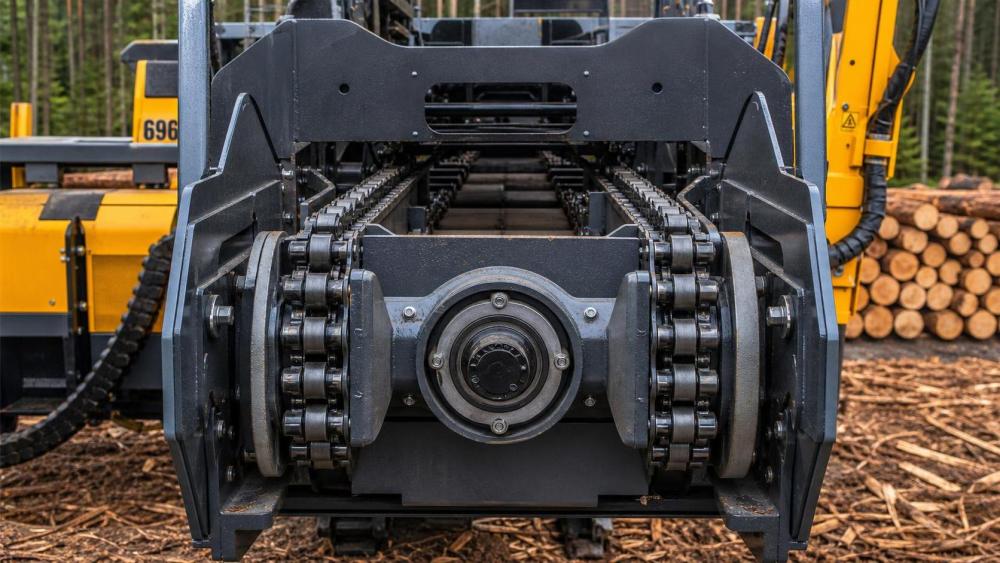
Material selection is one of the earliest points where application fit starts to separate. In wet forestry conditions, corrosion resistance matters, but selecting purely on corrosion resistance can be misleading if it compromises fatigue performance or wear behavior under shock. In many machines, the better question is not “stainless or carbon steel,” but how the chain metallurgy, surface treatment, and heat treatment profile suit a mixed environment of moisture, wood acids, debris, and intermittent impact. Some operating zones need stronger wear resistance at the articulating surfaces; others need better resistance to rust seizure during idle periods and cold starts. The answer can vary within the same machine.
Mud, bark dust, and moisture do not damage all chain systems the same way
One common mistake in chain specification is assuming contamination severity can be judged by how dirty the machine looks from the outside. Forestry contamination is more specific than that. Wet bark fines behave differently from dry wood dust. Mud splash creates another problem altogether because it can carry abrasive mineral particles into articulating joints. Moisture on its own may be manageable; moisture mixed with fines often creates a paste that displaces lubricant and turns a chain drive into a wear mechanism.
This has direct consequences for lubrication strategy. A lubricant that performs well in enclosed industrial conveying may be wrong for an exposed forestry attachment because tackiness, penetration, washout resistance, and dirt attraction have to be balanced. Too light, and the film leaves the pin and bush interface quickly. Too adhesive, and it traps abrasive fines. There is no universal best answer, but the maintenance team should be able to explain what failure they are trying to prevent: washout, corrosion, abrasive wear, cold-start stiffness, or fling-off at speed. Without that clarity, lubrication intervals get shortened without solving the root cause.
Cold weather complicates the picture further. In forestry regions where equipment starts below freezing, chain flexibility, lubricant mobility, and tension response can change noticeably during the first operating period. A chain set correctly in a heated workshop may behave differently after exposure to low ambient temperatures and packed debris. That is why field-adjusted tensioning practices and accessible inspection points are part of reliability design, not afterthoughts for service manuals.
Shock loads are usually a system problem before they become a chain problem
In forestry heads and processing attachments, load is rarely smooth. Stem shape varies, operator handling varies, and hydraulic response is not perfectly uniform. When a chain drive sees repeated shock, engineers sometimes jump straight to a larger pitch or higher nominal strength. That can help, but it may also shift stress into sprockets, shafts, couplings, or hydraulic motor output components if the rest of the drive path is unchanged.
A more reliable evaluation starts with how the shock is generated. Is it caused by abrupt reversing? Poor synchronization between hydraulic actuation and chain-driven movement? Excessive slack leading to impact engagement? Misalignment from structural flex? If the root issue is dynamic, simply increasing chain size may extend survival time while preserving erratic machine behavior. In some projects, better chain guidance, improved tension control, and more stable shaft support can reduce wear more effectively than selecting a heavier chain series alone.
Why maintenance access changes the correct specification
A chain selected for a forestry machine that returns to a central workshop every shift may not be the right choice for equipment working remotely with limited service support. This is where industrial MRO thinking becomes practical rather than administrative. The right chain application is partly determined by what the owner can inspect, lubricate, tension, and replace without turning routine service into a major stoppage.
Procurement teams sometimes compare component cost without pricing the labor and production effect of chain access. If a guarded chain system requires substantial disassembly for inspection, the threshold for preventive intervention rises. Operators will continue running it longer, and the chain must tolerate that behavior. In those cases, service life consistency can matter more than headline capacity. A component with predictable elongation behavior and clearer wear progression is easier to manage than one that performs well initially but degrades abruptly after contamination events.
This is also where smart condition monitoring begins to matter, even in relatively traditional mechanical systems. Not every forestry machine needs a complex digital layer, but vibration changes, motor load trends, temperature shifts near support bearings, or repeated tension-related adjustments can provide early reliability signals. For fleets where downtime cost is high and spare parts logistics are slow, those signals are often more valuable than another round of nominal component upsizing.
Selection errors usually start with the wrong comparison basis
One of the most common customer questions in industrial chain applications forestry programs is whether a heavier chain automatically means better durability. The short answer is no. It may improve margin in one failure mode while worsening efficiency, lubrication behavior, shaft loading, or response in another. Another common question is whether sealed or protected arrangements always outperform more open systems. Again, not always. In heavily contaminated zones, partial sealing that traps fines can become harder to maintain than an accessible layout designed for regular cleaning and re-lubrication.
The better comparison basis is operational fit: duty cycle, exposure pattern, shock frequency, available maintenance interval, alignment stability, and the behavior of connected components such as bearings, sprockets, couplings, hydraulic motors, and seals. That kind of comparison is slower than reading catalog ratings, but it is far more reliable. In forestry machinery, many transmission failures are mixed failures. Wear appears in the chain, but the cause is shared with lubrication management, sealing, or structural deflection.
For OEMs, that means the specification phase should include service assumptions, not just design loads. For maintenance teams, it means failure review should document contamination type, tension history, sprocket condition, and adjacent component wear instead of recording “chain failure” as a single category. Those details are what make the next specification meaningfully better.
What a sound evaluation looks like
A practical evaluation usually starts with five questions. What kind of contamination reaches the articulation points? Are shock loads driven by material variability or by machine dynamics? How stable is shaft alignment under peak load? What lubrication can realistically be applied at the required interval? And what does failure cost in service hours, lost production, and collateral component damage? If those answers are vague, chain selection is still premature.
When those conditions are defined clearly, the decision becomes more disciplined. Material and surface treatment can be matched to corrosion and wear risk. Lubrication can be chosen for washout resistance and contamination behavior rather than generic preference. Tensioning and guidance can be reviewed as reliability items. Bearings and seals around the drive can be checked as part of the same load path. That is the level where industrial chain applications forestry machines depend on stop being mechanical parts choices and become reliability engineering choices.
The strongest specifications usually come from teams that accept a simple reality: forestry equipment does not fail under neat laboratory conditions. It fails in mud, in cold starts, under partial visibility, with mixed loads, and often far from a workshop. Chain systems that remain stable there are rarely the result of one oversized component. They are the result of choosing the chain as part of a bearing, sealing, lubrication, and maintenance strategy that matches the machine’s real operating ground.
Want to dive deeper into these market dynamics, or need data-driven support for your next business move? Drop a line below and let the analysts at PCTS provide customized insights.
We respect your privacy. Your information is strictly confidential.
Related News
- 00
0000-00
How to check vibration analysis software for sensor compatibility - 00
0000-00
IndexBox Forecasts 3.8% Annual Growth for Global Radial Seals Market Through 2035 - 00
0000-00
How to assess the chemical compatibility of FFKM sealing sheets - 00
0000-00
IndexBox Forecasts 3.6% Annual Growth for Construction Bearings Market - 00
0000-00
When do hydraulic components require an export license?
Weekly Insights
Stay ahead with our curated technology reports delivered every Monday.