





Coupling and Sprocket Systems Design: Mistakes That Raise Wear Costs
In coupling and sprocket systems design, small specification mistakes can trigger faster wear, higher maintenance costs, and unexpected downtime.
That problem rarely starts with one dramatic failure.
More often, it begins with overlooked details in alignment, load assumptions, lubrication, shaft support, or chain engagement.
Over time, those choices raise friction, amplify vibration, and shorten replacement intervals.
For industrial operations, the result is a direct hit to lifecycle cost and schedule stability.
This article explains where coupling and sprocket systems design commonly goes wrong and how to correct it early.
Why wear costs rise faster than expected
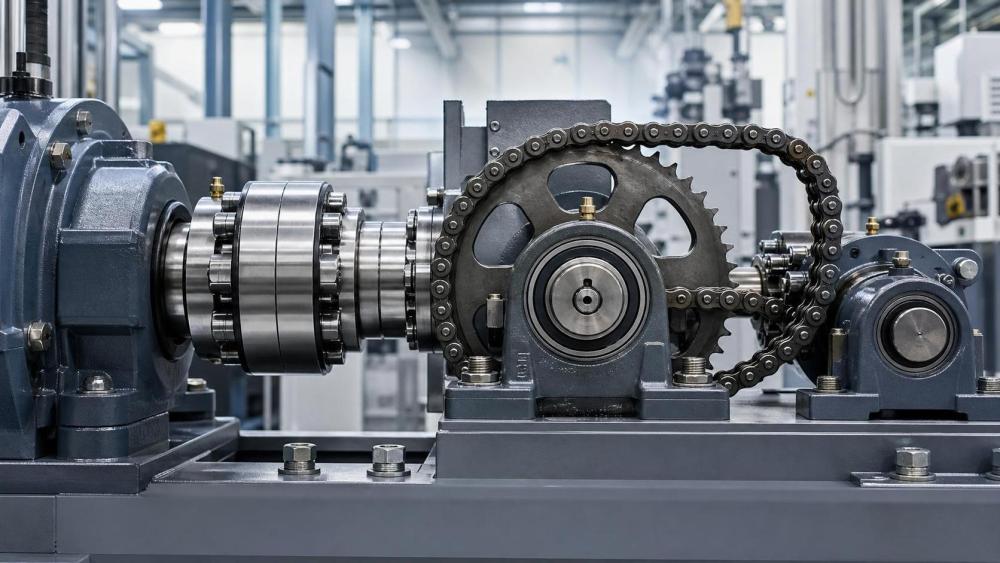
In many facilities, wear cost is treated as a maintenance issue.
In reality, it is usually a design issue first.
A coupling can absorb some misalignment, but it cannot compensate for poor system geometry forever.
A sprocket can deliver torque efficiently, yet tooth wear accelerates when tension, pitch match, or chain path are wrong.
This is why coupling and sprocket systems design should be reviewed as one connected transmission problem.
The main cost drivers are usually easy to recognize:
- Premature chain elongation and sprocket tooth hooking
- Coupling element fatigue and hub fretting
- Bearing overload caused by side forces or shaft movement
- Noise and vibration that spread to adjacent components
- Frequent shutdowns for adjustment, relubrication, or replacement
When these symptoms appear together, the design basis usually needs a deeper review.
Mistake 1: selecting components by nominal torque only
One of the most common coupling and sprocket systems design mistakes is sizing from average torque alone.
That shortcut ignores startup shock, reversing loads, variable speed, and transient overload.
In conveyor lines, packaging equipment, mixers, and heavy-duty indexing systems, peak conditions often dominate wear behavior.
If the selected coupling is too soft or too small, torsional movement increases.
If the sprocket and chain set is undersized, contact pressure rises sharply.
The practical fix is simple.
Build the design around real duty cycles, not catalog headlines.
- Map startup, stop, shock, and jam conditions.
- Apply service factors based on application severity.
- Check torque spikes against coupling limits and chain capacity.
- Review fatigue life, not only static rating.
This approach improves reliability before the equipment ever reaches commissioning.
Mistake 2: underestimating alignment and shaft movement
Alignment errors remain a major source of wear in coupling and sprocket systems design.
Many teams check alignment at installation but miss thermal growth, frame deflection, and foundation movement during operation.
That gap matters because even small angular or parallel offset changes the load path.
The coupling starts absorbing movement continuously.
The chain then sees uneven engagement and side loading at the sprocket.
Common consequences include:
- Accelerated insert, grid, or elastomer wear
- Hub loosening and keyway damage
- Chain tracking instability
- Local tooth wear on one side of the sprocket
A better method is to define operating alignment limits during design review.
That includes hot alignment targets, shaft float assumptions, and base stiffness checks.
In real projects, this prevents repeated troubleshooting later.
Mistake 3: using the wrong sprocket geometry for the application
Sprocket wear is not only about material quality.
Geometry decisions inside coupling and sprocket systems design have a direct effect on wear rate.
Tooth count, pitch diameter, hub design, chain wrap, and center distance all influence contact behavior.
Small sprockets are often chosen to save space.
But too few teeth increase articulation angle and accelerate pin-bushing wear.
Poor wrap angle also reduces load sharing across teeth.
That means higher stress on fewer contact points.
In abrasive or corrosive environments, the wrong tooth profile can magnify the damage even faster.
A stronger design review should ask:
- Is the sprocket diameter large enough for chain life targets?
- Is chain wrap adequate under all load states?
- Are hardened teeth or special materials required?
- Does the layout allow stable tension control?
These questions turn coupling and sprocket systems design into a lifecycle decision, not a parts list exercise.
Mistake 4: ignoring lubrication and contamination pathways
Even a well-sized transmission system will wear early if lubrication strategy is weak.
This is another recurring issue in coupling and sprocket systems design.
Teams often specify chain lubricant but fail to design for delivery, retention, and contamination control.
Dust, water, chemicals, and fine particles then turn normal wear into abrasive wear.
Couplings also suffer when grease selection or seal protection is not matched to speed and temperature.
From a cost perspective, this is usually one of the easiest problems to prevent.
At this stage, coupling and sprocket systems design must account for environment, maintenance access, and relubrication intervals together.
Mistake 5: separating design decisions from maintenance reality
A transmission layout may look correct on paper and still fail in service.
The reason is simple.
Some coupling and sprocket systems design decisions ignore how equipment is actually inspected, adjusted, and repaired.
If guards are difficult to remove, alignment checks get delayed.
If chain tension points are hard to access, crews may leave settings outside target range.
If replacement requires major disassembly, worn parts stay in service too long.
In actual operations, maintainability shapes wear cost as much as materials do.
Useful design checkpoints include quick inspection windows, defined wear limits, safe tensioning access, and standard spare part strategy.
That shift makes coupling and sprocket systems design easier to sustain over years, not just during startup.
A practical review framework for lower lifecycle cost
The most effective way to improve coupling and sprocket systems design is to run a structured pre-release review.
This review should connect engineering, procurement, and maintenance perspectives.
A practical checklist usually covers five points:
- Verify real duty cycle, peak load, and service factor assumptions.
- Confirm alignment behavior under thermal and structural movement.
- Review sprocket geometry, chain wrap, and tension stability.
- Match lubrication and sealing strategy to the operating environment.
- Test maintenance accessibility and spare parts logic before release.
From a business standpoint, this creates better predictability in total cost of ownership.
It also reduces emergency purchasing, field modifications, and schedule disruption.
That is the real value of disciplined coupling and sprocket systems design.
Conclusion
Most wear cost problems do not come from a single bad part.
They come from weak assumptions inside coupling and sprocket systems design.
When load, alignment, geometry, lubrication, and maintenance access are reviewed together, component life becomes more predictable.
That means fewer wear surprises, lower replacement frequency, and stronger budget control.
For organizations focused on industrial reliability, better coupling and sprocket systems design is one of the clearest ways to reduce avoidable lifecycle cost.
Want to dive deeper into these market dynamics, or need data-driven support for your next business move? Drop a line below and let the analysts at PCTS provide customized insights.
We respect your privacy. Your information is strictly confidential.
Related News
- 00
0000-00
IndexBox Forecasts 3.8% Annual Growth for Global Radial Seals Market Through 2035 - 00
0000-00
How to assess the chemical compatibility of FFKM sealing sheets - 00
0000-00
IndexBox Forecasts 3.6% Annual Growth for Construction Bearings Market - 00
0000-00
When do hydraulic components require an export license? - 00
0000-00
How to size modular pneumatic valve systems for adequate airflow
Weekly Insights
Stay ahead with our curated technology reports delivered every Monday.