





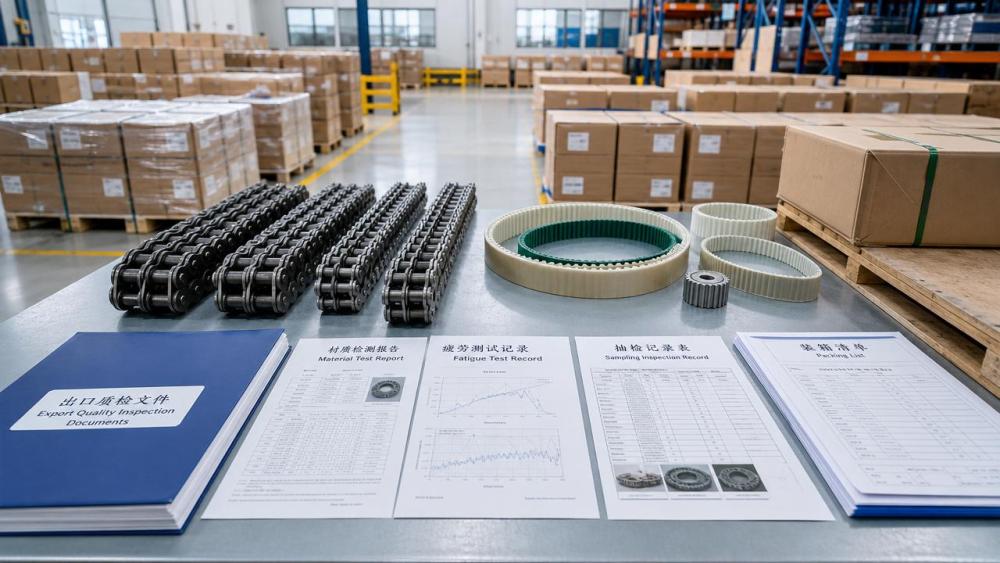
Effective June 1, 2026, China Customs has updated its import and export spot-check inspection catalogue to include Heavy Roller Chains and PU Timing Belts as key products for annual inspection attention outside statutory inspection. For exporters, manufacturers, sourcing teams, and quality documentation staff, this is not just a catalogue update; it directly affects technical file readiness, shipment compliance, and delivery reliability. The requirement to provide material composition reports, fatigue test data, and declarations of conformity to standards such as ISO 606 and ISO 5296 makes this a practical compliance issue that can quickly reach the shipping and customer-facing stages of business.
What the catalogue update confirms
According to the information provided, the General Administration of Customs of China began implementing a revised catalogue of import and export commodity spot-check inspections on June 1, 2026. Under this update, Heavy Roller Chains and PU Timing Belts were included for the first time as priority spot-check targets outside the scope of statutory inspection.
The same information states that exporters must cooperate by providing material composition reports, fatigue testing data, and declarations showing conformity with standards including ISO 606 and ISO 5296. If a spot check fails, the consequences may include return of the full shipment batch or technical rectification, with possible effects on delivery timing and customer trust.
Where the rule change reaches into the supply chain
Export documentation moves closer to shipment risk
For direct export companies, the most immediate impact is that technical compliance records can no longer be treated as supporting paperwork prepared only when customers ask. Because the spot-check scope now explicitly covers these products, shipment readiness may depend on whether supporting material reports, fatigue data, and standards declarations are complete, consistent, and available on time.
Manufacturing control becomes more visible
For processing and manufacturing businesses producing Heavy Roller Chains or PU Timing Belts, the change may affect how production records, raw material traceability, and test evidence are organized before goods move to export. From an industry perspective, what deserves closer attention is whether factory-side quality files can support the exact claims made in export documents and standards declarations.
Procurement and supplier review face tighter checks
For procurement teams and sourcing intermediaries, the update raises the importance of supplier qualification in a practical way. If materials, performance data, or conformity statements are incomplete or inconsistent, the issue may surface not only in customer audits but also during export spot checks. Observably, this pushes procurement review closer to compliance review, especially for products that depend on documented material and fatigue performance.
Testing and compliance support functions may see added pressure
Testing service providers, certification-related service teams, and internal compliance departments may also be affected because the rule change increases the operational value of usable reports and declarations. The issue is not only whether testing exists, but whether records align with the product being shipped and the standards being cited in the export process.
What companies should review now
Check whether technical files match shipment reality
Companies handling the affected product categories should pay close attention to whether material composition reports, fatigue test data, and declarations to ISO 606 or ISO 5296 are current, internally consistent, and linked to the actual exported goods. Analysis shows that documentation gaps can become a delivery problem once spot checks begin to affect batch release or post-shipment handling.
Watch contract timing and delivery commitments
Because failed spot checks may lead to return of the full batch or technical rectification, exporters and sales teams should closely review delivery schedules, buffer time, and communication with buyers. It is more appropriate to understand this as a compliance-to-delivery issue rather than only a customs filing matter.
Review supplier evidence before export booking
Where upstream materials or outsourced processing are involved, companies may need to confirm in advance that suppliers can provide the necessary composition records, testing support, and conformity documentation. If such evidence is assembled only after shipment arrangements are underway, the risk may shift from documentation delay to export disruption.
Continue tracking how the rule is applied in practice
The provided information confirms the new inspection focus and the required supporting materials, but it does not provide more detailed implementation language. For that reason, companies should continue monitoring official wording, practical enforcement approaches, and any downstream changes in customer specifications or tender documentation that may begin to reference this inspection development more directly.
Why this looks like an execution signal, not just a notice
Analysis shows that this update is better read as an execution-level compliance signal rather than a purely symbolic catalogue revision. The inclusion of specific product categories, combined with explicit expectations around material, fatigue, and standards documentation, suggests that affected exporters should prepare for closer scrutiny in actual shipment workflows. At the same time, it remains necessary to observe how consistently the rule is applied and whether market participants begin adjusting purchase terms, acceptance documents, or supplier qualification thresholds in response.
How the market is likely to read this development
From an industry perspective, the most rational reading is that the new spot-check focus raises the operational importance of technical evidence for Heavy Roller Chains and PU Timing Belts in export trade. It does not by itself confirm a broader regulatory expansion beyond the information provided, but it does signal that compliance preparation, document control, and delivery planning for the named products deserve more immediate attention. For now, this is best understood as a rule already in effect that also warrants continued observation as implementation practice becomes clearer.
Basis of this article and what still needs verification
This article is generated based on the user-provided news title, event date, and event summary concerning the June 1, 2026 expansion of China Customs spot checks for exported Heavy Roller Chains and PU Timing Belts. For developments of this kind, relevant source categories typically include official notices, customs or trade authority publications, industry association updates, standards organization documents, and reporting by established trade or industrial media.
No specific official source link was provided in the input, so the exact official publication path still requires further verification. What remains worth monitoring includes detailed implementation wording, practical compliance interpretation, any changes in certification or documentation expectations, shifts in tender or procurement documents, industry feedback, and how affected companies execute against the new inspection focus.
Want to dive deeper into these market dynamics, or need data-driven support for your next business move? Drop a line below and let the analysts at PCTS provide customized insights.
We respect your privacy. Your information is strictly confidential.
Related News
- 00
0000-00
How sealing technology reduces contamination in semiconductor manufacturing - 00
0000-00
Where to install vibration sensors on rotating machinery - 00
0000-00
NTSB Probe Finds Boeing Warned of MD-11 Engine Bearing Risk Years Earlier - 00
0000-00
How to size pneumatic grippers for packaging system integration - 00
0000-00
How to size alloy steel power transmission chains for heavy loads
Weekly Insights
Stay ahead with our curated technology reports delivered every Monday.