





Heavy-load reliability starts with the real service condition
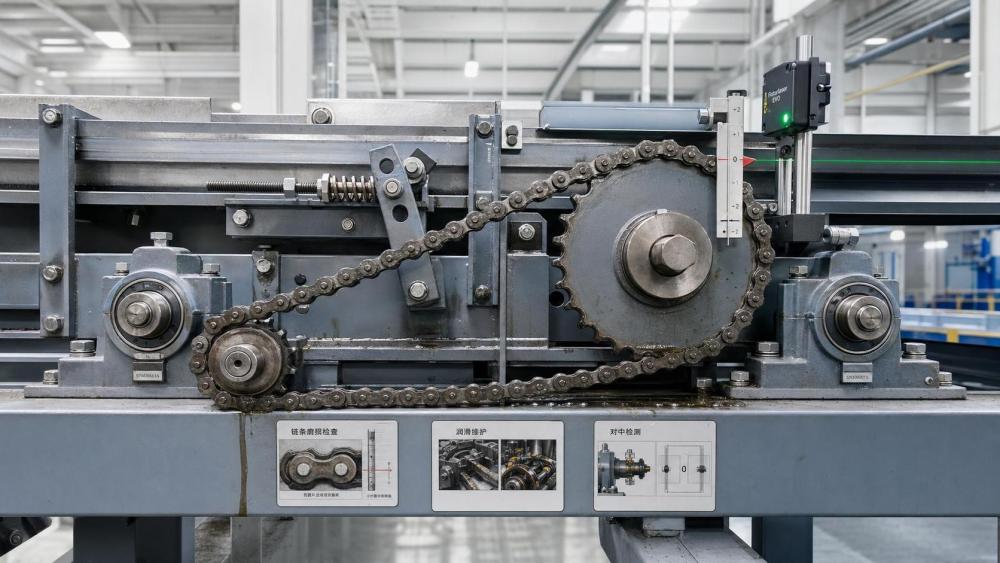
A practical chain transmission system maintenance routine is rarely built from catalog ratings alone.
In heavy-load service, the same chain size can behave very differently across conveyors, bucket elevators, mixers, kiln drives, and packaging transfer lines.
That is why chain transmission system maintenance should begin with operating reality: shock load, speed variation, contamination, lubrication access, and shutdown cost.
In actual field work, failures often develop quietly.
Elongation, poor alignment, stiff joints, uneven wear, and sprocket tooth damage usually appear before a visible break.
A good checklist therefore protects more than the chain itself.
It supports bearings, shafts, seals, lubrication systems, and the wider transmission path that keeps torque moving under demanding industrial conditions.
This matters in a broader MRO context as well.
On platforms such as PCTS, chain drives are assessed alongside bearings, hydraulic units, couplings, seals, and condition monitoring devices because reliability is never isolated to one component.
Different operating scenes create different maintenance priorities
The main reason chain transmission system maintenance varies by application is load behavior.
A slowly indexed conveyor with frequent starts creates repeated impact.
A continuous high-speed line creates heat, lubricant throw-off, and faster articulation wear.
Environmental exposure changes the picture again.
Dust, washdown chemicals, abrasive fines, and high ambient temperature all shift the inspection interval and lubricant choice.
More importantly, similar symptoms may come from different causes.
A hot chain may point to over-tension, poor lubrication, or shaft misalignment.
Uneven wear may come from sprocket runout rather than chain quality.
The stronger approach is to classify the scene before writing the maintenance frequency.
This kind of breakdown makes chain transmission system maintenance more accurate than a single time-based schedule.
Where heavy-load conveyors and elevators need closer watching
Conveying systems often look stable because speed stays low and motion seems predictable.
In reality, these are common overload environments.
Loaded starts, jam clearing, uneven feed, and stop-start duty can produce torque spikes well above nominal design load.
For this scene, chain transmission system maintenance should prioritize elongation measurement over simple visual checks.
A chain may still look usable while pitch growth is already forcing poor sprocket engagement.
That accelerates tooth hooking and creates cyclic impact on shafts and bearings.
The useful field questions are straightforward.
- Is slack changing after loaded startups?
- Do left and right strands wear at the same rate?
- Are take-up adjustments becoming more frequent?
- Does sprocket wear appear at one side first?
If the answer is yes to several of these, replacement planning should include chain, sprocket, and alignment review together.
Changing only the chain often shortens service life when worn tooth geometry remains in place.
High-speed transfer lines fail for quieter reasons
On faster lines, chain transmission system maintenance shifts away from visible overload damage.
The bigger risk is progressive friction at the articulation points.
When lubricant does not reach the pin-bush interface, wear increases quickly even if the chain exterior appears wet.
This is where lubrication practice matters more than lubricant quantity.
Drip, brush, oil bath, or automatic delivery must match speed, orientation, and guarding constraints.
Excess oil can also become a problem.
It attracts particles, creates fling-off, and masks early wear debris that should be investigated.
A practical checklist here should track temperature trend, running noise, lubrication point access, and chain path vibration.
If sensors are available, trend data from vibration or temperature monitoring can support chain transmission system maintenance before shutdown symptoms become obvious.
Dirty, wet, or corrosive environments need a different checklist logic
A chain drive in cement dust, fertilizer handling, food washdown, or chemical vapor service should not be maintained like a dry indoor line.
In these environments, chain transmission system maintenance depends on contamination control as much as wear control.
Cleaning must remove harmful deposits without flushing lubricant out of critical joints.
That balance is often missed.
Aggressive solvent cleaning can leave the chain looking better while internally wearing faster during the next run cycle.
Compatibility checks are equally important.
Lubricants, corrosion inhibitors, nearby seals, and protective covers must tolerate the same media and temperature range.
In mixed transmission systems, chain condition may deteriorate because adjacent seals fail first, allowing washdown water or dust to reach the drive.
That wider systems view is one reason PCTS links chain wear topics with sealing materials, bearings, and industrial MRO decision-making.
The checklist is stronger when inspection points are tied to decisions
Inspection becomes useful when every point leads to a decision.
Otherwise, teams record observations without changing risk exposure.
A workable chain transmission system maintenance checklist should include these decision-linked items.
- Measure chain elongation over a defined number of pitches and compare against replacement criteria.
- Check sprocket tooth profile for hooking, polishing pattern, and side wear.
- Confirm shaft and sprocket alignment with a repeatable method, not visual estimate alone.
- Inspect tension range under cold start and steady load, because one reading is often misleading.
- Verify lubricant reaches the load-bearing joint area, not only the outer plates.
- Look for cracked rollers, seized links, corrosion pits, and abnormal debris near guards.
- Review neighboring bearings, seals, and couplings when wear appears uneven or returns quickly.
This approach makes chain transmission system maintenance a reliability process, not a basic cleaning task.
Common misjudgments usually come from treating similar drives as identical
One common mistake is adjusting tension too aggressively.
A chain that looks loose at rest may be correctly set for thermal change and loaded deflection.
Over-tension raises bearing load and accelerates articulation wear.
Another mistake is replacing chain without checking the source of overload.
If the root cause is product jam, poor take-up travel, or shaft movement, the new chain will fail in the same pattern.
It is also risky to judge serviceability by noise alone.
Some heavily worn chains run quietly until timing, positioning, or tooth engagement begins to drift.
The broader cost mistake is focusing only on part price.
In heavy-load systems, downtime, collateral bearing damage, and emergency replacement effort usually outweigh the chain purchase cost.
Use the next shutdown to build a more reliable maintenance standard
The most effective next step is to sort chain transmission system maintenance by actual operating scene, not by asset name alone.
Group drives by load pattern, speed, contamination, lubrication access, and failure consequence.
Then define inspection intervals, wear limits, lubricant type, alignment method, and replacement triggers for each group.
During the next planned stop, record elongation, sprocket condition, joint freedom, and surrounding component health in one checklist.
That baseline makes future deviations easier to spot.
Where operating conditions are changing, compare chain data with bearing temperature, sealing performance, and drive vibration trends.
A chain drive rarely degrades alone, and the strongest maintenance decisions come from reading the transmission system as a whole.
Want to dive deeper into these market dynamics, or need data-driven support for your next business move? Drop a line below and let the analysts at PCTS provide customized insights.
We respect your privacy. Your information is strictly confidential.
Related News
- 00
0000-00
How to check vibration analysis software for sensor compatibility - 00
0000-00
IndexBox Forecasts 3.8% Annual Growth for Global Radial Seals Market Through 2035 - 00
0000-00
How to assess the chemical compatibility of FFKM sealing sheets - 00
0000-00
IndexBox Forecasts 3.6% Annual Growth for Construction Bearings Market - 00
0000-00
When do hydraulic components require an export license?
Weekly Insights
Stay ahead with our curated technology reports delivered every Monday.