





On-site generation projects often begin with a simple question: should the plant use reciprocating engines or a turbine package? For many sites, reciprocating power is the default because it is familiar, modular, and widely available. Yet there are operating conditions where that default creates hidden penalties in layout, maintenance planning, emissions compliance, or long-term fuel flexibility. For project managers and engineering leads, the better option is not the one with the lowest headline capital cost, but the one that fits the duty profile of the site without creating avoidable complexity later.
A gas turbine tends to fit better when the project has high and steady power demand, space constraints around the power island, a strong need for exhaust heat recovery, or fuel characteristics that make large engine fleets less practical. It can also be the stronger choice when the site values fewer rotating units, lower vibration at the foundation level, and simpler scaling into combined heat and power configurations. The trade-off is that turbines are not universally better. They are sensitive to ambient conditions, often need a more disciplined balance-of-plant design, and may be less attractive where frequent starts, deep load swings, or very small distributed increments dominate the operating profile.
Why the comparison matters early in project planning
By the time equipment procurement begins, many of the important decisions have already been locked in by utility strategy, process heat demand, permitting assumptions, and site civil layout. That is why the turbine-versus-engine decision should be made during front-end definition, not after electrical single-line diagrams are nearly complete.
Reciprocating plants and turbine plants affect more than generator efficiency. They shape the number of auxiliaries, the footprint of ventilation systems, exhaust routing, lube oil handling, spare parts philosophy, outage planning, and even noise control design. A project that assumes engines because they are easier to phase can later discover that multiple engine skids, multiple exhaust stacks, and repeated maintenance intervals create a heavier operational burden than expected. A project that assumes a turbine because it appears cleaner in concept can later find that part-load operation or hot-climate performance was not assessed carefully enough.
For project leaders, the question is less about which technology wins in general and more about which one matches the site's operating reality.
Where a gas turbine usually gains the advantage
Large, continuous base-load demand
If the facility expects to run at high utilization with limited cycling, turbine economics often improve. Many industrial sites with stable electrical demand do not need the fine-grained dispatch flexibility that engine arrays provide. In those conditions, fewer larger units can simplify plant architecture. That may reduce the number of major maintenance events to coordinate, the number of generator breakers to integrate, and the amount of piping and cabling spread across the power block.
Continuous process industries are the most obvious examples. When the core requirement is stable power output rather than repeated ramping, a turbine-based arrangement may be easier to integrate with long production campaigns and fixed staffing plans.
Strong demand for recoverable heat
One of the clearest reasons to favor a turbine is when the project is really a cogeneration project rather than a power-only project. Turbine exhaust is well suited to heat recovery systems that produce steam, hot water, or other usable thermal output. If the site already has a thermal load that runs in parallel with electrical demand, the overall plant value can shift quickly in favor of a turbine package even when the stand-alone electrical comparison appears closer.
This matters because project teams sometimes compare prime movers only on electric efficiency and forget the thermal side of the balance. In many industrial facilities, the ability to recover useful heat from high-temperature exhaust affects boiler operation, fuel purchasing, and plantwide energy coordination more than a few percentage points in electric-only performance.
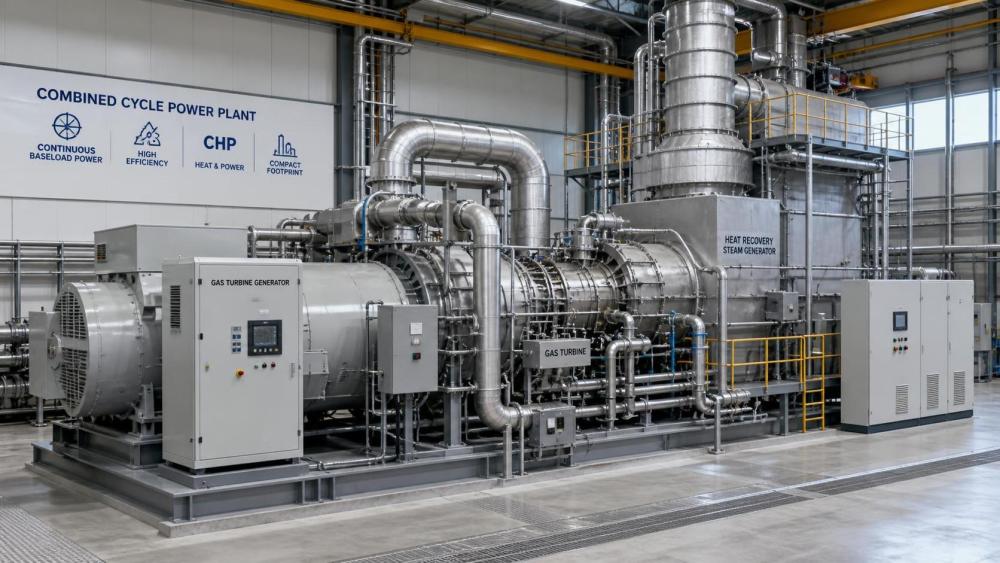
At this stage, teams often review package layouts and duty ranges for a Gas Turbine not as a purchasing shortcut, but as a way to understand how exhaust conditions, package size, and integration requirements align with the broader utility concept.
Limited space and cleaner plant layout
Where the available power island is tight, turbine systems may offer a more compact path to higher output. A reciprocating solution can require several units to reach the same total capacity, along with multiple exhaust paths, cooling provisions, and maintenance access corridors. That is manageable on a greenfield site with generous plot space, but much harder in revamp projects or industrial campuses with congested pipe racks and legacy buildings.
A smaller equipment count can also make sequencing simpler during construction. Fewer major foundations, fewer repeated hookups, and less congestion around access routes may reduce interface risk between civil, mechanical, and electrical contractors.
Lower vibration concerns in sensitive installations
Reciprocating engines introduce cyclic mechanical forces that must be handled properly in foundations and connected systems. This is not inherently a problem; engine plants are built successfully every day. But where the site includes sensitive instrumentation, adjacent process equipment, structural limits in retrofit buildings, or strict foundation constraints, turbine packages may be easier to accommodate. Lower vibration can simplify aspects of installation and reduce concerns about long-term impact on nearby equipment.
Fuel flexibility and site-specific gas conditions
Fuel quality can change the entire selection logic. Some projects have access to process off-gases, associated gas streams, or variable gaseous fuels that are difficult to manage across multiple reciprocating units without adding treatment steps or derating assumptions. In many applications, turbine systems can be evaluated more favorably when the fuel strategy extends beyond pipeline-grade natural gas. The answer depends on the exact composition, contaminants, pressure conditions, and pretreatment design, so this is an area where early fuel characterization matters more than generic technology preferences.
When reciprocating power still holds the stronger position
Project teams can make poor decisions if they look only at the strengths of turbines and ignore the cases where engines remain better aligned with site needs.
Reciprocating power often makes more sense when the load is highly variable, when the site needs stepwise modular expansion, or when partial operation is common. Engines can be brought on and off line in smaller increments, which may help facilities with uncertain demand growth or seasonal operating patterns. For remote projects, engine-based service ecosystems may also be easier to access depending on the region and the installed base of local technicians.
At smaller capacities, engines may offer a more practical starting point if the site wants to stage investment over time rather than commit to a larger single-block design. That matters to project managers balancing budget approval gates against a future demand curve that is still moving.
Decision factors that matter more than nameplate efficiency
Ambient conditions and performance margin
Turbine performance is closely tied to inlet air conditions. Hot climates and high elevations can reduce output and efficiency, which means the design margin must be checked carefully against the site's worst-case operating season. If the plant is expected to carry a fixed process load even on the hottest day, guaranteed output under local conditions becomes more important than catalog ratings.
Engines are also affected by environment, but the shape of the penalty differs. A project that ignores ambient derating can end up underpowered at exactly the time production is hardest to interrupt.
Maintenance philosophy and outage planning
Comparing maintenance only by interval length is a mistake. The more useful question is how maintenance fits the site's operating model. A plant with many reciprocating units may tolerate one engine offline while the others carry the load, which supports redundancy. The same plant also has more repeated service events, more consumable handling, and more chances for small availability losses to accumulate.
A turbine arrangement may concentrate maintenance into fewer major events. That can simplify routine planning, but it can also make each outage more consequential unless backup power, utility import capacity, or process load shedding has been built into the project concept. Project teams should map maintenance strategy against real operating constraints, not just manufacturer interval summaries.
Balance of plant and utility interfaces
The prime mover is only part of the installed system. Air intake filtration, exhaust systems, black-start provisions, gas compression or pressure regulation, cooling arrangements, water or steam interfaces, fire protection, and control integration all influence total project risk. Turbines can look attractive at package level, then become harder to justify if fuel pressure conditioning or heat recovery integration is underestimated. Engines can look straightforward, then become cumbersome when auxiliary systems are multiplied across many units.
This is where experienced project managers usually save money: not by forcing the lower-priced machine, but by uncovering the secondary systems that drive schedule, installation effort, and commissioning complexity.
Questions procurement documents should answer clearly
When the selection is narrowed, the bid package should force suppliers to respond on comparable terms. Otherwise, the project may compare dissimilar assumptions and choose the wrong platform for the wrong reason.
- What output is guaranteed at the site's actual ambient conditions, fuel conditions, and expected degradation profile?
- What operating range is realistic for continuous service, and what happens to heat recovery performance at part load?
- Which auxiliaries are included in the package scope, and which remain with the EPC contractor or owner?
- What maintenance activities require major disassembly, specialist support, or long-lead spare parts?
- How much site work is needed for foundation, ventilation, exhaust routing, and acoustic treatment?
- What protection and control interfaces are standard, and what customization is expected for plant integration?
These questions help prevent a common procurement problem: selecting on equipment price while underestimating integration cost and operational exposure.
Typical scenarios where turbine selection becomes more compelling
Common mistakes in turbine-versus-engine evaluation
One frequent error is treating all on-site generation as a pure electrical problem. If the site has a year-round thermal load, the comparison should reflect total useful energy, not only electric conversion efficiency. Another is assuming modularity automatically lowers risk. More units can mean more flexibility, but they also create more points of failure, more maintenance repetition, and more construction interfaces.
Teams also run into trouble when they rely on nominal ratings instead of guaranteed site performance, or when they postpone fuel analysis until after equipment preference has been set. In brownfield projects, layout assumptions deserve special attention. The winning technology on paper can become the losing one once real access routes, structural limits, and tie-in windows are considered.
What a project manager should carry into the final choice
If the facility needs flexible partial-load dispatch in small increments, reciprocating power may remain the better fit. If the site expects sustained high load, wants to capture exhaust heat, faces layout constraints, or would benefit from a simpler high-capacity block with fewer major units, a turbine deserves serious consideration from the start.
The best decisions usually come from comparing operating patterns, fuel reality, thermal demand, maintenance philosophy, and construction interfaces as one system. Once those factors are on the table, the cases where a gas turbine fits better than reciprocating power become much easier to identify—and much harder to dismiss based on first-cost assumptions alone.
Related News
- 00
0000-00
Where are axial piston pumps used in mining equipment? - 00
0000-00
Embodied AI Robotics and Drive Control Forum Held in Shanghai - 00
0000-00
How does seal service life affect the total cost of ownership? - 00
0000-00
Schaeffler to Cut 3,460 Jobs and Close Five European Plants - 00
0000-00
How does system size affect the price of a belt drive system?
Weekly Insights
Stay ahead with our curated technology reports delivered every Monday.