





A New Export Environment for Industrial Components
Export promotion for component exporters is changing in 2026 because industrial buying behavior is changing with it.
Price still matters, but it no longer opens doors by itself.
Cross-border buyers now compare technical data, compliance readiness, delivery resilience, and after-sales support before they shortlist suppliers.
That shift is especially visible in precision components, where bearings, hydraulic systems, pneumatic parts, seals, chains, belts, and transmission products directly affect uptime.
In practical terms, Export Promotion component exporters can no longer rely on catalog exposure alone.
They need stronger technical credibility, better digital visibility, and clearer proof of application value.
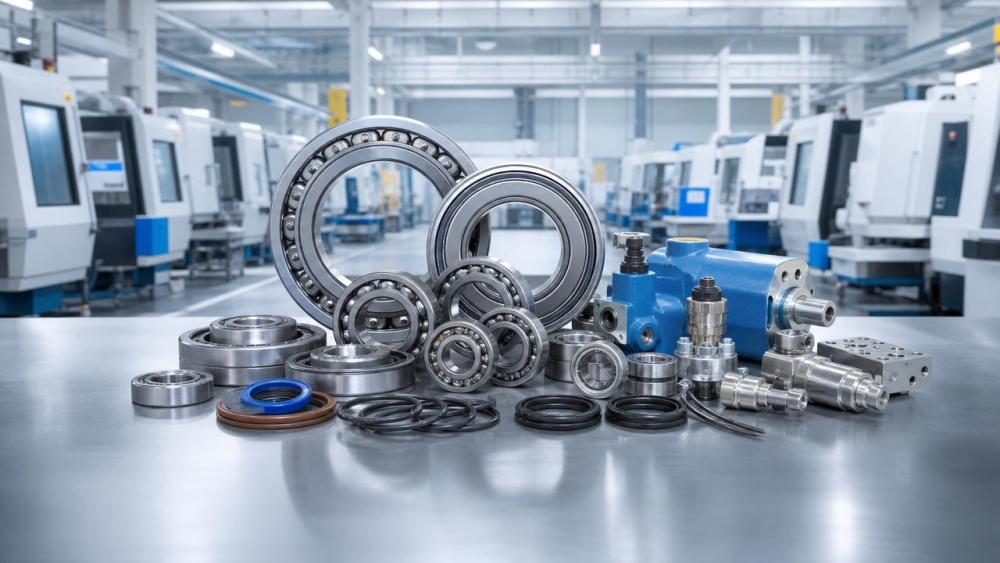
This matters across the wider industrial economy, from machinery production to MRO planning and automation upgrades.
When a component fails, the real cost is often downtime, warranty exposure, or process instability rather than the part price.
That is why export promotion in 2026 is becoming less about broad visibility and more about qualified visibility.
What Export Promotion Means in 2026
At a basic level, export promotion is the work of helping international buyers discover, evaluate, trust, and select an exporter.
For industrial components, that process is more technical than in many other sectors.
A buyer choosing a spindle bearing, hydraulic pump, pneumatic actuator, coupling, or chemical-resistant seal is not only comparing price sheets.
The buyer is judging performance under load, temperature, contamination, lubrication conditions, and service intervals.
So Export Promotion component exporters now depends on how well an exporter translates engineering capability into commercial confidence.
This is where industry intelligence platforms become more relevant.
PCTS, for example, sits at the intersection of component technology, market reporting, supplier visibility, and maintenance economics.
That combination reflects how international sourcing decisions are increasingly made.
Buyers want to understand not only what a component is, but where it performs, why it lasts, and how it reduces operating risk.
Why the Market Is Paying Closer Attention
Several pressures are converging in 2026, and together they are redefining export promotion for component exporters.
Trade and compliance expectations are rising
Industrial buyers want stronger documentation on material traceability, testing, product consistency, and market access readiness.
In some categories, environmental and regulatory disclosures are also becoming part of supplier selection.
Digital procurement is filtering suppliers earlier
Procurement teams and technical evaluators often begin online, long before any RFQ reaches a sales team.
If a supplier cannot clearly present application data, manufacturing strengths, and product range, it may never reach the shortlist.
Higher-value customers want proof, not claims
For sectors like wind power, automation, heavy equipment, chemicals, and precision manufacturing, basic marketing language is no longer persuasive.
Case interpretation, failure prevention logic, and lifecycle cost arguments are becoming more important.
This is one reason Export Promotion component exporters is becoming more content-driven and knowledge-led.
Where the Real Business Value Appears
The most effective export promotion does more than increase traffic or inquiries.
It improves deal quality.
That distinction matters for component exporters serving technical industries with long qualification cycles.
For example, a seal supplier that can explain chemical resistance, maintenance intervals, and leakage prevention has a stronger position than one showing dimensions only.
A bearing exporter that connects lubrication strategy, vibration behavior, and service life can defend value more effectively.
This is why Export Promotion component exporters increasingly overlaps with technical education.
Which Product Segments Feel the Shift Most
Not all industrial components are marketed in the same way.
The 2026 shift is strongest where product performance is closely tied to reliability, safety, and maintenance cost.
- Precision bearings and spindle bearings, where accuracy, friction control, and wear behavior shape equipment output.
- Hydraulic pumps, motors, and cylinders, where pressure stability and service life drive system confidence.
- Pneumatic actuators and air cylinders, where speed, repeatability, and integration support affect automation adoption.
- Chains, belts, sprockets, and couplings, where torque transfer and harsh-environment durability are constant concerns.
- Mechanical seals, O-rings, and advanced sealing materials, where leakage control and media compatibility are mission-critical.
These are the exact areas where PCTS creates context that supports better export communication.
By linking design topics, application conditions, and market trends, it helps suppliers present capability in a language buyers can evaluate.
How to Read Export Promotion More Strategically
A useful way to assess Export Promotion component exporters is to separate visibility from credibility.
Visibility creates discovery.
Credibility creates progress in the buying cycle.
In 2026, both are necessary, but credibility is the more difficult advantage to build.
Signals that now carry more weight
- Application-specific content rather than generic product pages.
- Performance logic tied to uptime, contamination control, efficiency, or replacement cycles.
- Clear evidence of manufacturing process control and consistency.
- Export documentation readiness for target regions and sectors.
- Presence in industry-specific information channels, not only broad marketplaces.
This changes resource allocation.
Budgets once used mainly for catalog listing or exhibition exposure may now need more support for technical content, search visibility, and authority building.
Practical Moves for 2026 Planning
For many exporters, the next step is not a complete marketing overhaul.
It is a sharper alignment between product strengths and buyer decision criteria.
A practical review can start with a few questions.
- Does current export content explain application performance, not just specifications?
- Can a first-time visitor quickly understand where the component fits and why it reduces risk?
- Are compliance, testing, and quality signals visible enough for cross-border evaluation?
- Is the export message adapted for sectors such as MRO, OEM supply, automation, or heavy industry?
- Are market insights and technical narratives supporting the sales process?
When those answers are weak, promotion efficiency usually declines even if traffic remains stable.
When those answers are strong, Export Promotion component exporters becomes a margin protection tool rather than a lead volume exercise.
What to Watch Next
The next phase of export competition will likely reward suppliers that combine product knowledge, digital discoverability, and operational trust.
That is particularly true in precision components, where technical mistakes create expensive downstream consequences.
PCTS reflects this shift by organizing industrial knowledge around component performance, application logic, and supplier visibility rather than around product listings alone.
For 2026 planning, the useful move is to review export promotion through the lens of buyer confidence.
Look at where technical proof is missing, where digital authority is weak, and where commercial messaging fails to explain operational value.
That kind of review creates a clearer basis for stronger positioning, better-fit inquiries, and more resilient growth in global industrial markets.
Want to dive deeper into these market dynamics, or need data-driven support for your next business move? Drop a line below and let the analysts at PCTS provide customized insights.
We respect your privacy. Your information is strictly confidential.
Related News
- 00
0000-00
How to check vibration analysis software for sensor compatibility - 00
0000-00
IndexBox Forecasts 3.8% Annual Growth for Global Radial Seals Market Through 2035 - 00
0000-00
How to assess the chemical compatibility of FFKM sealing sheets - 00
0000-00
IndexBox Forecasts 3.6% Annual Growth for Construction Bearings Market - 00
0000-00
When do hydraulic components require an export license?
Weekly Insights
Stay ahead with our curated technology reports delivered every Monday.