





Meta Title: When Condition Monitoring Solutions for Motors Pay Off in Maintenance Planning
If you are evaluating Condition Monitoring Solutions for motors, the real question is usually not whether the technology works. It is when the spending starts to reduce maintenance cost in a way you can defend to finance, operations, and plant leadership. In most industrial settings, the payoff begins when motor failures cause production disruption, emergency labor, rushed spare-part purchases, or repeated uncertainty in shutdown planning. If motor assets are already stable, lightly loaded, and inexpensive to replace, the return may be slower. The value becomes clear when monitoring helps you move from “fix it when it breaks” to “plan the intervention before the breakdown becomes expensive.”
That distinction matters more than many procurement teams expect. A condition monitoring system can look cost-effective in a vendor presentation and still disappoint in real maintenance planning if it is installed on the wrong motors, tied to the wrong KPIs, or rolled out without a practical response process.
What project teams are really buying
For project managers and engineering leads, this is not just a sensor purchase. It is a decision about visibility, planning confidence, and risk control.
Motor condition monitoring usually combines some mix of vibration, temperature, current, speed, and load-related signals. The purpose is simple: detect abnormal behavior early enough to avoid an unplanned stop, and early enough that maintenance can be scheduled at a lower cost than emergency repair.
A short answer is this: Condition Monitoring Solutions for motors pay off when the cost of one avoided failure is materially larger than the annual cost of monitoring, response, and follow-up maintenance. That sounds obvious, but many teams still buy based on technical features instead of failure economics.
In practice, the strongest business case appears in lines where a motor problem does not stay isolated. It spreads into bearing damage, coupling misalignment, driven equipment stress, scrap, missed delivery, or safety exposure during rushed repairs.
When the ROI becomes measurable
Some plants expect instant savings from every monitored motor. That is usually the first mistake.
Return is easiest to measure in five situations:
- Critical motors that can stop production or create a bottleneck.
- Assets in hard-to-access locations where inspection is labor-intensive or hazardous.
- Machines with recurring issues such as imbalance, misalignment, bearing wear, overheating, or lubrication-related degradation.
- Operations with expensive emergency downtime, especially continuous process lines and high-utilization equipment.
- Sites where shutdown windows are limited and maintenance planning errors are costly.
If your environment fits at least two or three of those conditions, the payback discussion becomes much more grounded.
On the other hand, if the motor is small, non-critical, easy to swap, and backed by available spare inventory, full monitoring may be harder to justify. In those cases, route-based inspection or a simpler screening approach often makes more sense than a permanent system.
That is where many buyers go wrong: they assume all motors deserve the same level of monitoring. They do not. Good procurement starts with asset criticality, not with a catalog.
Why maintenance planning improves before accounting fully sees the savings
Some benefits show up in the maintenance schedule before they show up neatly in monthly cost reports.
For example, a motor may show rising vibration for weeks before failure. That warning allows the team to inspect alignment, verify bearing condition, check lubrication practice, and coordinate parts and labor during a planned stop. The accounting line item may still look like “maintenance spend,” but the plant has avoided overtime, collateral damage, expedited freight, and production loss.
This is why engineering teams often believe the system is paying off earlier than finance does. They are looking at planning stability, maintenance efficiency, and avoided disruption. Finance often wants a more direct comparison between monitoring cost and failure cost.
Both views are valid. The buying decision gets stronger when you define savings in advance. That can include:
- reduced unplanned downtime hours
- fewer emergency work orders
- lower rush freight for spare parts
- better use of planned shutdown windows
- reduced secondary damage to bearings, couplings, or driven equipment
- longer usable life for motors that were previously replaced too early
If nobody agrees on those metrics before implementation, the solution may still work technically, but the procurement case becomes harder to defend later.
Condition Monitoring Solutions for motors are not equally valuable in every maintenance model
The maintenance strategy already in place makes a big difference.
If the site is still largely reactive, condition monitoring can create a sharp improvement because even modest early warning is better than running to failure. If the site already has disciplined preventive maintenance, motor history tracking, spare-part planning, and skilled vibration analysis, the added value may still be strong, but it will come from better prioritization and fewer unnecessary interventions rather than from dramatic “surprise failure” reduction.
That difference matters during supplier evaluation. A site with mature reliability practices may need better analytics, integration, and alarm quality. A site at an earlier stage may need ease of deployment, simple dashboards, and clearer action guidance.
Buying more diagnostic sophistication than your team can use is a familiar waste pattern. So is buying a very simple system for a complex production environment where false alarms or missed faults will quickly damage trust.
Where buyers tend to overestimate savings
There are a few recurring assumptions that deserve a reality check.
First, not every alert prevents a breakdown. Some alerts lead only to inspection, and some inspections confirm that the motor can keep running safely. That is still useful, because avoiding unnecessary replacement has value too, but it is different from claiming every alert prevented failure.
Second, sensors alone do not create savings. The savings come from action: reviewing data, validating the fault, planning the intervention, and learning from repeated patterns.
Third, a monitoring project can underperform if spare parts planning is weak. Detecting bearing degradation early helps only if the required bearings, seals, couplings, or service resources can be secured in time. This is one reason industrial buyers increasingly look at monitoring in the broader context of MRO strategy rather than as a standalone digital purchase.
That broader view is where platforms such as PCTS can be useful. Not because they replace engineering judgment, but because they connect motor monitoring decisions with the surrounding component ecosystem: bearings, seals, power transmission parts, and maintenance economics. For teams comparing vendors or planning MRO risk reduction, that kind of cross-component visibility is often more practical than a narrow product pitch.
The procurement case gets stronger when failure consequences are uneven
A common trap in budgeting is to average everything. Plants say, “A motor replacement costs roughly X,” and then build the business case around that average. Real operations are rarely that tidy.
One failed motor might mean a standard workshop repair. Another might shut down a critical conveyor, a pump train, a packaging line, or an HVAC-dependent clean process. The direct motor cost may be modest while the operational consequence is large.
That is why the better question is not “What does a motor failure cost?” but “Which motor failures create unacceptable planning and production consequences?”
Once you rank assets that way, the decision becomes more precise. You may find that monitoring 15 percent of the motor population captures 70 percent of the maintenance risk. That is usually a better procurement outcome than trying to monitor everything in phase one.
How to judge whether the investment is mature enough for your site
Before buying, confirm a few practical points.
- Do you have a clear list of critical motors and their failure history?
- Can your team define what action should follow a high-temperature or high-vibration alert?
- Is there someone responsible for reviewing alarms and closing the loop?
- Can the maintenance planner use the data to improve shutdown scheduling?
- Are spare parts, contractor support, or internal repair capacity aligned with earlier fault detection?
If several answers are still unclear, the issue may not be the monitoring technology. It may be readiness.
In that case, a pilot on a focused group of critical motors is usually the better move. It gives you enough data to test alarm quality, response discipline, and cost justification without committing to a full-scale rollout too early.
What a sensible buying decision looks like
The strongest procurement decisions are rarely based on sensor specifications alone. They are based on maintenance consequences.
A sensible evaluation usually compares:
- critical asset coverage versus full asset coverage
- permanent monitoring versus periodic inspection
- data quality versus ease of use
- alarm reliability versus dashboard complexity
- implementation cost versus probable avoided downtime
Ask suppliers to explain where their solution works best and where it does not. Serious vendors can answer that clearly. If every motor, every site, and every failure mode supposedly delivers fast payback, the proposal is probably too generic to trust.
It is also reasonable to ask how the system supports the mechanical reality around the motor. Many motor issues are tied to bearing condition, alignment, load transmission, lubrication practice, base looseness, or driven equipment behavior. A monitoring strategy that ignores those links may detect symptoms but still leave the maintenance team guessing about root cause.
So, when do Condition Monitoring Solutions for motors pay off?
They pay off when early warning changes a maintenance decision in time to avoid a more expensive outcome. That usually means lower unplanned downtime, fewer rushed interventions, better shutdown planning, and more confident spare-part decisions. The payback is strongest on critical or failure-prone motors and weaker on low-consequence assets that are cheap and easy to replace.
For project managers, the smart move is not to ask whether monitoring is “worth it” in general. Ask where one avoided failure would justify the spend, where planning uncertainty is costing more than people realize, and whether your maintenance process is ready to act on the signals. When those pieces line up, Condition Monitoring Solutions for motors stop being a technology upgrade and start behaving like a cost-control tool.
FAQ
How long does it usually take to see ROI from motor condition monitoring?
It depends on asset criticality and failure frequency. On high-impact motors, value may appear after one avoided unplanned event. On lower-risk assets, payback can take much longer and may be harder to prove.
Should every motor in a plant be monitored?
No. Start with motors whose failure affects production, safety, access difficulty, or expensive maintenance windows. Broad rollout makes more sense after the critical assets are covered and the response process is working.
Is vibration monitoring enough on its own?
Not always. Vibration is powerful, but some applications also need temperature, current, speed, or load context to avoid misreading the condition or missing developing issues.
What is the biggest reason these projects fail to deliver savings?
Poor follow-through. Teams buy the system but do not define who reviews the data, what counts as actionable, and how maintenance planning changes after an alert.
Image Placeholder List
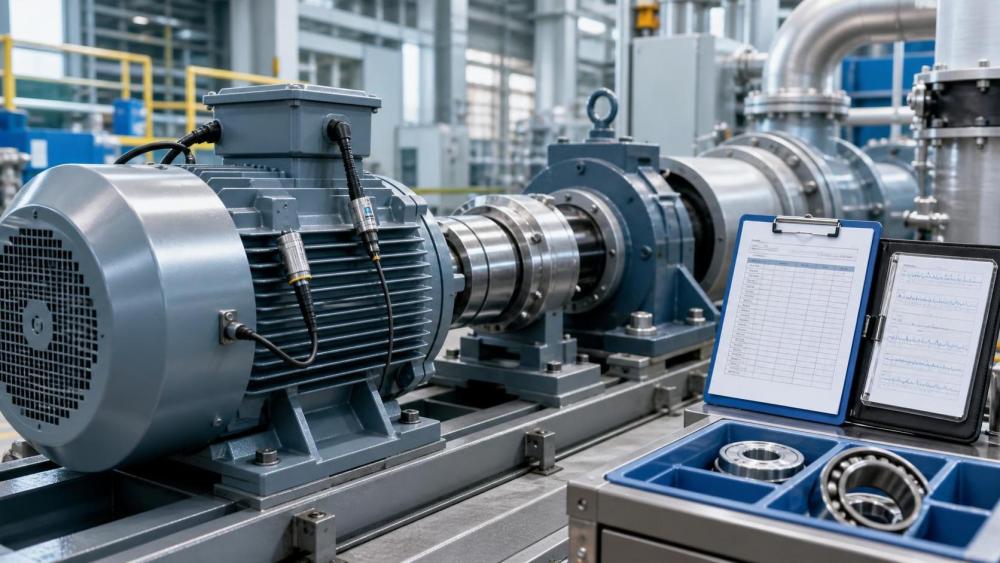
Suggested placement: after the section discussing where ROI becomes measurable.
Suggested image content: a simple decision graphic showing critical motors, failure consequences, monitoring triggers, and maintenance planning actions.
Suggested alt text: Motor condition monitoring ROI decision path for maintenance planning
Internal Link Anchor Text Suggestions
- Motor vibration monitoring for industrial maintenance: link to a technical explainer or guide page
- Bearing failure signs in rotating equipment: link to a bearing diagnostics page
- How to reduce unplanned downtime in MRO planning: link to a maintenance strategy page
- Choosing industrial sensors for predictive maintenance: link to a product comparison or buyer guide
- Spare parts planning for critical rotating assets: link to an MRO procurement page
External Authority Source Suggestions
- Industry association guidance on machinery condition monitoring and vibration analysis
- Motor or bearing manufacturer official technical documentation
- Academic or applied research publications on predictive maintenance economics and rotating equipment reliability
Want to dive deeper into these market dynamics, or need data-driven support for your next business move? Drop a line below and let the analysts at PCTS provide customized insights.
We respect your privacy. Your information is strictly confidential.
Related News
- 00
0000-00
How to check vibration analysis software for sensor compatibility - 00
0000-00
IndexBox Forecasts 3.8% Annual Growth for Global Radial Seals Market Through 2035 - 00
0000-00
How to assess the chemical compatibility of FFKM sealing sheets - 00
0000-00
IndexBox Forecasts 3.6% Annual Growth for Construction Bearings Market - 00
0000-00
When do hydraulic components require an export license?
Weekly Insights
Stay ahead with our curated technology reports delivered every Monday.