





It usually starts with a complaint that sounds simple: the conveyor keeps stopping, or it no longer runs as steadily as it did a few months ago. Production does not always halt because of a dramatic breakdown. More often, the line slows, tracking drifts, tension needs repeated adjustment, noise increases, and maintenance time expands little by little until everyone realizes the drive choice is costing more than expected.
That is the point where purchase price stops being the main issue. When people compare chain and belt drives for conveyors, the first discussion is often unit cost. But in working plants, the more urgent question is different: which option is less likely to create unplanned downtime, unstable movement, contamination risk, or difficult maintenance under the actual operating conditions? If you are evaluating a new conveyor or replacing an underperforming drive, that question usually leads to a better decision than a simple price comparison.
Many teams run into the same trap. A drive is selected from a catalog based on load and speed, then installed into an environment with dust, washdown, oil mist, heat, shock loading, starts and stops, or long operating hours. On paper, both a chain and a belt may seem suitable. In practice, one may tolerate the duty cycle much better than the other. The wrong fit does not always fail immediately, which is why the issue can remain hidden until uptime starts slipping.
Where the decision gets difficult
Conveyors look straightforward from a distance, but the drive sees everything the process does to the machine. A lightly loaded packaging line behaves very differently from a bulk material conveyor, an incline transfer, or a system that must index precisely. Evaluators often have to balance several conflicting priorities at once: torque capacity, cleanliness, noise, maintenance access, alignment tolerance, speed stability, spare parts handling, and the consequences of failure if the line stops mid-shift.
In that situation, it helps to stop asking, “Which one is better?” and start asking, “Better for what failure mode?” Chain and belt drives solve power transmission in different ways, and each tends to fail, wear, and demand attention in its own pattern. Uptime depends less on the abstract merits of either technology and more on whether the drive matches the conveyor’s real stress points.
A common mistake: treating rated capacity as the whole answer
One of the most common evaluation mistakes is to rely too heavily on nominal capacity. A drive may technically carry the required load and still be a poor uptime choice. For example, a system with frequent starts, reversing, shock loading, or irregular product accumulation can expose weaknesses that are not obvious in a basic sizing exercise.
Another mistake is to treat maintenance as a separate issue from selection. In reality, the maintenance burden is part of the selection. If chain lubrication is difficult because the conveyor is enclosed or hard to access, that affects uptime. If a belt requires very accurate alignment but the supporting structure is prone to deflection, that affects uptime too. The right evaluation method includes the operating environment, the installation quality that can realistically be maintained, and the skill level available for routine service.
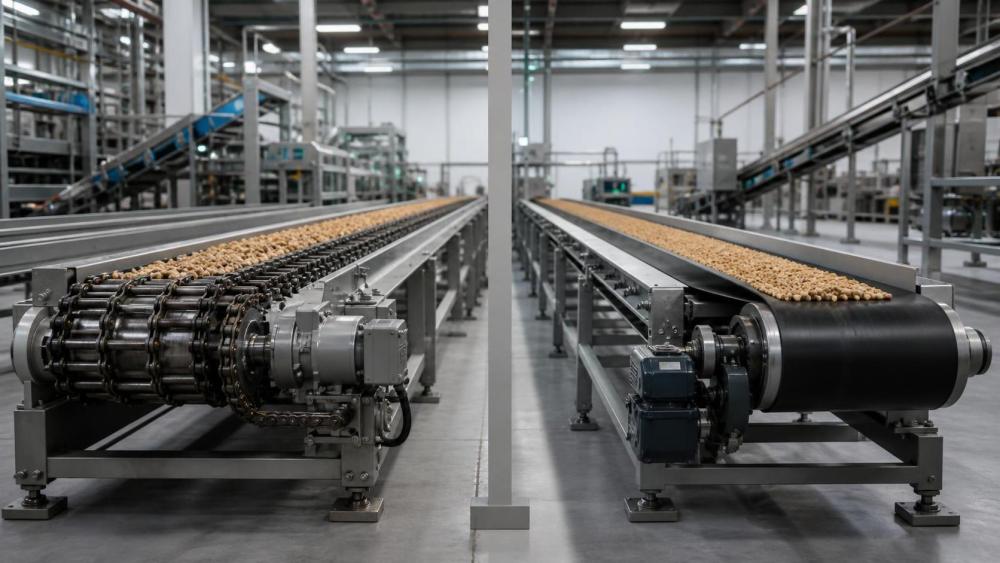
When a chain drive tends to make more sense
Chain drives are often considered when the conveyor must handle heavier loads, transmit higher torque, or operate in conditions where slip cannot be tolerated. They can be a practical choice for applications where positive engagement matters, especially if the system sees intermittent shock or uneven loading. In many industrial settings, chain is valued not because it is cheap, but because it remains predictable under demanding mechanical duty.
That said, chain is rarely a “fit and forget” decision. It usually asks for more attention. Wear elongation, lubrication condition, sprocket wear, contamination buildup, and tension changes all influence service life. If lubrication is inconsistent, a chain that looked ideal in theory can become the source of noise, accelerated wear, and unexpected stoppages. In dusty or abrasive environments, contamination may also work into the joints and change wear behavior faster than expected.
So the uptime question with chain is not only whether it can carry the load. It is whether the plant can support the maintenance discipline the chain requires. If the answer is yes, chain can be a durable and stable choice. If the answer is uncertain, the evaluator should be honest about that risk instead of assuming maintenance will somehow improve after installation.
Where belts often reduce trouble
Belt drives are frequently chosen for quieter operation, cleaner running, and lower routine maintenance. In many conveyor arrangements, they are easier to live with day to day. They can also be a good fit where smoother motion is preferred, where lubrication would be undesirable, or where operators work close to the equipment and noise matters.
But belts create their own set of uptime questions. Tension matters. Alignment matters. Pulley condition matters. In some environments, heat, chemicals, moisture, or product debris may shorten life or affect traction. A belt system that is slightly misaligned may still run for some time while slowly developing tracking issues, edge wear, or inconsistent speed transfer. This can be especially frustrating because the conveyor appears operational until the problem becomes large enough to interrupt production.
For technical evaluation, the useful question is whether a belt’s lower routine maintenance offsets its sensitivity to installation condition and environmental exposure. In many lighter-duty or cleaner applications, the answer is yes. In harsher duty or where absolute positive drive is needed, the answer may be less comfortable.
The better comparison points for uptime
When comparing chain and belt drives for conveyors, a more reliable approach is to judge them against the operating problems most likely to damage uptime. Price belongs in the discussion, but later, not first.
Load behavior over a full shift
Some conveyors run evenly. Others experience surge loading, shock, jam events, repeated starts, or uneven distribution. A drive that looks acceptable under average load may struggle with real peaks. Evaluators should review startup torque, stopping frequency, inclines, and any condition that causes sudden force changes.
Maintenance access in the real machine layout
If a chain needs lubrication or inspection in a cramped enclosure, that work may be deferred. If a belt requires precise tracking adjustment but access points are awkward, small issues may persist too long. A design that is difficult to service often becomes unreliable even when the drive type itself is sound.
Contamination and surrounding media
Dust, washdown, oil mist, abrasive fines, temperature swings, and chemicals all matter. A clean dry packaging area invites a different choice than a wet food line, a foundry transfer system, or a dusty aggregate application. The environment changes not only wear rate but also the kind of failure likely to appear first.
Stability requirements at the driven end
Some conveyors only need to move product from one point to another. Others must maintain accurate timing, position, or synchronized transfer with adjacent equipment. Where movement stability is critical, backlash, slip, stretch behavior, and tension consistency deserve closer attention than initial cost.
Failure consequences
If the conveyor is easy to stop and service without affecting upstream or downstream processes, replacement intervals may be easier to tolerate. If one drive failure disrupts an entire production chain, then predictability and inspection visibility become much more important than saving on the initial purchase.
A practical way to narrow the choice
When the decision is not obvious, it helps to review the conveyor in layers rather than trying to choose from product categories alone.
Start with the motion requirement. Is the drive expected to deliver positive, non-slip transmission under variable load? Is quiet operation a priority? Does the conveyor run continuously, or does it index and stop repeatedly? This first layer often removes unrealistic options quickly.
Next, look at the environment without idealizing it. Plants rarely stay as clean, dry, aligned, and well-adjusted as drawings suggest. If contamination, poor access, washdown, or temperature exposure are routine, build that into the decision. A drive that works only under near-perfect upkeep may not be the best uptime choice.
Then examine how maintenance is actually performed. Not how it should be performed, but how it is likely to be performed on this line, by this team, with this amount of access and shutdown time. That is often the most honest filter in the whole process. Some selection mistakes happen because a technically correct drive is chosen for a maintenance reality that does not exist.
Finally, consider replacement planning and component availability. Sprockets, pulleys, belts, chains, tensioning hardware, and alignment-related parts should not be treated as afterthoughts. A drive system is easier to keep online when wear items, matching components, and inspection points are straightforward to manage across the life of the conveyor.
Signs that the current drive choice may be wrong
Repeated retensioning is one sign. Frequent lubrication complaints are another. Noise that returns shortly after adjustment, uneven product transfer, visible tracking drift, sprocket or pulley wear patterns that appear too early, and recurring alignment corrections can all suggest the issue is not just maintenance execution. Sometimes they indicate that the basic drive type is mismatched to the duty.
It is also worth paying attention to failure patterns that move around the system. If the plant keeps replacing belts, bearings, sprockets, idlers, or tensioning components but the underlying instability remains, the problem may not be a bad batch of parts. It may be that the conveyor needs a different transmission approach, or a more realistic assessment of load and environment.
Making the decision without overcomplicating it
Technical evaluation does not need to become an academic exercise. In most cases, the decision improves once the team shifts from “lowest purchase price for the rated load” to “lowest disruption under actual working conditions.” That change in mindset often clarifies whether the conveyor needs the positive engagement and heavier-duty character commonly associated with chain, or the cleaner and lower-routine-maintenance behavior often associated with belts.
Neither option is automatically economical if it keeps creating stoppages. And neither option is automatically expensive if it runs reliably for the duty it was truly selected for. The useful comparison is not chain versus belt in general. It is chain versus belt for this conveyor, in this environment, with this maintenance reality, and with these uptime consequences if something goes wrong.
That is why chain and belt drives for conveyors should be evaluated as operating decisions, not just component purchases. Once uptime risk, wear pattern, access, contamination, alignment sensitivity, and service interval expectations are brought into the same discussion, the better choice usually becomes clearer.
Want to dive deeper into these market dynamics, or need data-driven support for your next business move? Drop a line below and let the analysts at PCTS provide customized insights.
We respect your privacy. Your information is strictly confidential.
Related News
- 00
0000-00
How sealing technology reduces contamination in semiconductor manufacturing - 00
0000-00
Where to install vibration sensors on rotating machinery - 00
0000-00
NTSB Probe Finds Boeing Warned of MD-11 Engine Bearing Risk Years Earlier - 00
0000-00
How to size pneumatic grippers for packaging system integration - 00
0000-00
How to size alloy steel power transmission chains for heavy loads
Weekly Insights
Stay ahead with our curated technology reports delivered every Monday.