





Choosing an MRO solutions platform used to mean building a larger vendor list and hoping competitive quotes would keep spend under control. That is no longer enough. In most industrial environments, maintenance purchasing sits too close to production risk to be treated as simple spot buying. A bearing with the wrong internal clearance, a seal material that cannot tolerate the media, or a hydraulic component with unclear interchangeability can trigger far more cost than the purchase price suggests.
That is why supplier control and cost visibility have become the two tests that matter most. If a platform cannot help procurement teams understand who they are buying from, what technical risk sits behind each part, and how spend behaves across the lifecycle of equipment, it is not solving the hard part of MRO.
A useful MRO solutions platform should support decisions across bearings, hydraulic systems, pneumatic components, seals, chains, belts, couplings, and other maintenance-critical parts where reliability and interchangeability are rarely straightforward. In practice, the best platforms do not just aggregate suppliers. They organize technical and commercial information in a way that helps buyers compare options, screen risk, and make better replenishment decisions under time pressure.
Start with the real procurement problem, not the software label
Many platforms are presented as procurement tools, industrial marketplaces, or supplier databases. Those labels matter less than the operational problem they solve. For MRO buying, the main challenge is usually a mix of fragmented demand, inconsistent specifications, emergency orders, and uneven supplier quality. Cost visibility is poor because spend is spread across many low- to mid-value items, often purchased by different plants or maintenance teams under different naming conventions.
Before comparing vendors, define where the current process breaks down. Is the issue uncontrolled supplier onboarding? Duplicate SKUs? Limited traceability on critical spares? Weak cross-site visibility into consumption? Too many equivalents with unclear technical fit? A platform that looks impressive at catalog scale may still fail if it cannot handle industrial detail at the item level.
This is especially true in categories covered by PCTS, where component performance depends on application context. A mechanical seal is not just a seal. It is a decision about media compatibility, pressure, temperature, shaft condition, and downtime tolerance. The same is true for spindle bearings, hydraulic pumps, chemical-resistant O-rings, or heavy-duty chains in dirty operating environments. If the platform flattens those differences into generic product names, procurement loses control even if supplier count increases.
Supplier control is more than supplier discovery
A common mistake is to judge a platform by how many suppliers it lists. Volume can help, but control comes from structure. Procurement teams should look at how the platform exposes supplier identity, specialization, manufacturing capability, distribution role, and product scope. For example, there is a meaningful difference between a manufacturer of precision bearings, a regional distributor of mixed MRO brands, and a trader offering broad catalog access with limited technical depth.
The platform should make it easier to answer questions such as:
- Is this supplier a producer, authorized channel partner, or general intermediary?
- Which product families are core to its business?
- Can it support technical documentation and replacement guidance?
- Does it appear consistently in the applications and markets relevant to our equipment base?
- How transparent is it about materials, standards, tolerances, and compatibility limits?
In industrial categories, poor supplier control often starts with weak classification. If a platform cannot separate high-precision motion components from commodity consumables, buyers will struggle to apply the right approval path. A platform with real value should help procurement segment suppliers by risk and technical criticality, not just by geography or price band.
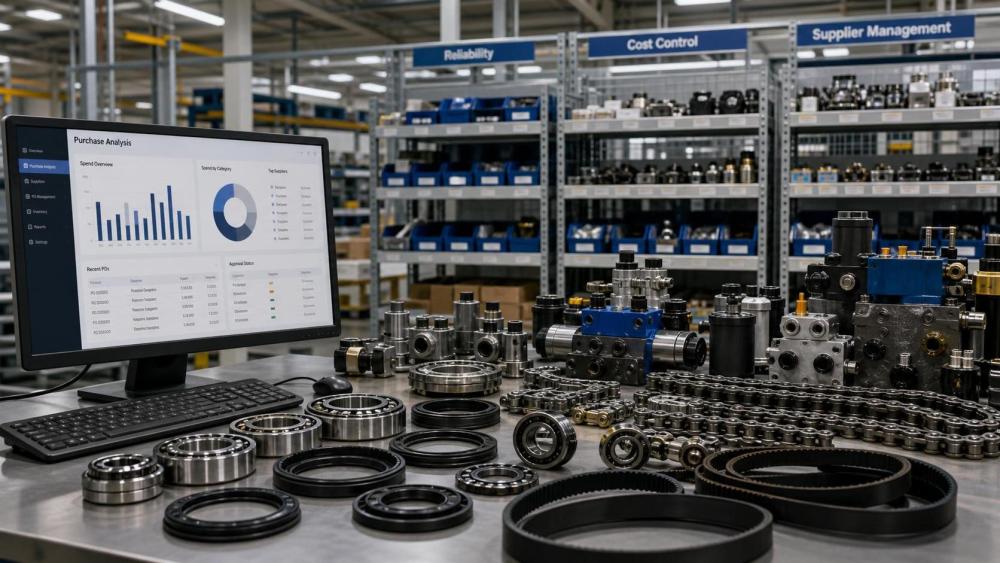
This is one reason industry intelligence portals can be more useful than generic sourcing directories. PCTS, for instance, is built around the engineering logic of rotation, sealing, fluid power, transmission, and reliability. That matters because supplier evaluation is stronger when procurement can view a vendor within the technical ecosystem it actually serves, rather than as an isolated name on a list.
Cost visibility should extend beyond unit price
The phrase “cost visibility” is often used loosely. In MRO, it should mean at least four things: visibility into price consistency, spend concentration, replacement frequency, and consequence of failure. Without those layers, a platform may help you compare quotes but still leave the bigger economic picture hidden.
Take bearings and seals as an example. Two parts may look interchangeable at invoice level, yet one may require more frequent changeout because of lubrication behavior, contamination exposure, thermal cycling, or media attack. A hydraulic motor that is cheaper upfront may create higher maintenance labor or inventory burden if spare kits are harder to source. Belt and chain replacements can follow very different wear patterns depending on alignment, load variation, or dust conditions. None of this is abstract; it is where maintenance cost actually lives.
A strong platform should therefore support lifecycle-oriented evaluation. It does not need to predict exact savings in every case, but it should help buyers connect part choice to maintenance economics. Useful signals include replacement cycle guidance, application notes, condition monitoring relevance, material differences, and context on failure modes. PCTS does this well in principle by linking product categories with topics such as lubrication, vibration monitoring, belt slip prevention, chain wear, edge-based fault diagnosis, and spare parts planning. That kind of context is what turns sourcing data into purchasing judgment.
Look closely at technical comparability
One of the hardest procurement tasks is deciding whether an alternative part is truly equivalent. Many platforms make substitution look easier than it is. In industrial MRO, equivalence is rarely a matter of dimensions alone. Buyers need enough structured information to see whether the proposed part matches the operating requirement.
For different categories, that means different things. For bearings, you may need to verify load rating, speed capability, clearance, cage design, lubrication approach, and contamination tolerance. For seals and O-rings, material family, temperature range, media compatibility, and compression behavior may be central. For hydraulic and pneumatic components, pressure range, flow characteristics, seal package, mounting, response behavior, and maintenance access can all matter. A platform that reduces all alternatives to “same type” is not giving procurement a serious basis for decision.
Check whether the platform supports standardization, not just transactions
Good MRO procurement usually becomes cheaper when the organization buys fewer variants, from fewer approved sources, with clearer part definitions. That sounds simple, but it is difficult in environments where plants have legacy preferences and maintenance teams solve urgent problems locally. A useful platform should help expose those inconsistencies.
Look for signs that the platform can support rationalization: grouping similar parts, clarifying category taxonomy, surfacing compatible alternatives, and connecting engineering content to purchasing records. If your team is trying to reduce duplicate stock across bearings, couplings, pneumatic actuators, or sealing kits, the ability to compare functionally similar items matters more than having the biggest product count.
This is where specialized portals often outperform broad B2B platforms. PCTS, for example, brings together supplier visibility with category knowledge across tribology, fluid power, sealing materials, and transmission systems. For procurement, that creates a more useful path to standardization because part decisions are anchored in operating reality, not only in supplier marketing language.
Assess how the platform handles risk information
Not every purchase needs the same level of scrutiny. A platform becomes more valuable when it helps distinguish low-risk replenishment from technically sensitive items. That includes showing where documentation is thin, where application fit is uncertain, or where local compliance and certification requirements may need separate verification. In some categories, especially sealing materials, pressure components, or parts used in regulated production environments, that check cannot be skipped.
Procurement should also pay attention to whether the platform supports operational signals, not only product listings. Can it connect to content about wear patterns, lubrication practices, contamination control, or vibration monitoring? Those signals help buyers judge whether a recurring purchase is really a sourcing issue or a maintenance practice issue. Buying the same failed part faster is not a cost strategy.
What a practical evaluation process looks like
A sensible evaluation usually starts with a narrow test set rather than a platform-wide rollout. Select a few spend areas with different characteristics: one highly standardized category, one technically sensitive category, and one chronic emergency-buy category. Then review whether the platform improves supplier screening, part comparability, and visibility into repeat demand.
It also helps to involve maintenance or reliability personnel early. Procurement may see pricing fragmentation; maintenance may see a pattern of premature failure, wrong-material substitutions, or overstocked slow-moving items. The best platform decisions happen when both views are visible. In industrial MRO, data without application context can mislead just as easily as tribal knowledge without spend data.
If the platform cannot answer basic decision questions during that pilot, it probably will not improve at scale. Can it help you compare hydraulic pump options beyond brand names? Can it show meaningful differences between seal materials in aggressive media? Can it reveal where multiple sites are buying similar transmission components under different descriptions? Those are the practical tests.
A final filter: does it improve judgment?
The best MRO solutions platform is not the one with the longest directory or the loudest claim about digitization. It is the one that helps procurement make fewer avoidable mistakes. Better supplier control means understanding who is capable, credible, and relevant for a given category. Better cost visibility means seeing the commercial and maintenance consequences of part decisions before they show up as downtime, repeat orders, or excess stock.
For teams sourcing across bearings, hydraulic and pneumatic systems, chains, belts, seals, O-rings, and related industrial spares, a platform with genuine category intelligence has an advantage. That is why specialized environments such as PCTS are worth examining: they reflect how industrial components behave in service, not just how they appear in a catalog.
Before committing, ask for a decision-level review, not a feature tour. Use your own part families, your own supplier mix, and your own recurring pain points. If the platform makes those decisions clearer, it is probably useful. If it only makes searching faster, keep looking.
Want to dive deeper into these market dynamics, or need data-driven support for your next business move? Drop a line below and let the analysts at PCTS provide customized insights.
We respect your privacy. Your information is strictly confidential.
Related News
- 00
0000-00
How sealing technology reduces contamination in semiconductor manufacturing - 00
0000-00
Where to install vibration sensors on rotating machinery - 00
0000-00
NTSB Probe Finds Boeing Warned of MD-11 Engine Bearing Risk Years Earlier - 00
0000-00
How to size pneumatic grippers for packaging system integration - 00
0000-00
How to size alloy steel power transmission chains for heavy loads
Weekly Insights
Stay ahead with our curated technology reports delivered every Monday.